



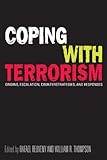
Rafael Reuveny, William R. Thompson, eds. Coping with Terrorism: Origins, Escalation, Counterstrategies, and Responses. Suny Series in the Trajectory of Terror. Albany: State University of New York Press, 2010. ix + 408 pp. $95.00 (cloth), ISBN 978-1-4384-3311-0; $31.95 (paper), ISBN 978-1-4384-3312-7.
Reviewed by Jonathan Zartman (Air University, Air Command and Staff College)
Published on H-War (July, 2016)
Commissioned by Margaret Sankey (Air University)
Rafael Reuveny and William R. Thompson have organized a fascinating edited volume that proposes a social science analysis of terrorism. They position this book in purposeful contrast to a variety of other approaches to terrorism. The introductory review of the literature offers an effective categorization of common approaches to terrorism, such as overviews, historical treatments, assessment of the human rights and legal implications, the psychology of terrorists, case studies of specific groups and areas, and assessments of weapons of mass destruction (WMD) threats. They note that policies based on a factually flawed understanding of terrorism fail to mitigate the threats, therefore they argue persuasively that a social science approach which analyzes terrorism as a subset of political violence offers the prospect of more rational and effective policies.
In the process of this analysis, they provide the reader the benefit of a broad range of approaches. For example, chapter 2 by Manus I. Midlarsky compares a number of historical cases, emphasizing how historical developments shape the collective psychology of groups toward supporting terrorism. Chapter 3 explains the crucial role of state violations of human rights as a motivating factor driving terrorism, and this analysis effectively integrates the shaping function of international influences in the social and political processes in which groups decide to engage in terrorism. The social science perspective that terrorism consists of rationally motivated political action that reflects specific conditions of competition and political opportunity finds a persuasive expression in Erica Chenoweth’s statistical analysis showing a curvilinear relationship between democracy and terrorism. Naturally, she concludes that states cannot use democratization as any simplistic antidote to terrorism.
The case studies in the middle of this book prove intellectually stimulating, marshalling a great deal of evidence toward conclusions that can run contrary to the conventional wisdom. For example, in contrast to the conventional wisdom that concessions tend only to encourage stronger demands and harder opposition, David Sobek and Alex Braithwaite argue that the Palestinians engaged in “unspoken reciprocity” in response to Israeli policies that moved in the direction of Palestinian goals. This book also offers a somewhat parallel but similarly provocative argument (by Gil Friedman) based on rational game theoretic modeling of the same conflict. These two chapters deserve detailed and discriminating assessments.
The chapter by I. William Zartman and Tanya Alfredson discusses in detail the potential prospects of negotiating with terrorists using a rational choice-game theory approach. The chapter on the increasingly common collaboration between terrorist groups and organized crime provides a well-documented but succinct demonstration of the character of threats facing states, enabled by what some writers have called “deviant globalization.”[1] The analysis of counterterrorism strategies by William Josiger encompasses a variety of motivations and forms of terrorism and compares the policies of the United Kingdom, Spain, and France, thus developing a broad and thorough consideration of alternative approaches, each with limitations and potential virtues. In contrast to supply-side analysis of terrorism, C. Christine Fair and Bryan Shephard analyze support for terrorism based on surveys in fourteen Muslim majority countries. They conclude that the high variation among countries means that aphorisms based on crude generalizations, like “the Muslim street,” have little value. The results also refute the common stereotype associating support for terrorism with low socioeconomic status. The chapter examining the role of global norms on state policies in South and Southeast Asia adds thoroughness and balance to the book. The discussion of Columbia’s struggle against the Revolutionary Armed Forces of Columbia (FARC) effectively illustrates the implications and risks of internationalizing a local struggle.
The careful analytical approach, broad scope, and thought-provoking character of this book as a whole justifies using it as a text not only in graduate-level seminars but also in advanced undergraduate courses. It is an effective demonstration of the potential contributions of social science toward addressing important policy challenges in the world today.
Note
[1]. On deviant globalization, see Michael Miklaucic and Jacqueline Brewer, eds., Convergence: Illicit Networks and National Security in the Age of Globalization (Washington, DC: National Defense University Press, 2013).
If there is additional discussion of this review, you may access it through the network, at: https://networks.h-net.org/h-war.
Citation:
Jonathan Zartman. Review of Reuveny, Rafael; Thompson, William R., eds., Coping with Terrorism: Origins, Escalation, Counterstrategies, and Responses.
H-War, H-Net Reviews.
July, 2016.
URL: http://www.h-net.org/reviews/showrev.php?id=39167
 | This work is licensed under a Creative Commons Attribution-Noncommercial-No Derivative Works 3.0 United States License. |

