



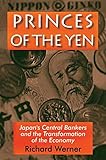
Richard A. Werner. Princes of the Yen: Japan's Central Bankers and the Transformation of the Economy. Armonk: M.E. Sharpe, 2003. 361 pp. $98.95 (cloth), ISBN 978-0-7656-1048-5; $36.95 (paper), ISBN 978-0-7656-1049-2.
Reviewed by Benoit Leduc (Government of Canada and Department of Political Science, University of Ottawa)
Published on H-US-Japan (November, 2004)
The Last of the Central Bankers
Princes of the Yen offers an interesting perspective on the role of the central bank in Japan's rapid economic development. The historical documentation provided on the war economy and development strategies, focusing on central bank's guidance and credit controls, offer original material on Japanese institutions that will be of interest to students of policy decision-making, particularly from chapter 1 to chapter 5.
The story behind Princes of the Yen is that Central Bankers were the shadow shoguns of Japan's economic growth, "the true government of Japan" (p. 246). They micromanaged credit and guided investments toward most productive areas. The core contention of the book can be read as a case study of Alexander Gershenkron's argument on the need for late-developers to centralize policy-making and financial authority to ensure industrialization. As such, the thesis is an alternative explanation on the sources of Japan's economic success in an already competitive intellectual space occupied by tenants of private banks or bureaucratic powers.[1]
Princes of the Yen argues that economic growth in Japan was and remains closely correlated to credit creation by the Bank of Japan (BoJ). This monetarist argument appears to stick rather well to postwar Japan given the close coordination between government planners, central bankers and the main banks that characterized its policy-making process. Under this hierarchical system, the BoJ organized Japan's Main Banks into a tightly knitted cartel, protecting their status, eliminating competition, guaranteeing bank loans, and coordinating their investments toward productive areas.
The author, however, goes further. Princes of the Yen also argues that the Bank of Japan could have prevented Japan's economic recession by lending money to corporations and banks from the beginning of the 1990s, but refused to accomplish this task because it considered a thorough reform of the banking system necessary. The author argues that Japan did not have to liberalize and adopt market-oriented reforms in order to come out of its recession. All that was needed was credit rationing during the 1980s as a diet to avoid creating both bubbling land prices and an obese economy; and credit creation during the 1990s to provoke the growth of emerging technologies and the service economy. For the author, the Japanese system working through government guidance and main bank leadership did not have to be abandoned. "All that was needed was to use the key control tool, credit creation, to supply the non-manufacturing and service sectors, especially high-value-added activities such as education, research and development, information services, software development, and telecommunications ... with new purchasing power" (p. 193).
Quickly summarized, the argument is that the BoJ originally mismanaged the timing of its decisions and then purposively decided to provoke a thorough reform of the banking sector. With reforms, the role of Japan's Central Bankers in credit management vanished.
This last portion of the work could be the source of a lengthy argument. It is not without its flaws. It is commonly known that credit was generously dispensed throughout the 1980s and led to skyrocketing land prices. As we are reminded, "Japan is only 1/26th of the size of the United States," but, in the 1980s "its land was valued four times as high" (p. 89). It is possible that temporarily halting credit creation in the 1980s would have prevented the bubble; but whether opening the coffers a decade later would have supported Japan's golden age is a matter that alchemists might reflect on.
A more probable and simpler explanation on the evolving role of the BoJ after the 1980s would propose that micro-managing credit creation for an economy the size of Japan's, which accounted by itself for 86 percent of the world's capital exports in 1987, became impossible. Under such circumstances, it became necessary to de-concentrate the decision-making authority on lending and investment by making banks responsible for their performance. Hashimoto's Big Bang in finance did just that in 1998; it eliminated the government's guarantee of banks solvability, allowing them to go bankrupt if they could not become profitable.
The changes brought to the Japanese economy since 1998 are rather impressive. Falling stock prices have dealt a blow to cross-shareholding, thus allowing greater foreign ownership of Japanese companies. Foreign ownership of financial institutions is reducing the role of the Main Bank System. By March 2001, foreign investors owned 18.3 percent of stocks listed on the Tokyo Stock Exchange, compared to only 2.8 percent in 1978. Yet, the adoption of market-oriented reforms does not necessarily lead to the Americanization of Japan's economy, as the author seems to fear. More likely, the creation of market-oriented institutions may improve the risk-assessment ability of financial intermediaries and support the growth of forward-looking small and medium enterprises that have lacked access to private capital in Japan.[2] Consortium-based financing is still well positioned to carry out the growth of projects of imposing robotics size. Reforms could well lead to a diversification of growth models rather than to a complete desertion of past practices. Hopefully, the opening of the Japanese economy to markets and the rest of Asia will lead to declining poverty and provide stable growth for the world's fastest growing populations. At last, Japan's Central Bankers may not have vanished without a cause.
Notes
[1]. On private banks, see Kent E. Calder, Strategic Capitalism: Private Business and Public Purpose in Japanese Industrial Finance (Princeton: Princeton University Press, 1993); on bureaucratic powers, see Chalmers A. Johnson, Miti and the Japanese Miracle: The Growth of Industrial Policy, 1925-1975 (Stanford University Press, 1983).
[2]. See, for instance, Ulrike Schaede "The 'Middle Risk Gap' andFinancial System Reform: Small Firm Financing in Japan," Discussion Paper No. 2004-E-11. Institute for Monetary and Economic Studies (IMES Discussion Paper Series), Bank of Japan. Available at: http://www.boj.or.jp/en/ronbun/dps04.htm.
If there is additional discussion of this review, you may access it through the network, at: https://networks.h-net.org/h-us-japan.
Citation:
Benoit Leduc. Review of Werner, Richard A., Princes of the Yen: Japan's Central Bankers and the Transformation of the Economy.
H-US-Japan, H-Net Reviews.
November, 2004.
URL: http://www.h-net.org/reviews/showrev.php?id=9992
Copyright © 2004 by H-Net, all rights reserved. H-Net permits the redistribution and reprinting of this work for nonprofit, educational purposes, with full and accurate attribution to the author, web location, date of publication, originating list, and H-Net: Humanities & Social Sciences Online. For any other proposed use, contact the Reviews editorial staff at hbooks@mail.h-net.org.

