



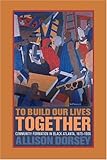
Allison Dorsey. To Build Our Lives Together: Community Formation in Black Atlanta, 1875-1906. Athens: University of Georgia Press, 2004. ix + 238 pp. $19.95 (paper), ISBN 978-0-8203-2619-1; $49.95 (cloth), ISBN 978-0-8203-2618-4.
Reviewed by Robert Cassanello (he/him/his) (Department of History, University of Central Florida)
Published on H-Urban (November, 2004)
Uplift Philosophy and the Emergence of Black Atlanta
Bill Cosby and his critics have reminded America that African Americans are bitterly divided along lines of class and social status. Although supporters of the comic have argued that his diatribe about "low economic blacks" was timely and to the point, his critics have lambasted him as an out-of-touch elitist. What is most amazing is that so many cultural critics and journalists believe that Cosby's attack on the black underclass was somehow new. Works by Kevin K. Gaines, Evelyn Brooks Higginbotham, Barbara Y. Welke, and Fon Louise Gordon have demonstrated the complexity of black thought in regards to social uplift strategies, specifically how the black elite viewed and chastised the black underclass as the cause for white racism in the South. These authors have documented and analyzed the origins of this racial "uplift" rhetoric. These leaders meant to lead the black masses by example and show poor blacks how to acculturate themselves through refinement and Victorian Era values and morals so that the race as a whole might be one day accepted by a majority of white America. Allison Dorsey, in her book To Build Our Lives Together, examines the impact of these ideas and strategies on the development of the black community in Atlanta in the late nineteenth century. She integrates the role black leadership and community building in Atlanta had on its development and uses this evidence as a case study of how these divergent ideas of racial uplift, social status and racial acceptance helped to shape the New South city.
Although the title states the study starts in 1875, the author traces the development of Atlanta back to the 1820s as an antebellum trading outpost in Northwest Georgia. The study really picks up at the end of Reconstruction and the emergence of Black Atlanta as a self-sustaining autonomous ethnic enclave within the city. The book then traces how black leaders used churches, schools, community and fraternal organizations to transmit social policy meant to uplift and reform the race. The book concludes with the Atlanta Race Riot of 1906, which the author believes closed the chapter on this uplift period. Overall the author makes the case that survival strategies and traditions founded in slavery were useful in creating this early black metropolis. These organizations and community groups tried desperately to fashion policies and programs that would contribute to a greater sense of racial understanding and community for blacks as well as demonstrate to whites that the black race was progressing toward civilization. However as the author notes, Atlanta as well as other cities of this period experienced a movement that installed disfranchisement, violence, segregation, and white supremacy as social policy which discouraged and derailed the efforts of elite black reformers.
Dorsey pulls together a wealth of sources on black Atlanta and for scholars unfamiliar with the city she seems to have left no stone unturned. Through careful examination of newspapers, city directories, church records, civic documents, and manuscript collections, the author has weaved a detailed and multifaceted picture of black elite life and culture in one Southern community. Since sources are so rich of the privileged classes, many scholars have a tendency to concentrate on them at the expense of the working and underclasses, however Dorsey manages to include their voices and opinions throughout the monograph as well.
There are a great many strengths to this work. It is detailed and exhaustive at fewer than two hundred pages, which would translate well for classroom use and earn the affection of students in a variety of classes. What is the real strength of this book is its detailed attention to related literature on the subjects covered in the text. Reading this book is like visualizing a quilt of what has been written in the last fifteen years on race, gender, class, sexuality, and social stratification. The author effortlessly demonstrates how the work of other scholars in a variety of subfields and other disciplines has an intimacy to our understanding of early Black Atlanta. As a result this work becomes important for researchers and scholars interested in ideas and theories of community development and intra-ethnic relations that might be unrelated to this specific city or even African Americans in general. There is little to be dissatisfied with in this book, it is bold, authoritative and comprehensive. The only thing readers will be longing for is a better understanding of the pre-1875 and post-riot histories of city. This book will soon inspire those other works.
If there is additional discussion of this review, you may access it through the network, at: https://networks.h-net.org/h-urban.
Citation:
Robert Cassanello (he/him/his). Review of Dorsey, Allison, To Build Our Lives Together: Community Formation in Black Atlanta, 1875-1906.
H-Urban, H-Net Reviews.
November, 2004.
URL: http://www.h-net.org/reviews/showrev.php?id=9971
Copyright © 2004 by H-Net, all rights reserved. H-Net permits the redistribution and reprinting of this work for nonprofit, educational purposes, with full and accurate attribution to the author, web location, date of publication, originating list, and H-Net: Humanities & Social Sciences Online. For any other proposed use, contact the Reviews editorial staff at hbooks@mail.h-net.org.

