



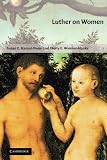
Susan C. Karant-Nunn, Merry E. Wiesner-Hanks, eds. Luther on Women: A Sourcebook. New York and Cambridge: Cambridge University Press, 2003. 254 pp. $64.00 (cloth), ISBN 978-0-521-65091-5; $25.99 (paper), ISBN 978-0-521-65884-3.
Reviewed by Beth Plummer (Department of History, Western Kentucky University)
Published on H-German (November, 2004)
Martin Luther and the Debate on Women
"Did women have a Renaissance?" This question, asked almost thirty years ago by Joan Kelly-Gadol, along with her work on the querelle des femmes, or debate on women, has inspired the work of a generation of Renaissance scholars, but also influenced scholars studying other major intellectual movements. "Did women have a Reformation?" and "what did Martin Luther contribute to the querelle des femmes?" are the questions at the heart of the book under consideration here. The first question is a practical one: did things change for women during the Reformation? The second is a theoretical question of whether thinking about women changed during the Reformation.
Bringing these questions of theory and practice right back to the source, so to speak, Susan Karant-Nunn and Merry Wiesner-Hanks have collected and translated a selection of Martin Luther's writings on the topic of women, most previously unavailable in English, in order to spark further research on these questions. The introduction gives a sense of why the authors felt such a source collection is necessary and an overview of the current scholarly literature on Luther and women. Pointing out the existence of a surprising gap in Luther studies since "there is as yet no book-length study of his ideas about women in any language" (p. 2), Karant-Nunn and Wiesner-Hanks argue convincingly for the need for such a book.
The bulk of the sourcebook is comprised of selections from Luther's writings translated from Latin and German into English. The authors chose, for reasons of clarity as they explain in the introduction, to present the sources thematically rather than chronologically, although sources are presented chronologically within each individual section. The topics include three chapters on biblical women (Eve, Mary and other women), three chapters on domestic and physical aspects of women's lives (marriage and the family, sexuality, and childbirth), two chapters on Luther's interactions with women (Katharina von Bora and other contemporary women), and a final chapter on his thoughts on witchcraft and magic. Each section of documents is proceeded by a short introduction and then divided into subtopics. The primary sources themselves are selections from sermons, letters, pamphlets, and lectures written by Luther as well as considerable material from Table Talk, a collection of notes by Luther's students about his comments during informal social occasions. The selections are generally short excerpts from longer works, although, in some cases, substantial portions of major works are included. Each text is proceeded by the original place of publication and page numbers are included within the texts for handy reference to original published texts for those readers who want to look at the original German and Latin.
Perhaps the biggest criticism I have of this work is built into the tensions of presenting a major German author to a non-German speaking audience, but that is also the strength of this work in making that same author available to a wider audience. Given the vast corpus of writings produced by Martin Luther and the amount of time he devoted to issues directly, and tangentially, related to the topic of women and women's lives, it would have been impossible and impractical to include every word Luther wrote about women in a single text. The authors, as they point out in the introduction, chose to focus more heavily on those works not previously available in English translation. By using extensive excerpts from previously translated works such as On the Estate of Marriage and Lectures on Genesis, it means that works such as On Monastic Vows or Luther's commentaries on Paul's Epistle's such as Commentary on 1 Corinthians 7 are not included. In making this necessary choice, the authors weight the source collection towards texts less available to non-German speakers, but perhaps miss presenting some important insights of Luther, especially on his reception of Paul. The book also would have been easier to navigate through the addition of a list of the included translated documents, and strengthened by a bibliography of Luther's works on women not included, for the benefit of those scholars not familiar with the field.
That said, this volume constitutes a valuable contribution to the teaching of Reformation studies, offering an accessible, very readable set of primary sources to faculty trying to include women in traditional courses on the Reformation or presenting the Reformation in courses on women's history. Through its bringing of the question "did women have a Reformation?" and Luther's contributions to the querelle des femmes to a new generation of students, this collection may inspire that comprehensive analysis of Luther's attitudes to women that Karant-Nunn and Wiesner-Hanks call for in their introduction.
If there is additional discussion of this review, you may access it through the network, at: https://networks.h-net.org/h-german.
Citation:
Beth Plummer. Review of Karant-Nunn, Susan C.; Wiesner-Hanks, Merry E., eds., Luther on Women: A Sourcebook.
H-German, H-Net Reviews.
November, 2004.
URL: http://www.h-net.org/reviews/showrev.php?id=9956
Copyright © 2004 by H-Net, all rights reserved. H-Net permits the redistribution and reprinting of this work for nonprofit, educational purposes, with full and accurate attribution to the author, web location, date of publication, originating list, and H-Net: Humanities & Social Sciences Online. For any other proposed use, contact the Reviews editorial staff at hbooks@mail.h-net.org.

