

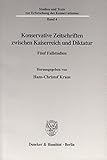
Hans-Christof Kraus, ed. Konservative Zeitschriften zwischen Kaiserreich und Diktatur: FÖ¼nf Fallstudien. Berlin: Duncker & Humblot, 2003. 186 pp. EUR 58.00 (cloth), ISBN 978-3-428-11037-7.
Reviewed by Raffael M. Scheck (Department of History, Colby College)
Published on H-German (November, 2004)
An Unusual Perspective on German Conservative Publications
The five essays in this collection offer a detailed look into generally little-known periodicals and contribute to the general history of German conservatism. They display well the multi-faceted nature of German right-wing politics and ideology from the late Hohenzollern empire to the Third Reich. While the five essays clearly show how different these conservative approaches were from National Socialism, they also reveal how little these ideological differences mattered after 1933 and how little resistance to National Socialism (with a few notable exceptions) they all inspired.
After a concise introduction, Hans-Christof Kraus presents his own contribution on the Süddeutsche Monatshefte, a magazine edited by Paul Nikolaus Cossmann that became a mouthpiece of annexationist circles in World War I and led a vicious campaign in support of the stab-in-the-back legend after the German defeat in 1918. Kraus presents an interesting and nuanced account; the passages on the efforts of Cossmann, who was born as a Jew and died in the Theresienstadt concentration camp in 1942, to mediate between anti-Semites and Jews are particularly touching. How could Cossmann ever imagine that anti-Semites, people with hardened prejudices, would ever be willing to modify their views in a dialogue with Jews who rejected anti-Semitism but were willing to consider its arguments? I would, however, be more critical of the magazine's role in preparing the stage for the Third Reich. Although Kraus is right in differentiating the revanchist and anti-democratic vision of the Süddeutsche Monatshefte from National Socialism, the magazine's relentless campaign against the Weimar Republic, which it blindly associated with the hated Treaty of Versailles, certainly helped prepare the ground for the Nazis. For this aspect (and in general), it is surprising that Kraus does not consider Paul Hoser's book on the Munich press. Hoser's study contains much information on Cossmann's political role and his publishing activities, which reached far beyond the Süddeutsche Monatshefte.[1]
The following two contributions, by Felix Dirsch and Dieter J. Weiß, focus on pronouncedly Catholic periodicals such as Hochland, the Historisch-politische Blätter, and the Gelbe Hefte. While catering to small elites, these magazines strove to mediate between the Catholic Church, modern life, and the German nation-state. The two contributions define a range of Catholic attitudes from a decentralizing, großdeutsch approach relating to the past Holy Roman Empire to a militantly deutschnational posture as represented by the National Catholic Committee of the German Nationalist People's Party (DNVP). Sadly, the editors of Hochland and the Gelbe Hefte were able to prove enough common ground with the Nazis to secure the publication of their journals into the Second World War (the Historisch-politische Blätter had faltered before 1933). Altogether, Dirsch and Weiß present careful intellectual analyses but are, in my view, not critical enough of the anti-democratic tendencies of these publications. Even the conditional support of Hochland for the Weimar Republic and its insistence on the Rechtsstaat cannot absolve it from its decidedly anti-democratic stance.
The two last contributions, by Karlheinz Weißmann and Guido Müller, focus on publications in the elitist field of Young Conservatives and proponents of a Europe-wide Conservative Revolution. Weißmann deals with Das Gewissen and Der Ring, whereas Müller discusses the Europäische Revue inspired by the Austrian author Hugo von Hofmannsthal. All of these periodicals dealt with problems of defining a new elite in German (and European) politics and with ways of creating an authoritarian state removed from the pressures of democracy and political parties. Although Das Gewissen, under the influence of Eduard Stadtler and Arthur Moeller van den Bruck, sought an unorthodox combination of bolshevist and nationalist elements for a while, the paper was later steered into a more strictly conservative course by Heinrich von Gleichen, which was also true of Der Ring, which eagerly supported the minority cabinet of Franz von Papen in 1932. Whereas Das Gewissen had stopped publication before 1933, Der Ring revised its elitist and anti-party stance (which had made it critical of the NSDAP) and transformed itself into a mouthpiece of Nazi propaganda in 1933. Unfortunately, Weißmann's analysis ends here. In a footnote, he mentions that some Young Conservatives once close to the journal, such as Paul Lejeune-Jung, Ulrich von Hassell, and intellectuals associated with von Papen, became victims of Nazi repression, but it would have been worthwhile to expand on this connection.
The Europäische Revue, which was supported by the export-oriented branches of German industry, advocated a central European economic and cultural cooperation between Germany, France, and Austria in the 1920s. Already open to fascist ideas before 1933, it seamlessly integrated itself into the Third Reich and survived as a proponent of a Nazi-dominated Europe until 1944. Müller regrettably says almost nothing about this last phase of the magazine. Moreover, a comparative analysis of the "European" vision of the magazine's editors and supporters with plans for a German-dominated Mitteleuropa in World War I and the Nazi vision of a "New Europe" after the defeat of France in 1940 is sorely missing.
Although I do sometimes miss a more critical distance between the authors and their subjects, this collection of essays offers a welcome and generally well-executed addition to the literature on German conservatism. It leads into the hodgepodge of anti-democratic ideas and often takes the reader away from the well-known völkisch, pan-German, and Nazi paths. In particular, the focus on Catholic-conservative, sometimes very pro-Austrian, visions of Germany, which were oriented more toward the Holy Roman Empire than toward the Bismarckian state, offers new glimpses into the complex mosaic of German conservatism in the period 1900-1933. Still, it should be stressed that the appeal of practically all of the magazines discussed in the book remained confined to a very narrow and elitist group of editors and readers. The book is therefore of interest only to specialists in right-wing German politics and culture.
Note
[1]. Paul Hoser, Die politischen, wirtschaftlichen und sozialen Hintergründe der Münchner Tagespresse zwischen 1914 und 1934. Methoden der Pressebeeinflussung. 2 vols., Europäische Hochschulschriften, Reihe 3: Bd. 447. (Frankfurt am Main: Lang, 1990).
If there is additional discussion of this review, you may access it through the network, at: https://networks.h-net.org/h-german.
Citation:
Raffael M. Scheck. Review of Kraus, Hans-Christof, ed., Konservative Zeitschriften zwischen Kaiserreich und Diktatur: FÖ¼nf Fallstudien.
H-German, H-Net Reviews.
November, 2004.
URL: http://www.h-net.org/reviews/showrev.php?id=9952
Copyright © 2004 by H-Net, all rights reserved. H-Net permits the redistribution and reprinting of this work for nonprofit, educational purposes, with full and accurate attribution to the author, web location, date of publication, originating list, and H-Net: Humanities & Social Sciences Online. For any other proposed use, contact the Reviews editorial staff at hbooks@mail.h-net.org.

