



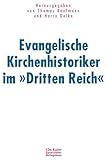
Thomas Kaufmann, Harry Oelke, eds. Evangelische Kirchenhistoriker im "Dritten Reich". Guetersloh: Christian Kaiser/GÖ¼tersloher Verlagshaus, 2002. 393 pp. Euro 44.95 (paper), ISBN 978-3-579-02673-2.
Reviewed by Judith Becker (Institut für Europäische Geschichte, Mainz)
Published on H-German (November, 2004)
Over the last few years, the behavior of scholars and institutions of higher education during the Hitler regime has increasingly become the topic of scholarly interest and some thorough debate. As long as the persons involved were still living and teaching in Germany the issue proved to be highly emotional and was therefore often avoided. Thomas Kaufmann and Harry Oelke in their collection of essays now aim at initiating an impartial reconstruction, not only of the behavior of individuals but of the discipline of Protestant church history as a whole. The collection is based on papers given at the Deutscher Historikertag in Aachen in 2000, though some of the essays have been considerably extended and one originates from a different conference.
The book is headed by two introductions by the editors; Oelke's is methodological and Kaufmann's historiographical. One wonders whether many of the methodological issues raised by Oelke (such as the hint that the theological premises of a church historian's research are necessary for understanding his work) are not self-evident, but a look at recent debates about German scholars on Nazism shows that a reminder of the basis of impartial research makes sense in this discussion. Oelke raises questions that reach far beyond the horizon of the book and will certainly inspire future research. In the second introduction, Kaufmann establishes the institutional, personal and theological background of Protestant church history in the 1930s. Most of the professors teaching before 1933 continued to teach after 1945 or were soon rehabilitated. The greatest part of them had received their education during or after World War I and were formed by the "antihistorical revolution" of these years. The most important exceptions to this rule were Emanuel Hirsch and Erich Seeberg. The intellectual distance between these and the younger generation is exemplarily shown by correspondence between Hirsch and Hermann Doerries from 1970, edited as an appendix to Kaufmann's introduction. This represents one of the several helpful editions of primary sources that are included in the collection of essays.
In the first essay, Martin Ohst sets forth the formative importance of World War I for Emanuel Hirsch by analyzing his writings during the war and later surveys as well as interpretations of the Third Reich. Hirsch formed his analytic categories during World War I and never modified them afterwards; only his perspective on events and his conclusions as to their outcomes changed. The basis for his research and diagnosis was an interdependence between theological insights and political considerations. His basic categories comprised an anti-teleological view of history, the predominance of the Volk and the interpretation of visible churches as enculturations of God's invisible Church. Hirsch viewed God as the Lord of the world, who tests the Voelker in wars in order to see which of them is worth existing. The Volk with the highest ethos wins the war. The defeat in 1918 subsequently demonstrated that the German people had not been morally good enough. Yet, Hirsch conceded that a revocation of this divine judgment was possible: the Germans could become strong again and force a new decision. Ohst points out that after World War II, Hirsch was resigned as to the moral strength of the German people. He did not believe in another chance for divine re-assessment of the situation. More interesting than these issues, however, are Hirsch's interpretations of pacifism and partly also of the ecumenical movement where he comes to conclusions that anticipate present problems. Ohst's very sensitive description of Hirsch's theology combines a good share of empathy with critical distance and the demonstration of the problems and limitations of Hirsch's stance.
Kaufmann, in his extensive essay on Erich Seeberg, shows more distance from his subject and comments much more directly. But then, he considers Seeberg's behavior rather than his theology and many of Seeberg's actions were frankly appalling. His theological oeuvre was far less influential than his university politics. As a powerful politician, he fought for his friends and pupils with all means and followed no restrictions in defaming opponents. As he had been at five universities within eight years he possessed great influence. In addition to that, Seeberg was a member of theological societies such as the Evangelischer Bund and the Gesellschaft für Kirchengeschichte. Another aspect that increased Seeberg's influence was his origin in a Baltic German family of professors. His father, Reinhold Seeberg, dominated Erich's theological thoughts and furthered his career. Following his father's reading of Luther and seeing World War I as a war between a German-Lutheran and a Anglo-Saxon-Calvinist-Catholic-Humanistic culture, Seeberg aimed at strengthening the soul of the German Volk. According to Seeberg, the nature of Christianity is shown by its enculturation, that is Protestantism and the "German spirit." In the NSDAP, Seeberg saw "deutschen Geist und christlichen Glauben, neues Reich und Reich Christi, Volk Gottes und deutsche Nation" united (p. 169). He thus aimed at building a German national church for National Socialists and traditional Christians. A combination of the traditions of Meister Eckhart and Luther should form the basis of this church. Therefore, Seeberg did research on Luther and Eckhart and took charge of critical editions of both, partly by defaming other historians who had begun editing before him. Seeberg obtained research fellowships from different state and scholarly institutions. By writing many reviews and references and by giving expert opinion on many things he increased his influence even further. The bibliography of Seeberg's works given as an appendix to the essay testifies to this influence. As far as the contents of Seeberg's work go, however, they perfectly fitted into the National Socialist concept of the humanities as it appeared in other disciplines as well and thus did not considerably influence church history after 1945.
Berndt Hamm investigates the susceptibility of the theology of the Holl school to be attracted by National Socialism with reference to the example of Holl's pupil Hanns Rueckert and with many references to Karl Holl himself. Although no direct lines can be drawn from Holl to the Deutsche Christen, many of his pupils became Deutsche Christen and there must therefore have been some particular disposition in this direction in his theology. Hamm shows how Holl's four fundamental categories were used by Rueckert to interpret the first months of the Nazi regime. First, God was perceived as an inhumane power, hard, cruel and conquering. Then, God was believed to show himself in history, judging or blessing Voelker. The changes of the year 1933 could easily be interpreted in this way. Third, people were asked to feel and experience God. 1933 was a historical event that evoked many feelings--and then every feeling could somehow be interpreted as coming from God. Hamm demonstrates how this category was one of the most dangerous ones as it opened reactions to political events up to every possible interpretation. Lastly, the answer of human beings was to be ethical, in new moral senses. The new regime with its enforcement of community, dedication and sacrifice thus attracted many Christians. The basic problem of Holl's theology that opened it to the attractions of Nazism was, as Hamm concludes, his theology of immanence according to which the world had obtained a sphere of its own which then had been theologically refilled, thus viewing "die Eigengesetzlichkeit der Welt als Gottesgesetzlichkeit" (p. 305).
Brennecke's essay is the only one in the collection that does not focus on a person but on a topic: he remarks that "Germanic Arianism" was the center of extensive debates during the first half of the twentieth century, but that since World War II hardly any research on it has been undertaken. As "Germanic Arianism" was meant to prove the Artgemaessheit of the Christian faith which had been denied by A. Rosenberg, more than one hundred treatises on the topic were published between 1933 and 1939. The main point of discussion was the role played by Wulfila in the Christianization of the Goths. Most of the Goths were Arian Christians and the Council of Nicaea made them heretics. From the end of the sixth century on, they converted to Catholicism in order to adapt to the Roman majority. This transformation was regarded by Nazi ideology as the "Fall of the Germans." Yet, the discussion was not started by the Nazis. From the mid-nineteenth century on, the demand for an "arteigenes germanisches Christentum" had been voiced (p. 321). The 1930s, then, viewed Christianity as such as artfremd. Even defenders of Christianity, such as K. D. Schmidt, used their opponents' arguments to prove Christianity to be the appropriate religion of contemporary Germans and thus undertook ideological historiography, the results of which were not reliable. Since Schmidt was on the "right" side in the Kirchenkampf, however, his argumentation that Arianism was appropriate to the ancient German peoples was adopted after 1945. Only in the 1970s did new research demonstrate that ideology and not objective research had been the basis of this argumentation.
In his essay, Oelke discusses the only scholar treated in the collection who was a member of the Confessing Church. Kurt Dietrich Schmidt was one of the rare professors who actually lost his job due to his church political involvement. Oelke investigates what made Schmidt so resistant to Nazi politics. He demonstrates how confession became more and more important for the Lutheran Schmidt. The key to Schmidt's viewpoint was the Lutheran doctrine of the two kingdoms. Obeying the authorities meant for him being loyal to the Weimar Republic. He engaged himself in the Christlich-Sozialer Volksdienst. Schmidt then was involved in the foundation of the Confessing Church in Schleswig-Holstein. He tried to balance loyalty towards the state with his engagement in the Confessing Church but, naturally, failed. When the University of Kiel, where he taught, was slated to become a "political university" in the sense of National Socialist ideology and Schmidt insisted on evaluating degree examinations for the Confessing Church, he was finally dismissed. Schmidt dedicated most of his research to the mission to the Germans. Here, Oelke's and Brennecke's essays complement each other, although the two authors do not always come to the same conclusions concerning the value of Schmidt's research. Oelke's essay is complemented by an edition of Schmidt's crucial letters to the ministry.
In the collection's last essay, Hartmut Lehmann compares two editions of Luther studies by Heinrich Bornkamm from 1933 and 1947. Bornkamm stated that he republished his studies from 1933 in 1947 without modifications. Lehmann, however, shows that not only did he alter several words and expressions but that whole passages were replaced. The most striking example probably is the elimination of a paragraph about the Germans and war and its replacement by reflections on Luther and music--one matter has nothing to do with the other. Bornkamm presented himself as a national conservative scholar in 1947 although his essays in 1933 had propagandized for the National Socialist regime. Lehmann ends his essay with open questions as to the reason for Bornkamm's modifications which appeal for further research on Bornkamm's Luther interpretation.
The collection of essays presents in-depth research on important persons and topics as well as editions of sources. Its only drawback is the restriction of its essays to well-known topics and partial discussions of the persons' careers it treats. If the editors wanted to present a collection with exemplary meaning for the whole discipline (p. 9), it is surprising that they did not include research on one of the twelve church historians whose political opinions fell somewhere between those of the National Socialists and the resistant Bekennende Kirche; these men constituted the second largest group of church historians). And, as Oelke states in his introduction, it is well known that Luther studies, the German mystic and the mission to the Germans were the central points of research during the Nazi regime. Oelke thus asks for research on "weitere prioritaere Themenfelder ... Solche zweiter und dritter Ordnung" (p. 27). In the collection, however, these topics hardly come into view. Yet these considerations are minor criticisms of a book that, on its whole, is highly interesting and will certainly provoke further research and deeper insights into Protestant church history during the Third Reich.
If there is additional discussion of this review, you may access it through the network, at: https://networks.h-net.org/h-german.
Citation:
Judith Becker. Review of Kaufmann, Thomas; Oelke, Harry, eds., Evangelische Kirchenhistoriker im "Dritten Reich".
H-German, H-Net Reviews.
November, 2004.
URL: http://www.h-net.org/reviews/showrev.php?id=9925
Copyright © 2004 by H-Net, all rights reserved. H-Net permits the redistribution and reprinting of this work for nonprofit, educational purposes, with full and accurate attribution to the author, web location, date of publication, originating list, and H-Net: Humanities & Social Sciences Online. For any other proposed use, contact the Reviews editorial staff at hbooks@mail.h-net.org.

