

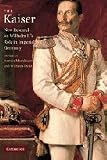
Annika Mombauer, Wilhelm Deist, eds. The Kaiser: New Research on Wilhelm's Role in Imperial Germany. New York and Cambridge: Cambridge University Press, 2003. xv + 299 pp. $60.00 (cloth), ISBN 978-0-521-82408-8.
Reviewed by Andrew Donson (Departments of History and Germanic Languages and Literatures, The University of Massachusetts Amherst)
Published on H-German (November, 2004)
The Kaiser Matters
No scholar has contributed more to the debate over the mercurial and impetuous rule of Kaiser Wilhelm II than John Röhl. As the editor of three volumes of Wilhelm's key correspondences with his best friend, Phillip von Eulenberg; as the mentor to dozens of senior political, military, and diplomatic historians of the Wihelmine period, including the contributors to this festschrift; and as the author of a forthcoming three-volume biography of the Kaiser as well as numerous important articles and monographs on German politics after Bismarck, Röhl has made an enviable career of defending the thesis that the volatility of German politics after 1890 originated in the so-called personal rule of the Kaiser. Against his interpretation that Wilhelm effectively made his ministers answerable to him only, detractors argue that growing popular political mobilizations during Wilhelm's reign challenged personal rule and, ultimately, overthrew the constitutional system that permitted it. The best contributions to this collection accordingly proceed with an awareness that the Kaiser's dominion was increasingly restricted by the press, the Reichstag, Pan-Germanists, army commanders, Social Democrats, foreign powers, and, above all, his own incompetence in matters of state. All the authors nevertheless retain the thesis that Wilhelm maintained personal rule in his control over appointments until 1916.
Holger Afflerbach and Matthew Stibbe contest Röhl's more limited personal rule thesis that Wilhelm was a "shadow emperor" during the First World War. They concede that Wilhelm was not involved in operational planning and failed miserably to bridge the differences between civilian and military leaders. His erratic behavior also undermined the regime's credibility with the public. But the authors rightly argue that until Hindenburg became supreme commander in August 1916, Wilhelm shaped the course of the war in making appointments: contraverting his generals, he kept Falkenhayn, responsible for the war of attrition, as chief of staff until Hindenburg and Ludendorff ousted him that same month. Even after 1916, the Kaiser tipped the balance in key political decisions. The decision to undertake unrestricted submarine warfare in January 1917, both authors argue, was largely a consequence of his reluctant support.
The contributions of Michael Epkenhans and Katherine Lerman rehash Röhl's arguments about Wilhelm's influence on foreign and domestic policy. Wilhelm's early obsession over having a navy, Epkenhans claims, was a major reason why his foreign policy departed from the traditional Prussian strategy of being a European land power. Nevertheless, Wilhelm's influence was limited: naval building stalled in the early 1890s because his caprice impeded coming up with a workable plan for a fleet. Though Wilhelm became commander-in-chief of the navy in 1899 under Admiral Tirpitz's plan, he left the most important decisions to subordinates due to his laziness, disinterest, and indecisiveness. Still, as Lerman shows in a deep analysis, Wilhelm amassed and protected his personal rule by insisting on lackluster ministers whose most outstanding qualities were quietude, lack of ambition, and unwavering loyalty. Wilhelm's legacy was to appoint bureaucrats who preferred retiring as pensioners to getting promoted or making sensible changes. These appointments left Wilhelm in control and the Prussian state superficially stable, but the bureaucracy was fundamentally torpid and therefore vulnerable to the dynamic critics on the left and right.
Most original are the contributions that leave political, diplomatic, and military history and look at culture. Bernd Sösemann shows that Wilhelm adored public celebrations and strove to disseminate symbols of his imperial rule, but that he incurred public relations disasters. Wilhelm was hostile toward the press and insensitive to his audiences in countless incidents beyond the Daily Telegraph Affair of 1908. The public found his frequent regal displays superficial and arrogant.
Most devastating to the regime, Isabel Hull argues with material from her forthcoming book, was the free reign Wilhelm gave, after 1916, to his generals with their reckless military culture. As Kaiser, Wilhelm held the responsibility of negotiating peace, but he abandoned this and many other civilian duties because he was insecure and incompetent. The generals in charge overlooked the sobering foreign and domestic conditions in their monolithic focus on victory through annihilation. In place of assements of political conditions were detailed plans and tactics that relied on highly disciplined troops willing to take extraordinary risks according to tight schedules. This approach to war without politics demanded officers have an unrealistic moral code: reckless daring (Kühnheit), disdain of death (Todesverachtung), and will to annihilate (Vernichtungswille). All these qualities were central in the general staff's terrifying plans for the Kaiser's certain suicide (Königstodesritt) in the fall of 1918. With the Allies threatening to invade German territory, the generals hoped Wilhelm's last stand would rally the troops to a final battle for annihilation (Endsieg). Their belief Wilhelm would agree to spill his blood on his regal pomp was as foolhardy as thinking it would make any difference: on the left and the right, the credibility of the Wilhelmine Empire was already ruined.
All the contributors support Röhl's contention that Wilhelm's personal rule reached its zenith in 1896 and declined thereafter. The contributions by Annika Mombauer (on the Boxer Rebllion), Roderick McLean (on the Treaty of Björkö), Ragnhild Fiebig-von Hase's (on relations with Theodore Roosevelt), and Matthew Seligmann (on links with British military attachés) show that after the turn of the century, the Kaiser was intimately involved in diplomacy but inept. Growing numbers of world leaders and German diplomats had little respect for Wilhelm, and by 1914 the foreign office made certain his influence was marginal.
All the articles in this volume nevertheless remind historians that, at least until 1916, the Kaiser was the single most powerful person in Germany. His whims, puerile fancies, distasteful pomp, bad judgment, and lackluster appointments undermined German credibility abroad. These deficiencies also destabilized the social and political order at home and led the Kaiserreich to an end in war and revolution.
If there is additional discussion of this review, you may access it through the network, at: https://networks.h-net.org/h-german.
Citation:
Andrew Donson. Review of Mombauer, Annika; Deist, Wilhelm, eds., The Kaiser: New Research on Wilhelm's Role in Imperial Germany.
H-German, H-Net Reviews.
November, 2004.
URL: http://www.h-net.org/reviews/showrev.php?id=9920
Copyright © 2004 by H-Net, all rights reserved. H-Net permits the redistribution and reprinting of this work for nonprofit, educational purposes, with full and accurate attribution to the author, web location, date of publication, originating list, and H-Net: Humanities & Social Sciences Online. For any other proposed use, contact the Reviews editorial staff at hbooks@mail.h-net.org.

