



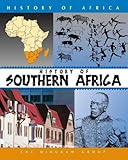
The Diagram Group. History of Southern Africa. New York: Facts on File, 2003. 112 pp. $30.00 (cloth), ISBN 978-0-8160-5065-9.
Reviewed by Christopher Lee (Department of History and the Stanford Humanities Center, Stanford University)
Published on H-SAfrica (October, 2004)
For the Younger Southern Africanist
This is a textbook for high school (secondary school) students and forms one volume out of six total that comprise the History of Africa series published by Facts on File. It provides a very detailed introduction to the region that should be of great help to teachers who want to offer a course on African history or those seeking to include southern Africa in a class on world history.
Despite its brevity at 112 pages, the coverage of the text is broad, ranging from "prehistory"--rock paintings, the Bantu migration from west-central Africa to southern Africa, for example--up to the modern period, with HIV/AIDS and even the current crisis in Zimbabwe being touched upon. Following a conventional narrative path, there are twelve chapters in total, beginning with a regional environmental overview, then moving to the pre-colonial period, early European settlement, the Mfecane, twentieth-century colonialism, apartheid, anti-colonial activism, and finishing with a perspective on contemporary regional developments. Important stops along the way include Great Zimbabwe, the Great Trek, and Shaka, though less obvious events and persons are also given time: the histories of Madagascar and Mauritius, for example, are covered, with discussion of their complex historical links to Asia as well as Africa. Much of the analysis is focused on politics, with themes of settlement, state formation, and strategies of resistance being primary. Surprisingly little attention is granted to economic history, particularly the mineral rush of the nineteenth century and its effects on the regional economy through labor migration and modern industrial development.
Much of the empirical breadth is accomplished through the inclusion of numerous maps, timelines, illustrations, and thumbnail sketches of various leaders and events. The publisher lists a total of three hundred illustrations and maps--roughly three per page. Many are useful and not superfluous. However, the quality can be rough, no doubt due to publishing costs, that can make certain historical figures and episodes--such as the Sharpeville Massacre or the Soweto Uprising--appear cheesy rather than powerful. Indeed, the visual quality at times renders the material as appearing fit for elementary (primary) school students, rather than teenagers, as intended. Moreover, the diversity of illustrations, timelines, and the like also tends to fragment the narrative. Teachers will have to work to amend this in the classroom. Differently, engaged students will likely have many more questions than the text can answer, stimulated from the abundance of material supplied here: this history moves quickly and is mostly suggestive, rather than achieving the depth and conclusiveness found in similar textbooks at the university level.
Nevertheless, that is to be expected in a book of this kind. It admirably achieves its primary goal of covering the region in a comprehensive manner. It is clear that the team of authors is familiar with recent historical analysis on the region, as suggested in the bibliography. This text, in sum, will no doubt be helpful in stimulating further interest in the region among younger students.
If there is additional discussion of this review, you may access it through the network, at: https://networks.h-net.org/h-safrica.
Citation:
Christopher Lee. Review of Group, The Diagram, History of Southern Africa.
H-SAfrica, H-Net Reviews.
October, 2004.
URL: http://www.h-net.org/reviews/showrev.php?id=9901
Copyright © 2004 by H-Net, all rights reserved. H-Net permits the redistribution and reprinting of this work for nonprofit, educational purposes, with full and accurate attribution to the author, web location, date of publication, originating list, and H-Net: Humanities & Social Sciences Online. For any other proposed use, contact the Reviews editorial staff at hbooks@mail.h-net.org.

