



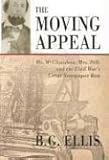
B. G. Ellis. The Moving Appeal: Mr. McClanahan, Mrs. Dill, and the Civil War's Great Newspaper Run. Macon: Mercer University Press, 2003. ix + 677 pp. $45.00 (cloth), ISBN 978-0-86554-764-3.
Reviewed by Aaron Astor (Department of History, Northwestern University)
Published on H-South (September, 2004)
The Civil War Paper Chase
For four long Civil War years, a bizarre triangle including an alcoholic editor, a corrupt bookkeeper, and America's only female daily paper editorial writer published the Memphis Daily Appeal in five Southern cities. The "Bible of the Confederacy" served the Southern populace through the Civil War's end, defying the fate of other Confederate dailies upon Union occupation. Confederate dailies typically faced two choices when their host cities faced Union capture: shift editorial opinion or shut down. The editor of the Appeal chose a third option: evacuate to another Confederate-held city. The newspaper's odyssey from Memphis to Mississippi, to Georgia, to Alabama, and finally back to Georgia marked the precarious nature of newsgathering for an information-starved Confederate population. Its printers struggled to dismantle a massive, $10,000 steam-driven Hoe press, place the apparatus on multiple rail cars, and reassemble the mammoth device under pressure from Union guns no fewer than five times. Yet its travails also reflected the internal conflict and chaos that accompanied Southern society's ultimate and complete collapse. From Memphis to Grenada, Mississippi, then on to Jackson, Atlanta, Montgomery and finally Columbus, Georgia, the Appeal recorded the final desperate burning of cotton bales, wholesale looting by the citizenry and soldiery alike, the free distribution of whiskey among both invading Union soldiers and straggling Confederates, and the desperate resolve of local patriots eager to carry the fight another day.
Barbara Ellis' The Moving Appeal: Mr. McClanahan, Mrs. Dill, and the Civil War's Great Newspaper Run is more than just a story about a newspaper or an editor. It is a biography of a media phenomenon. This thoroughly researched, highly readable narrative traces the Memphis Daily Appeal's arduous journey across the South, providing a unique perspective on the Civil War. Ellis, a former journalism professor at McNeese State University in Louisiana, provides readers with a compelling study in nineteenth century journalism, an extensive analysis of Deep South military operations, and an intriguing account of the lives of some extraordinary personalities. Thanks to an acrimonious suit between rival claimants to the paper after the Civil War, the author had access to volumes of private correspondence and internal documents.
The first five chapters detail the origins of the Appeal's main principals. John Reid McClanahan was a financially risk-averse protege of Jackson, Tennessee newspaper editor Jesse McMahon. As a young newspaper carrier for McMahon's Truth Teller and District Sentinel McClanahan "learned which headlines to shout that would fill his pockets. He learned that carriers also took the initial brunt of public reaction to the news" (p. 47). Moreover, his early exposure to the great national newspapers like Horace Greeley's New York Tribune and James Gordon Bennett's New York Herald introduced McClanahan to the importance of type-setting and styles, as well as the art of editorial bombast. Both of these traits, in addition to punctual delivery of the daily product, served McClanahan well through the very end. McClanahan also learned the importance of blunt diction. Indeed, one of Ellis' most poignant observations about McClanahan's editorship was his attention to receptivity. Mindful of a relatively illiterate population in the antebellum South, McClanahan wrote in a style that would enable "parlor and tavern orators to make the rafters ring when they read his work aloud" (p. 52). He also recognized the importance of "pass-alongs;" many people reading the newspaper did not pay for it, but advertisers were willing to pay a premium for access to free readers (pp. 1, 512n). Moreover, he made sure to include numerous local interest stories that veered far away from formal politics and appealed to men and women of all social and economic classes.
If McClanahan was the no-nonsense editor who disdained prolixity and the arts of high finance, bookkeeper Benjamin Franklin Dill and his wife America Carolina Dill were profligate speculators. But Carolina's editorial combativeness, in particular, would serve the Appeal well. In the 1850s, Carolina Dill demonstrated her propensity to rankle the local Baptists who wanted to gain control of the University of Mississippi at Oxford. Dill's exposure of this scheme earned her the everlasting disdain of Oxford's Baptist community (which still continues to this day). While B. F. Dill remained in the cash office for the duration of the Appeal's life, Carolina migrated into the role of assistant editor. McClanahan would remain the public face of the Appeal, but Dill's imprint was unmistakable. Indeed, as Ellis points out, women regularly controlled the printing operation of newspapers, though most historians relegate the role of women to footnotes. "'Assisting' in the print shop usually meant doing everything except pulling press handles: writing, editing, setting type, dickering with vendors, selling and collecting advertising and subscriptions, and especially minding the 'counting rooms'" (p. 32). But Carolina accomplished more than most "newspaper wives." Carolina Dill would remain a dominant force at the Appeal, despite the increasingly hostile relationship between herself, her husband, and McClanahan.
The remainder of the book details the war career of the Appeal. Ellis outlines the arduous process of dismantling, transporting, and reassembling the Hoe press on the eve of Union invasion. She also highlights the increasing importance of such a "national" newspaper for the Confederate cause. Each time the Appeal moved to a new city, McClanahan had to ensure the editor of the existing daily paper that he would refrain from commenting on local affairs. The Appeal was still the Memphis Daily Appeal, even if it was published in Mississippi, Georgia, or Alabama. As such, the Appeal established a formidable reputation for both news accuracy and nationalistic editorial fervor. The Appeal's numerous contacts on the battle fronts?-including future newspaper luminaries like Henry Watterson-?made the Appeal indispensable for Confederate and Union troops alike. Indeed, Ellis' discussion of anonymous war sources is one of the most intriguing elements of this book. Throughout the war, though especially during Sherman's Atlanta campaign, pseudonymous sources reported back the activities of Union and Confederate troops. McClanahan maintained troublesome relations with all of these men for a number of reasons that still resonate with war journalists today. Were they giving away secret information to opposition readers? Were they painting an unduly pessimistic picture of the battlefront? Were they giving a reliable version of the truth or did they try to impress readers with sensationalist nonsense? War correspondents were regularly fired and rehired over failure to adhere to McClanahan's rigorous standards.
The Moving Appeal offers a unique perspective on the war. But it has its limitations. For one, Ellis offers little insight into why McClanahan switched from being a steadfast Unionist in pre-war Memphis to becoming a champion of secession. The Appeal had regularly lampooned fire-eating secessionists like Yancey and called for adherence to the Union through early December 1860. Ellis comments that by Christmas 1860 "McClanahan joined millions ... and threw in his lot with the secessionists" (p. 116). Yet historians of Tennessee have stressed that secessionist sympathies were far from universal, especially before the fall of Fort Sumter.[1] Indeed, Shelby County even voted against secession in a February plebiscite. Ellis does not seriously address the intra-Tennessee struggle over secession?-other than mentioning that McClanahan downplayed a Union torchlight parade in Memphis--which rendered Tennessee the last state to join the Confederacy. It seems unlikely that McClanahan had so little to say about the reluctance of other Tennesseans to follow the secessionist course.
If the book missed some intriguing political quandaries, it also glossed over some social questions. Slavery, for example, is rarely discussed, either as a political or social issue. It seems rather unlikely that McClanahan's opinions regarding slavery were limited to stereotyped hatred of Yankee abolitionists. Indeed, detailed discussions of slavery typically dominated the editorial columns of Civil War-era Southern newspapers; it is doubtful that the Appeal would have differed in this respect. Other questions regarding Civil War-era Memphis society receive little attention, including relations between the large Irish population and native born whites. Historians would likely find McClanahan's (and Ellis's) insights regarding the breakdown of Southern society more intriguing than the litigious quarrel between the heirs of McClanahan and Carolina Dill following the mysterious post-war deaths of McClanahan and B. F. Dill (which occupy an entire chapter).
Nevertheless, The Moving Appeal is an invaluable contribution to the study of nineteenth-century journalism and a compelling narrative of the Confederate homefront. Scholars who rely upon newspapers as sources will learn much about the mechanics of news production. Most importantly, historians of the Civil War gain an intriguing perspective of the Confederacy's rise and fall from one of the South's most notable, resolute and enigmatic propagandists.
Notes
[1]. See Stephen Ash, Middle Tennessee Transformed, 1860-1870: War and Peace in the Upper South (Baton Rouge: Louisiana State University Press, 1988); or Daniel Croft, Reluctant Confederates: Upper South Unionists in the Secession Crisis (Chapel Hill: University of North Carolina Press, 1989). Both of these books deal with other sections of Tennessee. However, they both make clear that while western Tennessee was the most pro-secessionist, that sentiment was not universal even there.
If there is additional discussion of this review, you may access it through the network, at: https://networks.h-net.org/h-south.
Citation:
Aaron Astor. Review of Ellis, B. G., The Moving Appeal: Mr. McClanahan, Mrs. Dill, and the Civil War's Great Newspaper Run.
H-South, H-Net Reviews.
September, 2004.
URL: http://www.h-net.org/reviews/showrev.php?id=9749
Copyright © 2004 by H-Net, all rights reserved. H-Net permits the redistribution and reprinting of this work for nonprofit, educational purposes, with full and accurate attribution to the author, web location, date of publication, originating list, and H-Net: Humanities & Social Sciences Online. For any other proposed use, contact the Reviews editorial staff at hbooks@mail.h-net.org.

