



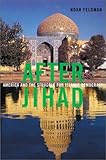
Noah Feldman. After Jihad: America and the Struggle for Islamic Democracy. New York: Farrar, Straus & Giroux, 2003. 260 pp. $24.00 (cloth), ISBN 978-0-374-17769-0; $14.00 (paper), ISBN 978-0-374-52933-8.
Reviewed by T. K. Vogel (Department of Political Science, New School for Social Research)
Published on H-Diplo (August, 2004)
Theological Fine Print versus Political Reality
In After Jihad, Noah Feldman argues that the violent option in political Islam is "spent, peripheral, unrealistic, and indeed distasteful in the light of the violence of September 11," and that this is accepted by "many, perhaps most, Muslims" (p. 232). International revolutionary jihad constitutes "the last, desperate gasp of a tendency to violence that has lost most of its popular support" (p. 8).
Even though this remains largely unexplained, these assertions--far from being self-evident--are of crucial importance to the key arguments in After Jihad, which concern the historical and doctrinal prospects for democratization in the Muslim world and the role of the United States in promoting it. Even small bands of armed troublemakers can provide a convenient pretext for authoritarian rulers not to liberalize their societies; Egypt is a prime example. In consequence, the prospects for democracy in the Middle East may be affected more decisively by small, armed groups rather than by the question of "how Islamic democracy is possible in historical and theoretical terms," one of the questions this book aims to answer (p. 16). How persuasive the assertion of a post-jihad era appears may well determine the extent to which the reader will relate to the rest of After Jihad.
In contrast to revolutionary jihad, Feldman writes, non-violent political Islam continues to hold great appeal for the disenfranchised populations of the Middle East because, as he observes with regard to Egypt, "Islamism speaks the language of justice in a place where justice is hard to come by" (p. 165). Moreover, Islamists tend to dominate civil societies in many countries of the region because government repression has eliminated more overtly political organizations. The mosque provides a ready-made communication and dissemination infrastructure for a message that may or may not be in line with government policy; and religious beliefs provide a pool of strong feelings waiting to be mobilized. Feldman rightly also points to another, darker reason: many autocrats--secular or otherwise--brutally suppress a wide range of opposition groups but leave alone precisely those that appear most threatening to the West, which helps reduce external pressure on these regimes since the alternatives are so unappealing. (The Saudi rulers have mastered this game to perfection.)
Islamists like Hezbollah--a group curiously underdiscussed in this book, as is the situation in Palestine more generally--capitalize on government failure by providing education and health care to their constituents, services that ineffective state bureaucracies deliver rarely or badly. They emerge in reaction to states that are weak in promoting their citizens' welfare and, as a rule, strong in restricting their freedom. What makes Hezbollah's burgeoning social services division interesting, of course, is that it is wedded to an effective political party as well as a terrorist organization. Other Islamist groups provide similar services but have never engaged in violence and are committed to the democratization of the unfree societies in which they live.
Feldman suggests that this preoccupation with justice and development is inherent in Islamic doctrine and not just an opportunistic device to increase power and influence, or a direct reaction to bad governance. In fact, Feldman argues, the United States must support these forces for reform, since they present the only hope for genuine political change in the Middle East--not despite, but because of their Islamist character. While democracy cannot be forced on anyone, external support to democratizing states and movements is crucial, and in extreme cases, externally-induced regime change is the only way to get rid of the dictators in the Islamic world (pp. 210-211).
In this context, Feldman's typology of Muslim autocracies is quite useful since it makes explicit the implications of various forms of dominance for democratization. The oil monarchies of the Gulf, which do not tax their citizens, are highly unlikely to reform on their own: they are personal fiefdoms that do not rely on the consent of the governed. At the same time, they are participants in the world economy and are increasingly dependent on political alliances with the United States to maintain their form of government, both of which offer incentives for at least moderate reform. Oil dictatorships like Libya or Saddam's Iraq, by contrast, are much less open to Western pressure, and it may well be that their violent overthrow is the only way to get rid of such regimes. Relatively oil-less, relatively secular governments--those in Jordan, Egypt, Morocco, and elsewhere--offer the best hope for internal, gradual democratic reform: they rely on some measure of international legitimacy, which they generate through democratic rhetoric; they are to some extent reliant on the consent of the governed and can therefore no longer shut out their citizens from political decision-making altogether; and they are unwilling or unable to engage in outright, overt repression.
How to engage with a stagnant, authoritarian Middle East under threat of being engulfed by jihadist violence is, of course, the key question facing the western democracies today, and the key reason many readers will pick up this book. The United States and the United Kingdom have taken up the challenge with regard to Iraq, with results that are not particularly convincing. Feldman himself, a law professor with a background in Islamic thought, served as constitutional advisor to the Coalition Provisional Authority in Baghdad for several months in 2003, and the arguments in this book will rightly be measured against the U.S. performance there. His arguments are a much-needed corrective to popular beliefs about the cultural and religious roots of the democracy deficit in the Muslim world and to a defeatist attitude towards the prospects of democratization there. (Unfortunately, it may well be that the failing experiment in Iraq, for which U.S. ineptitude is more to blame than any inherent cultural and political factors, will only help to reinforce such stereotypes.)
Both Islam and democracy are "mobile ideas" with a broad appeal and great adaptability to local circumstance: they are mobile because they are universal, flexible, and simple (p. 32). Not only are Islam and democracy compatible; Feldman claims that a distinctly Islamic form of democracy is currently emerging as a model for increased political participation, improved living standards, and expanded personal liberties in the Middle East. However, as with many other assertions in this book, we are left without convincing examples. Feldman links such democratic innovation to the emancipatory potentials inherent in Islamic doctrine, a discussion that takes up the first of the book's three parts, "The Idea of Islamic Democracy."
But what is the relevance of such ideas for the practice of politics and diplomacy in a region that has been in economic and social decline for centuries, whose governments spend most of their energy on brutalizing their subjects and extracting their wealth, and whose populations are deeply distrustful of outside interference and cynical about peaceful reform? Feldman never quite outlines the implications of the doctrinal and historical compatibility between Islam and democracy for the practice of international politics, or of emerging forms of "Islamic democracy." This puts his entire endeavor in a strangely unreal light, which is only reinforced by the structure of the book.
Feldman's bold assertions are backed up by incoherent single-issue chapters--the longest around fourteen pages, the majority less than ten--that tend to provide bland national descriptions or policy advice that stays at the most general level. This reviewer could not quite shake off the suspicion that these chapters may have seen the light of day as policy memos--though the thought that policy may be made on that basis is not entirely reassuring. A fairly typical example is Feldman's "discussion" of Yemen: "The British stayed until the 1960s, then the country split into a Marxist dictatorship--the only pure one in the Arab world--and a more conventional non-Marxist dictatorship. The two have recently been united and taken a shot at democracy, with mixed results. After initial elections, the president seems headed for old-fashioned dictatorship" (p. 135). We are completely left in the dark as to why any of this may have happened; these developments seem to just kind of occur the way a sandstorm sweeps through the desert. There are also baffling lapses of logic or writing, or both, as when Feldman writes that "Ataturk's approach cannot and should not be repeated" and, in the subsequent paragraph, "if [democratization] can happen in Turkey, it can happen elsewhere" (p. 112). This comes immediately after the helpful observation that "the example of Turkey does not demonstrate that every broadly popular Islamic movement will be democratic. Turkey has a special character because of its history of secularism" (p. 111). Of course, this distinctive and unique character also applies to Indonesia (p. 118) and Pakistan (p. 119). One is left wondering whether this might be due to the fact that none of these three important countries are Arab, but Feldman does not tell us.
The relevance of the doctrinal compatibility of Islam and democracy is further diminished by Feldman's casual observation that "Islam has long proven tremendously flexible in its engagement with different political theories and systems" (p. 230). In light of this fact--and I believe it is a fact--the entire previous description of the emancipatory and egalitarian dimensions of Islamic thought appears distinctly less significant than Feldman makes it out to be. If Islam can adapt to different political theories and systems, then why would democracy be a more likely model for modernizing and reforming states or Islamist elites than, say, the paternalistic authoritarianism with some measure of consultation that seems to be emerging in the Gulf? Feldman's response is less than convincing: "No self-respecting Muslim would deny that all people are equal. If that is true, then why should any Muslim embrace a form of government that seems to be based on some premise other than equality" (p. 77)?
Feldman himself seems to have his doubts. His later chapters are riddled with the kind of generalization and qualified prediction that makes it almost impossible to gauge what the author in fact means to say. In a fairly typical example, he says that "in any Islamic democracy, one could expect many, and perhaps eventually most, citizens to choose political and social values that emphasize individual freedom and rational collective decision making" (emphasis added, p. 229). Another, equally unenlightening generalization points, in fact, to another critical flaw in Feldman's argument: "today's Islamists, influenced perhaps by mobile democracy, do not generally propose to treat non-Muslims unequally, at least not in their published writings or official pronouncements" (emphasis added, p. 68). One would be wise not to risk one's life on such heavily qualified statements.
Feldman has a hard time admitting that Islam, by doctrine and practice, treats men and women unequally, or Muslims and non-Muslims, or one kind of Muslim as against another. Pluralism, like individual freedom and egalitarianism, is part of Islamic doctrine, which for Feldman settles the issue. According to him, "there is no principled reason in Islam to suggest that anyone, Muslim or non-Muslim, man or woman, regardless of race or any other characteristic, should not be permitted to participate equally in collective decision making" (emphasis added, p. 63). While this may be true in principle, which I am not qualified to judge, it is certainly also true that Islamic societies have indeed treated women and non-Muslims unequally in centuries of political and social practice. While it may be true that the brutal oppression of Shi'i in Saudi Arabia, for example, is not preordained by Islamic teaching--and I am not qualified to judge--it is also true that this is an entrenched practice with distinctly religious overtones. It raises the possibility that Islamic democracy may indeed be a realistic prospect for the Muslim world, but that minorities of any kind would probably not feel particularly welcome in such places--which, of course, undermines the very concept of democracy.
Feldman's argument here is, again, not all that reassuring: "In principle ... a state with an official religion can recognize the equality of all its citizens as long as the religion itself embraces equality for everyone" (emphasis in original, p. 62). He then goes on to stress that "I wish only to suggest that Islamic law itself is less unequal in its treatment of women than is imagined by many in the West and the Muslim world alike" (emphasis added, p. 66). Is not "what the law says" always open to interpretation that will be colored by political and social concerns of the day? Is not "what the law says" much less important in social and political practice than what it is held to say? What does it mean in this light that "the religion itself embraces equality?"
What is missing in Feldman's account, in other words, is politics. His fairly nuanced discussion of the situation in Iran--a country that has taken theocratic democracy farther than anyone else--demonstrates that he is not blind to the exigencies of governance and strategy. But throughout his analysis, Feldman relies extensively on doctrinal sources for equality and emancipation without ever considering how they are implemented in political reality and affected by opportunistic preferences. But it is these that will determine whether the wider Middle East will successfully democratize, not the theological fine print.
If there is additional discussion of this review, you may access it through the network, at: https://networks.h-net.org/h-diplo.
Citation:
T. K. Vogel. Review of Feldman, Noah, After Jihad: America and the Struggle for Islamic Democracy.
H-Diplo, H-Net Reviews.
August, 2004.
URL: http://www.h-net.org/reviews/showrev.php?id=9685
Copyright © 2004 by H-Net, all rights reserved. H-Net permits the redistribution and reprinting of this work for nonprofit, educational purposes, with full and accurate attribution to the author, web location, date of publication, originating list, and H-Net: Humanities & Social Sciences Online. For any other proposed use, contact the Reviews editorial staff at hbooks@mail.h-net.org.

