

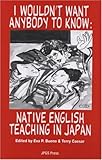
Eva P. Bueno, Terry Caesar, eds. I Wouldn't Want Anybody to Know: Native English Teaching in Japan. Tokyo: JPGS Press, 2003. 252 pp. $25.00 (paper), ISBN 978-4-900178-21-2.
Reviewed by Sandra Katzman (National Defense Academy, Yokosuka, Japan)
Published on H-US-Japan (August, 2004)
Speaking in English: Why Bother?
Teaching English in Japan is a contradiction in terms, according to the collection of essays gathered in this interesting, admittedly biased book that held my interest mostly because I teach English in Japan. I laughed with the authors and scoured their stories for kernels of useful information about the profession. The range of topics and styles of writing indicate the editors' broadmindedness in filling what they identified as a gap in publishing about this often-discussed, largely non-academic specialty.
In their introduction, Bueno and Caesar state that the work will focus on the experience of teachers. It is in this spirit, they argue, that contributors include teachers of levels from junior high schools to universities. After the essays were submitted, the editors became aware of the essays they would never read because many teachers were unwilling to write. The editors take this null set as their thesis, and explain why so many essays do not exist. There are no essays written by Japanese teachers of English, Bueno and Caesar say, because the personal subject was unacceptable to potential authors. In another step away from transparency, several contributors required pseudonyms because of the perceived danger to job security. However, the editors did not intend a diatribe, they state: "When we began this project, we had no intention of compiling a collection of essays somehow adversarial in nature" (p. 25). But the theme of the failure of the job runs through the essays so strongly that the editors embrace it in the title, a reference to someone who would not write about teaching English in Japan.
In the introduction, Bueno and Caesar also address other issues clearly labeled as native speakers only, the borders of shame, just for laughs, and ghettoized expatriate. They organized the collection by understanding these common themes. By bringing their knowledge of the literature of language learning to bear on the collection, Bueno and Caesar provide outside scholarly citations to the first person voices of the essays. Some of the essayists themselves cite newspapers, learning theory literature, and association publications.
The chapters are loosely grouped to show a range of opinions in pairs and triplets of essays, with the exception of a chapter of six very short comic episodes compiled by the editors. The first part, "Overtures," focuses on placing teaching in perspective, the first from a bus during a typhoon en route to work, and the second by comparing teaching English in Japan and in other more communicatively friendly contexts. In the typhoon, the reader feels trapped in the bus with the author, who creates an amusingly claustrophobic scene including schoolchildren, the bus driver, and the main character's attempts to write a novel. On the other hand, in the other more formal critique of the self-defeating rules for teaching language non-holistically, the reader understands the well-meaning strategies and how the Japanese student is defeated by years of being lectured to about the English language.
The second section, "General Perspectives," includes two essays. "Box of Tissues" refers to the inevitable crying session of students in his office experienced by the author, who holds a Masters of Comparative Literature from the University of Madison at Wisconsin and a Bachelors Degree from Brown University. Michael Pronko discusses the roots of the frustration. "More than almost any other field of study in Japan, English has been subjected to the most rigorous standards of organization and control out of all proportion to the reasonable need for order and coherence. It is no wonder that so many students perform so badly, they are often taking two courses at the same time--one on instructions and another on English" (p. 72). Pronko traces the controls on English as a Second Language up to what he believes to be the source. "ESL more than many other fields has been created within the interplay of economic and academic considerations. It is a massive industry which demands that language and learning activities have immediate rather than long-term effects, an odd notion to hold about an object of learning as vast and complex as a language" (p. 73).
The next essay spans the decades from 1987, beginning with the well-known Japan Exchange and Teaching Program, of which the author was one of the first teachers. The essayist's initial youthful enthusiasm is tempered by the observation that "people change the little chunk of the system they happen to be sitting on" (p. 94).
Each essay in the book is competently written and the collection is well edited. Each essay focuses on one complaint, written from a personal point of view after the experience occurred. The style, then, hovers between diary and exposition.
There is a scathing portrait of the exploitation of young English speakers who are employed as teachers in an essay called "A Leading Language School." Of his training there, the author writes, "and the 'method' was not to be challenged, changed, or played with. Each lesson was supposed to follow a very rigid pattern so the product could be delivered according to the Blitz way of delivering the product" (p. 108). In the epilogue to this essay, the author denigrates the school's teachers: "People who can barely flip hamburgers in their own countries once they arrive in Japan wear ties, and acquire the title of teachers" (p. 114). However, the business itself he hates more: "But mostly now I despise companies such as Blitz and the many other language schools which set themselves in this country and proceed 'to process' the youth of English speaking countries" (p. 113).
A pseudonymous author, with the book's most unique angle, is the young man who searched for his roots in Japan, meeting his father's ancestors but quitting the country because so many strangers, who confused his appearance with his ability to speak Japanese, spoke so rudely.
In another essay, a woman with a Ph.D. in American literature chronicles her journey through a decade at "three very different institutional phases." She responds to the discovery that many professors lecture in Japanese: "No wonder my students could not understand me" (p. 124)! Finally obtaining a tenure track position, she is disenchanted when an altercation with an office mate, hired with the same promise, leads her to the unhappy fact: "At the end of four or five years, the university fires each of these people [hired as tenure track], and starts all over again" (p. 131).
There is an essay by an anthropologist who explicates as a dramatic role his job teaching. "There is something about English in Japan, where it has been a long running show, continuing to play a key part in nation building, identity formation, and configuring the educational system" (p. 135).
Another essay contains a detailed, hilarious and inspired instruction for teaching English through movies. The globe-trotting author refers to his long experience. "For the preview exercise I used a technique that I had tried once with great success in Iran while teaching a sixteen millimeter version of Shirley Jackson's The Lottery" (p. 148).
An essay in the "Quarrels" section describes helping a colleague intent on changing a university English conversation class into an economics class. The doomed effort fails at its inception because of a misbegotten test given to classify students by level of fluency.
One of the most complete arguments is the appropriately named "Drawbacks of Being a Native Teacher," by Charles Kowalski, who studied language education at the Monterey Institute in California. Kowalski is quick to point out the literary excellence of non-natives including Joseph Conrad and Kazuo Ishiguro, whose novels in English earned him the Booker Prize and other awards. He mentions the many excellent non-native teachers he has met. And his allegory about the non-native Tortoise and the native Hare in a race that wends through the Grove of Grammar, the valley of Vocabulary as well as the hidden roots and Learning Strategies is memorable. One author relates loosing a marriage, a job, and finally starting his own language school.
One essay, written by collection co-editor Terry Caesar, challenges the notion of graduate studies in English in Japan, ending in a despairing suggestion of its title, "Downloading a Doctorate". The embittered author explains the logic of his four-year tenure at a university: "With my departure next year, the native scholarship unfortunately necessary to launch the new doctoral program will be gone, no longer necessary for the continuance of the program, which, I'm told, merits a sum of money--I don't know how much--from the Ministry of Education, just to help it get started" (p. 217).
The book ends with a final essay on the rare case of a failure at the doctoral level of a candidate. The author explains why usually "nobody is allowed to fail" in Japan. "Maintaining this belief is crucial to the fiction that Japanese society is comprised of a single, middle class, so prevalent in commercial advertising, even as it demands increasingly exorbitant economic and intellectual subsides: ganbatte [perseverance] pays" (p. 233).
Cautions are revealed in selections about the flimsy status of full time university professors. Individual students are described in shrewd detail.
In many ways, this book was fun to read. The writing is varied, clear, and engaging. As a whole, it makes a convincing argument that the status of "English as a Foreign Language" is permanent in Japan. The authenticity of this limitation comes not so much from the many strident arguments as from the accumulation of personal stories. Remarking on the non-random unrepresentative sampling, the editors nonetheless show quite convincingly that there are institutional problems with teaching English in Japan. This involves students, schools, government programs, political insecurity, and finance.
As they note, there is a lack of scholarly work that addresses this area of English-Japanese relations. This work helps to fill this void.
However, the collected work is one-sided, not addressing positive aspects. Its overly negative appraisal of English-language teaching in Japan may delay the improvement of conditions. Furthermore, the persistence of non-academic class content is explained away as keeping English in a second-class status to Japanese. This conclusion is not fully supported; the seemingly exploited young teachers may be hawking something other than sociable conversation.
In conclusion, Bueno and Caesar have brought out a well-written collection with a powerful argument. Despite its limitations, it fills a need and offers a good start to reading well-developed essays about teaching English in Japan.
If there is additional discussion of this review, you may access it through the network, at: https://networks.h-net.org/h-us-japan.
Citation:
Sandra Katzman. Review of Bueno, Eva P.; Caesar, Terry, eds., I Wouldn't Want Anybody to Know: Native English Teaching in Japan.
H-US-Japan, H-Net Reviews.
August, 2004.
URL: http://www.h-net.org/reviews/showrev.php?id=9666
Copyright © 2004 by H-Net, all rights reserved. H-Net permits the redistribution and reprinting of this work for nonprofit, educational purposes, with full and accurate attribution to the author, web location, date of publication, originating list, and H-Net: Humanities & Social Sciences Online. For any other proposed use, contact the Reviews editorial staff at hbooks@mail.h-net.org.

