



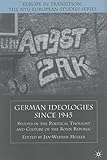
Jan-Werner Mueller, ed. German Ideologies since 1945: Studies in the Political Thought and Culture of the Bonn Republic. New York and Basingstoke: Palgrave Macmillan, 2003. x + 252 pp. $55.00 (cloth), ISBN 978-0-312-29579-0.
Reviewed by Ronald J. Granieri (Department of History, University of Pennsylvania)
Published on H-German (July, 2004)
Motorized, Yes, but Maybe Not Biedermeier After All?
Despite its material and political success, the old Federal Republic of Germany (or, as custom is beginning to label it more frequently, the Bonn Republic), always carried the stigma of intellectual inferiority. Inspired in part by the mutual animosity between the Christian Democratic governments of Konrad Adenauer and Ludwig Erhard, and prominent intellectuals such as Guenther Grass (with whom Erhard, despite being an academic himself, engaged in some nasty exchanges full of anti-intellectual polemics), the common picture of the Bonn Republic, especially in its first two decades, was a state and society focused on material comfort and prosperity, generally uninterested in the life of the mind or in critical thought. This conclusion is summed up best by Erich Kaestner's dismissive description of the postwar age as "motorized Biedermeier."
The reality beneath this characterization, however, is rather more complex. There is always a certain irony when intellectuals complain that the majority of society does not listen closely enough to them. After all, is it not part of the definition of an intellectual to be outside of the mainstream? As scholars turn their attention to many heretofore underappreciated aspects of postwar history, a more nuanced picture of postwar intellectual life is emerging, where political stability and intellectual ferment interacted with each other, eventually leading to the social and cultural upheaval of the 1960s.[1]
Jan-Werner Mueller, whose own work on postwar German intellectuals has earned great praise, deserves even more for editing this collection of essays on West German political thought. Although the volume's purpose is not to defend the Federal Republic's intellectual reputation per se, the various essays should help readers understand how much was going on beneath the placid surface of the economic miracle. As West German intellectuals wrestled with the implications of recent history, they built a foundation for the future development of a democratic German political culture.
The essays in this eclectic collection, which had its origins in a conference held at New York University, offer several fascinating insights on West German political thought from the rubble years through the immigration debates of the present day. The topics range from the very specific (such as John McCormick's analysis of Habermas's conception of the Sozialstaat or Rainer Forst's discussion of the concepts of cultural toleration embodied in the Federal Constitutional Court's "crucifix judgment" of 1995) to broader meditations on larger intellectual trends (such as Anson Rabinbach's discussion of the humanism and guilt within the Geisteswissenschaften or Alfons Soeller's analysis of the impact of remigres on West German political thought). The eleven contributions are divided into four sections: the immediate postwar years; the legacies of 1968; the transformation of German conservatism; and the issue of multiculturalism in the 1990s. As with any collection, the variety of the topics and perspectives offers a real challenge to the reviewer, and any evaluation will include a bit of subjectivity, but I would like to offer a few observations from the perspective of a specialist in West German politics.
Most importantly, the essays as a whole certainly should remind readers of how much the reconstruction of German intellectual life was shaped by the political and historical realities of the Nazi years and the Cold War. Intellectual life could not develop in a vacuum, and it was in dialogue with events that German intellectuals struggled to find ways to reconnect with earlier traditions across the abyss presented by National Socialism. One of the ways they did this in the late 1940s, according to Anson Rabinbach's essay, was by paring away the extremes of left and right from intellectual life, and using a vocabulary that "was decidedly unpolitical and heavily weighted toward moral and theological concepts," relying on keywords such as "guilt, spirit, Europe, and humanism" (pp. 29 and 37). Rabinbach's work, focusing on influential journals such as Merkur, where discussions centered on the need to restore the "European spirit" and to struggle against the "nihilism" represented by National Socialism (p. 34), also points out how much these attitudes were common on both sides of the developing Iron Curtain, an insight which should encourage further comparative studies of intellectual life in the two Germanys. The emerging Cold War, however, deepened the split within Germany both intellectually and politically, as those intellectuals who embraced the concept of the Abendland considered it a way to push German rehabilitation by encouraging identification with the West. As Alfons Soeller notes, analyzing the work of a pioneer of German political science, Arnold Bergstraesser, "as long as a prominent place in the Occidental culture was reserved to the German tradition, represented by Herder, Goethe, and Hofmannsthal, an influential place in the Western world was secured for that part of Germany that laid claim to this tradition" (p. 54).
The connection between German intellectual life and the Cold War, however, would also mean that the critical perspectives on the latter would lead to critical reappraisals of the entire postwar intellectual tradition. This was of course clear in the actions of the student protesters of 1968, but was also true of the representatives of the post-reunification New Right, whose criticism of the Federal Republic's ties to the West and (ultimately failed) attempts to redefine German conservatism followed close on the heels of reunification. The difficulties of both the 68ers and the New Right in transcending familiar habits of thought indicates the broad significance of Westbindung as a founding principle of the Bonn Republic. As it happens, both the ideology of 1968 and the rise and fall of the New Right are the subjects of essays by Mueller himself (though he modestly avers in the foreword that the inclusion of two of his own essays was due to a contributor's withdrawal from the collection rather than editorial hubris), which reflects both the breadth of his own interests and the broad ambitions of the collection.
The desire to transcend the Nazi past and reconnect with earlier traditions also had some ironic consequences, which the essays identify in unusual ways. On the one hand, the rejection of the kind of mystical nationalism that had inspired proto-Nazi thinkers encouraged a reconfiguration of German conservatism in the 1960s. As Dirk van Laak argues, this new conservatism showed a "total absence of metaphysical legitimation," and moved toward a technocratic defense of a secular domestic order. These conservatives took their cue from the success of Adenauer and Erhard's model of managed capitalism and an avoidance of class conflict, which would be emphasized by Helmut Schelsky's characterization of the Federal Republic as a "leveled middle-class society" (pp. 151-3). This technocratic conservatism would eventually overwhelm the humanistic "metaphysics" which Rabinbach and Soeller identified as constitutive of conservative thought in the immediate postwar years, surely an unintended (if perhaps unavoidable) consequence of Westbindung.
Dagmar Herzog's discussion of the "body politics" of 1968 reveals an even juicier irony, pointing out how the sexual conservatism of the 1950s, against which so many 68ers were rebelling, was not necessarily the continuation of long traditions, or even (pace Wilhelm Reich) a product of Nazi sexual repression. Rather, Herzog argues that this "redomestication of sex ... was bound up with a complex reaction against Nazism--and its defeat" (emphasis in original, p. 112). It was a reaction against the real and perceived sexual license of the Nazi years, where natalist ideology had celebrated certain forms of sexual expression and the SS had actually reveled in their rejection of narrow Christian morality. In some cases, Herzog concludes, such repression reflected the parent generation's attempt to suppress their own personal histories. Apparently, the German generation gap was based not only on the inability of parents and children to understand each other, but also on their misunderstanding of the roots of their misunderstanding. Herzog's analysis recasts the generational conflict of the 1960s and the attendant discourses about sex, Fascism, and repression that accompanied it, which should challenge many of the comfortable assumptions that shape each side of this conflict.
For all the collection's intellectual richness, its only notable weakness is the ambivalent treatment of the connection between political thought and "real existing" politics. Despite Mueller's introductory comments that the essays would avoid "a pure Geistesgeschichte, the kind of disembodied history of thought so familiar from the conservative German historiographical tradition" (p. 12), a few of the essays do indeed focus on specific intellectuals and their internecine debates, with little clear discussion of the political developments in the era. More significantly, even where the essays to address the intersection of ideology and politics, the collection does not include any analyses of the politically most influential ideologies of the immediate postwar period, either Christian Democracy or Social Democracy. Their existence is taken as given, and other movements are contrasted with them within individual essays, but one wishes that Mueller had cast the net for the conference and the volume a bit wider. As Dagmar Herzog showed in her discussions of the sexual revolution, re-examining the supposedly familiar can often yield rich rewards. Jerry Z. Muller's dissection of neo-conservatism after 1968, like van Laak's discussion of technocratic conservatism, for example, make reference to the dominant center-right ideology of the CDU, but neither author explicitly tries to determine the intellectual pedigree or the larger implications of Christian Democracy as a pro-Western transnational alternative to nationalism or traditional German conservatism. Julia Angster's excellent discussion of the Westernization of the postwar West German labor movement offers a notable exception to this criticism, as she details how West German unions learned from the American model of the AFL to move toward the political center, even as they resisted complete Americanization, a development that paralleled the transformation of the postwar SPD. Angster's work relates the organizational politics of labor to larger discourses of Westernization and Americanization in ways that should inspire other authors to attempt similar analyses of other groups within the Bonn Republic.
Even this limited criticism, however, reflects less dissatisfaction with the collection at hand as much as a desire to see more work in this vein on a wider variety subjects. As scholars and students try to understand the intersections between intellectual and political life in the Bonn Republic, there is much that we still need to learn. Those who want to learn how to pursue further analyses of that intersection would do well to start by reading this book.
Note
[1]. A very valuable recent collection that also discusses the cultural and intellectual history of the Bonn Republic is Hanna Schissler, ed. The Miracle Years: A Cultural History of West Germany, 1949-1968 (Princeton: Princeton University Press, 2001).
If there is additional discussion of this review, you may access it through the network, at: https://networks.h-net.org/h-german.
Citation:
Ronald J. Granieri. Review of Mueller, Jan-Werner, ed., German Ideologies since 1945: Studies in the Political Thought and Culture of the Bonn Republic.
H-German, H-Net Reviews.
July, 2004.
URL: http://www.h-net.org/reviews/showrev.php?id=9618
Copyright © 2004 by H-Net, all rights reserved. H-Net permits the redistribution and reprinting of this work for nonprofit, educational purposes, with full and accurate attribution to the author, web location, date of publication, originating list, and H-Net: Humanities & Social Sciences Online. For any other proposed use, contact the Reviews editorial staff at hbooks@mail.h-net.org.

