



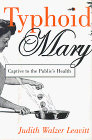
Judith Walzer Leavitt. Typhoid Mary: Captive to the Public's Health. Boston: Beacon Press, 1996. xviii + 331 pp. $25.00 (cloth), ISBN 978-0-8070-2102-6.
Reviewed by Julie Johnson-McGrath (Harvard University)
Published on H-Urban (April, 1997)
Because cities concentrate great numbers of people in close quarters, because those people and their products, both industrial and biological, foul the air and streets and water, and because cities draw residents and visitors from everywhere, introducing new cultures--again, both biological and otherwise--to their neighbors, American medical history IS urban history. Too often, though, historians of medicine have left unexamined the link between the urban context and the knowledge created there, considering the urban siting as merely incidental, rather than transformative. Now, however, Judith Leavitt, a distinguished historian of American medicine at the University of Wisconsin-Madison, has produced a book which illustrates how central the urban social, demographic, and political context was in shaping the iconography surrounding the most famous historical epidemic focus, the woman who became known as "Typhoid Mary."
Leavitt's analysis of Typhoid Mary's creation centers on separating the facts of the case from their interpretation by a variety of medical, legal, and social authorities. The woman who became anathematized as Typhoid Mary was an Irish immigrant cook named Mary Mallon, a single working woman like hundreds of thousands of others in urban America. She was the first, but not the most deadly, asymptomatic typhoid carrier--someone who, while feeling and appearing perfectly healthy, could nonetheless infect others with typhoid fever--identified in New York City. She was associated with forty-seven cases of typhoid, and only three deaths, again, a smaller number than other typhoid carriers caused, but a record that nonetheless caused her to be forcibly removed from her home, subjected to medical procedures without her consent, and eventually to be isolated for twenty-six years of her life on North Brother Island in the East River. Leavitt attributes the draconian treatment afforded Mary Mallon to the influences that gender, ethnicity, and class had on defining appropriate and inappropriate behavior in early twentieth century urban America.
Late nineteenth century developments in biochemistry and bacteriology seemed to offer an escape from the unceasing pall of urban death and disease. Whereas previously medical theory had associated the general filth and foul smells of cities with the prevalence of disease, and organized to clean the streets of mud, manure, and animal carcasses, the germ theory of disease identified the source of illness in microscopic organisms that might be found in the cleanest kitchen, laundry, or body. Because it so violently contradicted existing theory and practice, germ theory encountered pockets of resistance throughout the medical profession and in public opinion. Moreover, the new theory failed to explain why some people who were exposed to germs failed to fall ill, and particularly, how someone perfectly healthy could nonetheless infect others with potentially deadly diseases.
Despite this failure of germ theory to explicate the precise methods of disease transmission, and despite the fact that the vast majority of epidemic diseases, including typhoid, continued to stem from contaminated water supplies, and not the food-handling of asymptomatic carriers like Mary Mallon, public health authorities leaped at the opportunity to identify and curtail Mary Mallon's minor contribution to the ills New Yorkers suffered. Leavitt traces the mindset and behavior of medical officials, middle-class native-born men and women who strongly felt that their scientific explanations should be believed, however nonsensical they seemed. She examines the legal arguments given by Mallon and her attorney in an effort to free her from her captivity, and those offered, successfully, in return by public health authorities on why she should remain. Social attitudes that associated the Irish with dirt, made docility a requisite characteristic for femininity, and assumed that socioeconomic class determined intelligence all figured strongly in the characterizations public health workers made of Mary Mallon and her resistance. Mary Mallon's reluctance to turn over samples of blood, urine and feces to the stranger who appeared at her place of work, who followed her home to importune her further, and who charged her with spreading death and disease through the occupation she had always engaged in, was deemed irrational and ignorant by public health officials, who never considered how nonsensical and threatening such demands and accusations might appear to a layperson. The drama of Mary Mallon's capture by a phalanx of uniformed policemen, following a chase through her employer's home in which other servants aided her in temporarily eluding her captors, also received differing and mutually antagonist interpretations from S. Josephine Baker, who was in charge of the capture, and from William Randolph Hearst's sensation-seeking New York American, and other newspapers who gave the story full play. Yet those same papers that had painted her as an innocent victim turned and demonized her after it was discovered that during a brief period of freedom, she had returned to cooking to support herself. Leavitt has also uncovered a letter from Mary Mallon herself detailing her involuntary commitment and resentment of her high-handed treatment by public health authorities. She rankled particularly at being renamed "Typhoid Mary," and in her condemnation of her treatment, gives a strong, clear voice to many of the indignities suffered by foreign-born workers at the hands of scientific, Progressive urban reformers.
Leavitt's skilled use of the tools of social historical analysis, and her strong sense of the urban social fabric make Typhoid Mary an excellent choice for anyone wishing to explore the febrile, fertile intersection of medical and urban social history.
Copyright (c) 1997 by H-Net, all rights reserved. This work may be copied for non-profit educational use if proper credit is given to the author and the list. For other permission, please contact h-net@h-net.msu.edu
If there is additional discussion of this review, you may access it through the network, at: https://networks.h-net.org/h-urban.
Citation:
Julie Johnson-McGrath. Review of Leavitt, Judith Walzer, Typhoid Mary: Captive to the Public's Health.
H-Urban, H-Net Reviews.
April, 1997.
URL: http://www.h-net.org/reviews/showrev.php?id=958
Copyright © 1997 by H-Net, all rights reserved. H-Net permits the redistribution and reprinting of this work for nonprofit, educational purposes, with full and accurate attribution to the author, web location, date of publication, originating list, and H-Net: Humanities & Social Sciences Online. For any other proposed use, contact the Reviews editorial staff at hbooks@mail.h-net.org.

