



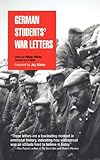
Philipp Witkop, ed. German Students' War Letters. Philadelphia: University of Pennsylvania Press, 2002. xxvii + 376 pp. $15.95 (paper), ISBN 978-0-8122-1816-9.
Reviewed by Geoffrey J. Giles (Department of History, University of Florida)
Published on H-German (July, 2004)
Fallen Students
These moving and articulate letters from the front, written by German students who died in the First World War, were originally published in English in 1929. It is not immediately clear why interested scholars or present-day students could not simply go to the library to consult the original edition, or better still, the original German publication, which contains a larger selection of letters than provided here. Jay Winter justifies this straightforward re-issue with the "burst of interest in recent years in 'war literature.'"
Philipp Witkop's intention was to emphasize the high-mindedness of the young men killed in the war. Germany, too, had its Rupert Brookes. By September 1918, once Witkop's plan had become known, he was swamped with some 20,000 letters from the front, entrusted to him by grieving parents. Ten years after the war, when he brought out this edition, many Germans were beginning to move on and forget these ordinary heroes. A second request, published in one hundred newspapers in 1929, yielded just fifty replies.[1] Extending Witkop's original idea to keep the flame of memory burning, the first English edition sought, in addition, to counter anti-German sentiment in Britain in the postwar years. As its editor, Annie Wedd, notes: "Many English people have been accustomed to think of the German army as a horde, if not of actual barbarians, yet of primitive, unreasoning automatons, blindly obeying the orders of slave-drivers with whips and revolvers" (p. xxv). Little did she know that many would see their view starkly reinforced little more than a decade later. Without commenting that the published letters have clearly been selected with extreme care, Wedd breezily asserts that these overwhelmingly "thoughtful, poetic, romantic, religious youths" have escaped the "brutalizing influence" of German imperial militarism. "To readers disgusted with the squalor of much recent War literature this book will come as a relief" (p. xxvi). Ah, thank goodness! It was a noble contest after all, fought between jolly decent chaps on both sides. Wedd also had a missionary purpose, then, slightly different from Witkop's, and closer to the aims of the League of Nations, or as she puts it herself, helping "towards the establishment of justice and a better understanding between nations" (p. xxvii).
Philipp Witkop did not conceive his book from such an internationalist perspective. The Bavarian state library's only copy of the original book is a later edition with a foreword dated autumn 1933, and there Witkop sounds rather pleased with recent political developments "in these days of national self-reflection."[2] But if he was an ardent nationalist, he was not a Nazi, and Winter notes that he tried (in vain) to resist the removal of some Jewish or pacifist voices from his original collection (p. xii). Witkop strives to emphasize the positive values of German militarism, such as comradeship, and cheerfully ignores racist undertones. One letter-writer, Kurt Schlenner, is ecstatic about the "universal comradeship which runs through the whole German army and is shown by our all calling each other 'Du.'" And then this law student goes on to reflect that things cannot possibly be so wonderful in the French lines, because "over there every man must first have a look to see whether the comrade appearing before him is of his own race or not--one could not very well respect a nigger as a comrade" (pp. 26-27). Yet Witkop is anxious to portray the German students as showing decent respect toward white French troops at least. Karl Josenhans, reading the homely letters he has taken from the corpses of two Frenchmen, finds them very similar to the sort of letters he and his friends receive, and muses: "When one reads such things it quenches the last spark of hatred towards the French, even if one still felt one" (p. 39). On the eastern front, there are the standard descriptions of the squalor and filth. Ernst Guenter Schallert writes from Galicia of the "wooden hovels in which people and animals all live together with the lice and fleas." Yet what he then goes on to say is by no means so typical a German reaction: "The Jews, who still go about here in their peculiar costume and with long beards, are distinguished from the real natives by being slightly more human" (pp. 101-102--the original German does not contain the qualifier "peculiar" which could be interpreted as somewhat pejorative). Even he concludes with a moderate dig at them, though: "For the rest, their one idea is to get money out of our soldiers, who have come to protect them, as long as there is any to be got" (p. 102). Wedd omitted the phrase "from the Russians," altering the sentence which had initially read: "For the rest, their one idea is to get money out of our soldiers, who have come to protect them from the Russians, as long as there is any to be got."
Winter has not commented on the translation (or the omissions and additions) but some renderings are a little confusing. Even in 1929, "Love-gift" (for Liebesgabe) must have sounded more like an illegitimate child. And the talk of smoking "Love-gift cigars" will unwittingly conjure up an image of Bill Clinton in the Oval Office for many of the present generation. It is admittedly a tough term to translate. Liebesgabe is an archaic term for "alms," but that will not work here. Something like "tokens of affection from the home front" would have to be used. Wedd's 1929 footnote, incidentally, explaining these to be "presents sent by anonymous donors in Germany" is not quite correct (p. 7). This was a highly organized effort for which collecting tins were passed around in places like restaurants and bars, and the items were purchased in bulk for distribution to the troops. Another tricky concept to render succinctly is: "Auf dem Marsch genoss ich die ganzen Freuden des Wandervogels."[3] Surely there is a lot more meaning in this than: "I enjoyed the march just as if it had been a walking-tour for pleasure" (p. 102). In this same letter, where the student speaks of German patrols in his section of the front in France bringing in "quite a lot of bottles of red wine" to share round, the original text talks of "a number of bottles of good red wine" (my emphasis, p. 8).[4] Just a nuance, but no doubt there are many such examples. A couple of pages later, Wedd has altered a direct quotation from a French woman about the war from: "il est triste pour nous et pour vous," to "C'est triste...." Why? And in the same letter, the sentiment that "we [Germans] are seeing to it that our enemies' belongings do not starve" should have puzzled even Jay Winter (my emphasis, pp. 11-12). In fact, the letter-writer was referring to the Angehoerigen, the family members or loved ones of the French soldiers. And it should be "do not need to starve completely"--the German soldiers were handing out the odd piece of bread to the locals, not serving up hot meals for them.[5] Another writer reports a comrade shouting: "One more spring and I shall be in the enemy trench" (p. 111), but he was not contemplating the necessity of waiting another whole year, but rather the ease of doing it with just one leap (Sprung).[6] All in all, there seems to be a need for a whole host of corrective and explanatory footnotes here, but Winter leaves the reader floundering and offers no help whatsoever.
A volume with many inconsistencies like these, at least, needs a good introduction, and Jay Winter's is altogether thoughtful and informative, as far as it goes. He argues vigorously for the importance of this work in helping to "inaugurate a new phase in the unfolding of a fully European cultural history of the Great War" (p. vii). He discusses the role of Witkop's letters as "foundational texts" of the myth of "war enthusiasm," so important to the subsequent generation of Germans (p. ix). And he reminds the reader that these letters from university students are simply not representative of the army as a whole. His chiding but neat phrase is that Witkop is guilty of a "Hegelian sleight of hand--taking elites as representative of the nation as a whole" (p. x). Winter rightly points out that, given both army censorship and self-censorship, these are "constructed representations" and not to be simply accepted as raw evidence. Their fascination lies in what they can tell us about the construction of a narrative (pp. xiv-xv). He provides references to some of the recent literature on Feldpostbriefe, though it would have been helpful to mention some of the older literature on mentality, such as Robert Wohl's highly relevant and still useful book, The Generation of 1914 (1979).
This somewhat brief seventeen-page foreword focuses squarely on Witkop's letters, but a further contextualization would have enhanced the understanding of today's students, toward whom (rather than scholars) the book is evidently directed. A comment on the collections of students' letters in 1871, following the Franco-Prussian War, would not have been out of place. And his estimate of the total number of First World War soldiers' letters in the tens of millions seems much too low (p. v). In the first year of World War I alone, German soldiers wrote six million letters every day (and received another 8.5 million daily themselves). Such figures underline how rarefied this selection of the letters of a mere 95 soldiers is (131 in the German edition).[7] Most of all, I miss a discussion of some of the other published German collections, which make for interesting comparisons. Most are largely unknown, but deserve greater attention.
Particularly noteworthy are perhaps the collections of letters from Jewish soldiers. Even before the German army's notorious census sought to minimize the contribution of Jews to the fighting front, Eugen Tannenbaum brought out in 1915 a collection of letters from Jewish soldiers. Patriots to a man, they give a fascinating glimpse, too, of the way their religious faith transcends national borders more strikingly than Christianity. One reads repeatedly of the generous hospitality of other Jews in areas through which the Germans or Austrians are marching. In Bedzin, a town not far from Auschwitz whose 15,000 Jewish families were wiped out in the Holocaust, Kurt Levy writes how, after attending a service at the synagogue, the locals positively fell over each other to try to lure the four German sergeants into their homes for a Rosh Hashanah meal. And the hospitality did not just extend to other Jews. One soldier writes from Kolomea (starting point of a terrible deportation of Jews during the Second World War, a train journey described by Martin Gilbert) how tirelessly the local Jewish population lined the streets to press gifts of food and drink on the passing soldiers, and even volunteered to join the fight against the Russians.
The perceptions of Russian and Polish filth, later to play such a prominent role in dehumanizing the enemy in World War II, are already evident here, and serve to strengthen the patriotism of these German Jewish soldiers. They saw "hard evidence of what it means to be culturally several centuries behind. Deutschland, Deutschland ueber alles!" One soldier, while sharing the view of the "animal dullness and sickening filthiness" of Polish peasants, observed a greater cleanliness, even a kind of nobility, in the homes of ordinary Jews. Yet he too had already learned how to dehumanize the enemy: "I have unlearnt any sympathy with these animals, these herds of cattle. We Germans must strike out at them mercilessly, and that we are doing, thank God!" Was this just overcompensation? There was another motive for being the brave warrior. Another soldier writes from near Lodz: "I am endlessly proud to be permitted to join the fight for my beloved, admirable fatherland. I know hour by hour that an especial responsibility lies with every Jew to show over and over again that he is prepared to lay down his life for the German cause, in order to prove thereby that Jews cannot be outmatched in their love for the fatherland." Far from reporting overt anti-Semitism in the German army (though remember that the letters are carefully selected), there are reports of the greatest respect being shown to them as Jews. A Jewish chaplain, wishing to hold a service, is immediately offered, unsolicited, the assistance of the regimental band. Elsewhere a Catholic church is provided for the Jews of two adjacent divisions to hold a Yom Kippur service which moves the rabbi and entire congregation to tears.[8]
The initials RJF will make most readers of this review think of Baldur von Schirach. Yet as well as designating the Reichsjugendfuehrung in Nazi Germany they also still stood for the Reichsbund juedischer Frontsoldaten. In 1935, in a climate of worsening anti-Semitism, this group launched a collection of letters, this time exclusively of fallen Jewish soldiers. Their message is a powerful (and obviously deliberate) one. The letters resound with heroism and devotion to country. But they too seek to portray anti-Semitism as un-German. Joachim Beutler writes from the trenches in France: "I have never heard of any anti-Semitism here, the times are too serious for that." Lieutenant Berthold Elsass, the only Jewish officer in his regiment, recovering from a serious shrapnel wound to his head, expresses the hope that "with this war we Jews will finally achieve equal rights in every respect." Yet this volume also reveals the official discrimination. Gotthold Kronheim, an apprentice pharmacist, who has only made it to sergeant, knows full well why he has been deliberately held back. He wants Germany to win the war, confident that in this way his fellow-countrymen will learn to "assess the value of a man according to his deeds and his vigor, not according to his religious faith." There was little hope of that in the very year that brought the Nuremberg Laws.[9]
Perhaps the most disturbing omission from Professor Winter's foreword is the failure to mention, at all, the equivalent volume from the Second World War, published in 1952 by Walter and Hans Baehr, Kriegsbriefe gefallener Studenten 1939-1945 (1952). These letters of fallen soldiers also make an important contribution to a discussion on "constructed memory." Again there is much about the glorious comradeship among the soldiers. And, after the Second World War, there was an even greater need to stress the decency of German combatants. No disparaging comments about the Jews, please! Yet there are repeated glimpses of rather unattractive attitudes that seem to pass over the heads of the editors. At least one letter echoes the anti-Semitism within the army leadership, now officially sanctioned. Paul Kaysel, having served with conspicuous enthusiasm and courage during the Polish campaign, was recommended for promotion as an officer candidate. The proud soldier is profoundly shaken when Army High Command rejects the request on the grounds of his part-Jewish background. Adding insult to injury, it dismisses a further attempt by his captain to circumvent this, with the comment that neither the death of Kaysel's father in the First World War, nor any degree of bravery on his own part, can propel Kaysel into the officer corps.
The Baehrs' book includes young faculty members, too. The thirty-year-old Dr. Wolfgang Doering is shocked by the brutality of war in Poland already in October 1939, and writes of his struggle not to become hardened, coarse and without feeling, as he admits some soldiers have. Even after the war, the self-confidence of Germans, that they were the bearers of culture for much of the civilized world, had not been irreparably damaged, and so the editors show no qualms about including the usual offensive comments about Eastern Europe in their anthology. August Althaus reports how appalled his infantry unit was to encounter the "stinking gutters and filthy houses in the suburbs" of Lodz, as they took over the town in September 1939. North Africa also contained much scope for shock. A doctoral candidate in theology, Theodor Kinzelbach, shudders at the unhygienic conditions of the market place in Tripoli: "Swarms of flies sit on the meat, which hangs freely on the doorposts in the street with all kinds of innards attached. Knowledgeable housewives check the quality with their filthy fingers before they decide on a definite purchase." Yet things were not so very different in German markets at the time, and fingernails were probably no cleaner, except among the middle class. A second theology graduate student, Bernhard Ritter, in the thick of Operation Barbarossa, sounds disgusted with the poverty of Byelorussia. Now that he is marching further on, he encounters more "orderly" conditions: "It does you good after the pathetic travesties finally to see real, complete human beings again, people you actually like to look at." Ethnic Germans, perhaps! Here is a student of ideas who has succumbed to the stereotypes of physical appearance. Yet another theology student is moved by the deep faith of the Russian people ("I have yet to see a house that did not have the picture of a saint.") But was that respectful view shared by very many of the German invaders in 1941? "Poor, unfortunate Russians!" continues this student, Kurt Vogeler. "Who can help feeling pity?" He goes on to wonder if there is no one in the whole of civilized Europe who can prick the conscience of the world to ensure that "human beings are treated like human beings. I forget that these are different times and people do not want to hear anything more about humanity. Brute force is the characteristic of our century.... What a wretched war this murdering of people in the eastern part of Europe is! A crime against humanity!" It is fortunate indeed that the censor or the Gestapo did not get wind of these sentiments, which they would have interpreted as a classic case of Wehrkraftzersetzung. On the other hand, they were a soothing balm for Germans in the postwar period, embarrassed by revelations about the Holocaust.[10] Since the expression of negative comments about the war was a serious criminal offense at the time, their occurrence could be presented as heroism subsequently (rather than just naivety). The comments of another would-be theologian, Bernd Schuenemann, about the devastating air-raids on Kassel that he had seen with his own eyes--95 per cent of the houses destroyed, 70,000 dead, corpses lying in the streets--were not only passed on privately, but mimeographed in a newsletter to his fellow-students from high school at Christmas 1943. He, too, was lucky to get away with this.[11]
Finally, Winter has missed a significant opportunity in this age of terrorism to point his readers toward a chilling collection of farewell letters, published in German already in 1956, and written by Japanese kamikaze pilots. These, too, are thoughtful young men and their letters provide a rich source for comparative study. One pilot, Nakamura Tokuro, is actually reading Witkop's book admiringly (for a second time!) in the days before his death, marveling that he cannot find a single disparaging word spoken about the enemy by these soldiers on the threshold of death. He criticizes the self-aggrandizement of the Japanese, and thinks they should be more modest. Takeda Kiyoshi regrets the bloody brutality of an NCO toward his men that he has recently witnessed. Yet they all accept their assignments as a signal honor, and work themselves into a mindset where they will be "nothing more than a machine, nothing more than a molecule of a magnet drawn toward the enemy aircraft carrier ... without a personality, without feeling and of course without a mind." Nevertheless it is not easy, and these young men in their early twenties do not go to their deaths with quite the same fanaticism as the Islamic terrorists of today. Otsuka Akio confesses: "I'll say it quite openly, I don't want to die. My death is not a matter of indifference to me." And Tokuro reflects bitterly during a lonely night how much he would have liked to see his children off to school.[12]
These, and similar letters, do not lose their potency to tug at the heart-strings, and continue to be published up to the present. There is even a recent CD with readings from Feldpostbriefe aus Stalingrad.[13] The genre continues to flourish, and the Witkop collection holds an important place in it. Jay Winter has conceived his introduction rather narrowly. The targeted readers of this translated edition, who presumably do not enjoy German language skills, would have been better served with a more wide-ranging essay. Winter indeed opens a few useful doors upon avenues of exploration, but not enough. The novice reader will need a bit more help than this volume provides, if he or she is to be able to see the fascinating, big picture toward which these poignant letters can lead us.
Notes
[1]. Manfred Hettling and Michael Jeismann, "Der Weltkrieg als Epos. Philipp Witkops 'Kriegsbriefe gefallener Studenten,'" in Keiner fuehlt sich hier als Mensch...: Erlebnis und Wirkung des Ersten Weltkriegs, Gerhard Hirschfeld, Gerd Krumeich, and Irina Renz, eds. (Essen: Klartext, 1993) pp. 179-181. Winter misspells the author's name as "Hertlin."
[2]. Philipp Witkop, ed., Kriegsbriefe gefallener Studenten, 111. bis 120. Tsd. (Muenchen: Albert Langen & Georg Mueller), p. 6.
[3]. Ibid., p. 75
[4]. Ibid., p. 12.
[5]. Ibid., pp. 14-15.
[6]. Ibid., p. 83.
[7]. Hettling and Jeismann, p. 183.
[8]. Eugen Tannenbaum, ed., Kriegsbriefe deutscher und oesterreichischer Juden (Berlin: Neuer Verlag, 1915), pp. 3-6, 14-17, 40-41, 46, 67-77, 92-93, and 128-130.
[9]. Reichsbund Juedischer Frontsoldaten, ed., Kriegsbriefe gefallener Deutscher Juden (Berlin: Vortrupp, 1935), pp. 12, 17, and 41. This book, which might easily have been tossed on the trash heap in the Third Reich, carries (in the copy I consulted) a rather touching little bookplate, evidently affixed during the war, that shows a phoenix rising from the inferno of the burning Bavarian State Library, with the inscription "Aus Feuer und Wasser gerettet beim grossen Brande der Bayerischen Staatsbibliothek im Maerz des Kriegsjahres 1943." Hurrah for the librarians!
[10]. Walter Baehr and Hans W. Baehr, eds., Kriegsbriefe gefallener Studenten 1939-1945 (Tuebingen & Stuttgart: Rainer Wunderlich, 1952), pp. 16, 21, 48-49, 53, 109-110, 130-131 and 252.
[11]. Helmhart Kanus-Crede, ed., Kriegsbriefe deutscher Gymnasiasten, 2. Auflage (Allendorf an der Eder: Antigone, 1997), p. 24.
[12]. Klaus-Robert Heinemann, ed., Sturm der Goetter (Wiesbaden: Limes, 1956), pp. 25, 29, 50, 70 and 85.
[13]. Feldpostbriefe aus Stalingrad (Edition DeutschlandRadio, 2002).
If there is additional discussion of this review, you may access it through the network, at: https://networks.h-net.org/h-german.
Citation:
Geoffrey J. Giles. Review of Witkop, Philipp, ed., German Students' War Letters.
H-German, H-Net Reviews.
July, 2004.
URL: http://www.h-net.org/reviews/showrev.php?id=9563
Copyright © 2004 by H-Net, all rights reserved. H-Net permits the redistribution and reprinting of this work for nonprofit, educational purposes, with full and accurate attribution to the author, web location, date of publication, originating list, and H-Net: Humanities & Social Sciences Online. For any other proposed use, contact the Reviews editorial staff at hbooks@mail.h-net.org.

