



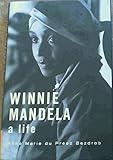
Anne Marie du Preez Bezdrob. Winnie Mandela: A Life. Cape Town: Zebra Press, 2003. xv + 287 pp. No price listed (cloth), ISBN 978-1-86872-662-2.
Reviewed by Patricia Van Der Spuy (History Department, Emory University)
Published on H-SAfrica (July, 2004)
"Whenever her name was mentioned in security circles, a shudder went through the ranks," Eugene de Kock, security policeman. "No one who has ever lived in this country can gainsay that Winnie was tremendous in her struggle role," Archbishop Desmond Tutu. "Winnie Mandela's hands are dripping with the blood of the people of South Africa," Xoliswa Falati, former friend. "[Winnie Mandela] is a political figure of almost Shakespearean tragic proportions," Judge Dennis Davis.
These quotations from The Penguin Dictionary of South African Quotations (1999) appear on the back cover of Anne Marie du Preez Bezdrob's Winnie Mandela: A Life, the first book-length biography that takes into account Winnie Madikizela-Mandela and the first to take her life story to the (near) present. Such a book is long overdue, and this is beautifully presented, with a stunning photographic cover portrait of Winnie Mandela, perhaps from the 1950s. (I could not find a date citation for this photograph.) The above quotations set up an expectation of controversy, debate, and analysis of the "political figure" of Winnie Mandela. The cover portrait captures the tone of the book: a tribute to a tragic heroine. Her fatal flaw in the Shakespearean tradition is perhaps her trusting nature; her fall, however, is attributed to a particular form of post-traumatic stress disorder, brought on by the unrelenting, torturous pressures of the apartheid regime. The tragedy is well captured, although the premise is debatable. (Madikizela-Mandela is not, after all, a Shakespearean creation.) However, one is left uncertain of the precise nature of Winnie Mandela's politics. None of those quoted on the book cover seem to have been interviewed for this book, and nowhere are their statements analyzed. This book could be critiqued from many different angles. As a popular text it is engaging, informative, and well written. However, from the perspective of this historian, the biography is overly sentimental and uncritical. It is based on a stereotypical view of "women's ability to face difficulties and misfortune with grace, tenacity and humor, and still embrace life with delight" (p. x).
The intended readership of this biography is unclear. It seems to be aimed at a non-South African readership; there is a glossary containing common South African words like baas equals "boss," and the Freedom Charter is described as similar to the American Declaration of Independence (p. 48). It is important that South Africans read this biography too. For me, it opens a conversation about the possibility, the relevance, and the right to present hagiographic narratives of struggle hero(ines). It also raises questions about the difficulties of writing holistic biographies of political leaders: this is a sensitive tale of personal relationships that underlie political ones, but in the process, it undermines Madikizela-Mandela's political role and does not begin to do justice to her politics per se.
For instance, in this reading, Madikizela-Mandela's political position within the ANC flows solely from her relationship with Nelson Mandela, rather than from any political analysis on her part. From attending (participating in?) Unity Movement meetings, Winnie Madikizela shifts effortlessly into fund-raising for the ANC (see chapter 4). There is no explanation, no analysis of process. Ironically, this is a story of Winnie Mandela with the politics (practically) left out. Crucially, there is no analysis of her participation in the ANC Women's League, of which she was a leader. Her shifting relationship to the African National Congress over half a century is largely unexplored and unexplained; a sense that it was a troubled relationship is mostly presented via innuendo, more overtly in the final chapters (see, for example, p. 271). Moreover, the striking similarities in the lives under apartheid of Winnie Mandela and Steve Biko are never mentioned, and her attitudes towards, or even the possibility of her activism within, the Black Consciousness movement remains unexplored. It strikes me that her activism and political leadership are represented as almost accidental and incidental. In my view this book represents the flip side of political biographies that typically underestimate the personal, like Doreen Musson's biography of Johnny Gomas and Brian Bunting's work on Moses Kotane.[1] Whereas their subjects seem to have no personal relationships that do not directly impinge on their politics, in the book under review personal relationships and emotions overwhelm political analysis.
Whether this book is aimed at academic readers is difficult to ascertain; therefore, I am unsure whether an academic review is necessarily appropriate. The book contains a bibliography and there are a few endnotes, so there seems to be some aspiration to appeal to academe. Half the chapters have one or two end notes; the rest have none. The paucity of references is explained as a way to avoid clutter (p. 275), but, for this reviewer, it is a serious methodological concern that blurs the boundaries between subject and author to a disturbing extent, setting aside concerns surrounding plagiarism. For the most part, the writer attributes thoughts, feelings and words to Madikizela-Mandela with very little evidence that Madikizela-Mandela herself would authorize them. There is no evidence that du Preez Bezdrop interviewed Madikizela-Mandela. Alan Reynolds, her spokesman, is acknowledged as a helpful source, but no endnote points to specific input from him. Of all the dozens of possible interviewees, the only persons interviewed and acknowledged in endnotes are the satirist Pieter Dirk Uys, journalist Hennie Serfontein and Marinus Wiechers, "political analyst and former professor of constitutional law" at UNISA. All sources listed in the bibliography are secondary, and include two previous biographies of Winnie Mandela, by Emma Gilbey and Nancy Harrison, and Winnie Mandela, Part of My Soul Went with Him.[2] The latter is not actually Mandela's autobiography, as this citation suggests; it is rather a compilation of interview transcripts and comments published in the mid-1980s. The compiler-editor, Anne Benjamin, specifically notes that Mandela did not have the chance to review the manuscript before publication.[3] Every comment attributed to Winnie Madikizela-Mandela in the book under review has been filtered and/or selected by someone other than Madikizela-Mandela herself before it came into du Preez Bezdrob's hands.
In addition to the option of interviewing people who participated in Madikizela-Mandela's life, there are numerous records of audio-visual interviews with Winnie Mandela that could have been sourced; other archival sources such as court transcripts--not to mention media reports--would have been fruitful. In the final part of the book, the author does present extracts of transcripts from the Truth and Reconciliation Commission around Winnie Madikizela-Mandela's alleged involvement in abuses during apartheid, although the author does not provide evidence of having interviewed anyone central to those hearings. A key question for me is, why did a writer with journalistic skills not conduct primary research throughout the process of writing this life story? Or, if she did, why is this not acknowledged? One partial answer might be that this book was completed in haste--why else did the author not wait for the results of Madikizela-Mandela's 2003 appeal to be published before completing the book, or, given the writer's reiteration of the possible significance of the 2004 elections, would that have not been worth waiting for (p. 270)? Surely, an exploration of all available primary sources is crucial to biography, and where the subject is--for whatever reason--not personally interviewed, a wide range of other oral and visual material should be sought and examined. This all has serious implications for the right to tell this life story in this way.
The book's subtitle, A Life (not claiming to tell the life), needs to be kept in mind throughout the reading of this biography, as it is certainly a partial representation of a life. The writer's liberal, Christian orientation, and her admiration for Madikizela-Mandela, infuses the entire narrative. The acknowledgement ends with thanks to "my Creator"; and the final sentence reads, in part, "as she moves into the final phase of her momentous life, Winnie Madikizela-Mandela could ask for no more than the prayers of the nation she has served" (p. 272). The book's blurb tells us that "this intimate, in-depth and unbiased biography reveals the enigma that is Winnie Mandela, by exploring both her personal and political life." Indeed it is intimate, and does evoke a personal life--Winnie Mandela as caring social worker, loving mother, Christian, brave but naive fighter to keep the Mandela name alive--all within the political context of apartheid. As the writer notes on the final page of the book, "Winnie said [in 2003] her community involvement was not an extension of her role as a politician, but a result of the fact that she still saw herself primarily as a social worker and a mother" (p. 272). This, of course, contrasts directly with Nelson Mandela's oft-reiterated statement that he "is" the ANC. This vision of Winnie Mandela, as social worker and mother, drives the biography. Her politics, however, are reduced to naïve courage in the face of an apartheid onslaught. "From that moment on, she dedicated her life to keeping the cause--and Mandela's name--alive" (p. 110).
Du Preez Bezdrob's position on Madikizela-Mandela is clear: "From the outset, this book was intended to be more than just the story of a remarkable woman or South African under apartheid. I saw it as a parable for the courage and compassion of women in war, and the effects of ruthless dictatorship: the brutality of unscrupulous leaders struggling for survival, and the enslavement of man [sic], whether in southern Africa or the former Yugoslavia.... Winnie belongs to this unique fraternity [sic] of extraordinary women, most of whom will remain forever nameless.... Many of their names are interchangeable with that of Winnie Mandela.... Winnie [is counted among] the millions of nameless women who choose to confront oppression and injustice when it is safer to turn and look the other way" (pp. x-xi). However, we also read that "she never resembled anyone" (p. xi). Not only does the author see Winnie Mandela as a symbol of women's struggles against oppression, but she identifies with Mandela personally: "I had had a taste--albeit just a fraction--of some of Winnie's experiences. I could relate to her as a woman, as well as identify with the loss of privacy, having your telephone tapped, being watched and followed, not knowing when or where the security police might pounce, wondering what might happen to your small children if some ill fate befell you" (p. x). This is no unbiased account of a life, and I wonder why the blurb should make such a claim, instead of acknowledging what could be a strength: that this is an overtly compassionate attempt to get into the mind and motivation of Winnie Madikizela-Mandela. It seeks to present a sympathetic, indeed empathetic, life narrative of a woman defined by courage, compassion, beauty, and regal bearing, but ultimately ground down by apartheid. This book attempts to explain a perceived shift in the persona of Winnie Mandela from the Mother of the Nation of earlier biographies, and of the liberation struggle--a persona reproduced here without analysis or irony--to Winnie Madikizela-Mandela, a woman accused of murder, convicted of kidnapping, and at the time of publication, indicted for fraud.
The book's central task is outlined in the preface. As a war journalist in, inter alia, Bosnia, and "political officer with the United Nations," du Preez Bezdrob is concerned with "the phenomena of political oppression and racism," and she "attempts to fathom the psychology of the oppressor, the warmonger and the victim" (p. ix). In this particular case, du Preez Bezdrob writes: "Some years ago, I saw photographs of Winnie Mandela in a magazine, and noticed that as a young woman she had lively, laughing eyes--the soulful, striking eyes many observers commented on. However, in later pictures, her eyes were mute, as if the light in them had been extinguished. That set me wondering what hardships had caused such a woeful metamorphosis" (p. x). The answer, for this writer, is contained in the quote from Madikizela-Mandela that appears on the final page of the book, after the argument has been made: "I am the product of the masses of my country and the product of my enemy." Is she not also the product of a relationship with the media spanning half a century? And as the author is a member of the media, would this relationship not have been the perfect subject for du Preez Bezdrob to pursue? This book seeks to explain how and why the light was extinguished from Winnie Madikizela-Mandela's eyes. I would reject the premise that the light was extinguished from her eyes. As the writer in fact unwittingly shows in the final chapter of the book, they continue to blaze. To me, the writer oversteps a line between compassion and hagiography, in evoking a glorious past, both for Winnie Mandela pre the mid 1980s, and for "African culture."
The biography is prefaced by a prologue and introduction. These place Winnie Madikizela-Mandela's life within the context of her ancestors, and set the tone for the narrative that follows. Because this context is significant, I discuss it in some detail below. As laid out in the contents page, the biography itself is divided into three parts, using the neat, but fraught, device of marital status. Winnie Madikizela-Mandela is thereby defined by her marital status. Part 1 is entitled "Winnie Madikizela," part 2 "Winnie Mandela," and part 3, "Winnie Madikizela-Mandela." As the cover photograph and indeed the book's title suggest, Winnie Mandela is the main focus of this biography, and the section dealing with the period of her marriage takes up thirteen of nineteen chapters. Madikizela-Mandela is given two chapters, entitled "Things Went Horribly Wrong" and "A Quiet Exit."
Historians may be intrigued by the way that the prologue sets up a surprising, and to me, frankly, inexplicable, dynamic to begin the story of a woman's struggle against the forces of apartheid. Here, white men are innocent; the code for British military strategic devastation (scorched earth) is used here, apparently without irony, to refer to a Zulu attack on "the Xhosa." ("A small group of white men had gone to the aid of the Xhosa after months of attacks by Shaka's Zulu impi, culminating in the attack on the Pondo Great Place" [p. 1].) The protagonists in the prologue are the "white men" helping "several thousand Pondo and Tembu fighters." The enemy are the Zulu "resplendent in full battledress, their strong ebony bodies still and taut in anticipation of the fight" (p. 2); an enemy which "looted" Xhosa cattle. A white man, Holden Bowker, saves a tiny Pondo boy whose mother had died. A footnote tells us "Bowker entrusted the boy to the care of a black woman on their [sic] farm, Tharfield, and promised her a cow to nurture him back to health. He was named Resurrection Jack, and remained part of the Bowker's weal and woes for seventy years"(p. 3). Is this not slavery packaged as salvation? The prologue ends: "Behind the disappearing backs of the white man and the black boy lay the ashes of the Pondo people's hopes and dreams; a black, smoldering scar in the soft green of the countryside" (p. 3). I am unsure what to make of such a prologue to the life of Winnie Madikizela-Mandela.
A romantic vision of an essentialized Africa is evoked before the life of Winnie Madikizela begins. The opening sentence of the introduction sets the scene: "From the colourful quilt of intertwined clans and tribes that make up the Xhosa people, two have become household names" (p. 5). The [unreflective] use of the word "tribes" sets off warning bells, which continue to chime throughout the book, reinforced by the reiteration of "witch doctor" (p. 17). To South Africanists, the quilt trope will call up Belinda Bozzoli's pathbreaking 1983 essay;[4] but du Preez Bezdrob's quilt is more evocative of ethnic (tribal?) tourism than of southern African historiography. The introduction tells a simplistic, heavily biased tale--for some unexplained reason vilifying "the Zulu"--of the late-eighteenth century that reveals no hint of more than two decades of historiographical debate: "[Shaka's ] bloody conquests caused major upheaval in all of southern Africa" (p. 5). We read about Shaka's "trail of terrifying destruction and bloody atrocities ... Shaka's impi moved south, killing and plundering as they went" (pp. 5-6). The source for this scene-setting scenario is Henry Fynn, "the Zulu king's famous English advisor," who unproblematically "chronicled Shaka's overtures to Faku" (p. 6). According to the bibliography, for this period of southern African history, the author consulted three works: Donald Morris, The Washing of the Spears (1965), E. A. Ritter, Shaka Zulu (1978), and Noel Mostert, Frontiers (1992). The point of the introduction is to demonstrate a lineage for Winnie Mandela. "She hailed from an imposing line of authentic and indisputable leaders. During a life beset with tragedy and trial, she ceaselessly demonstrated the well-chronicled characteristics of her ancestors, who were fearless and autocratic, with a natural penchant to command, and typified their dauntless courage, stubborn pride and instinctive aptitude for survival against all odds. Winnie Madikizela was to the manner born" (p. 10). The scene is thus set for the hagiographic portrayal of a life, and the subject herself is fixed within this framework.
Part 1 narrates the early personal, social and political development of Winnie Madikizela, a young girl whose political consciousness was built in the aura of her father's influence. "It was not her marriage to Nelson Mandela that made Winnie an activist, but the germination of seeds planted many years earlier by her father and teachers" (p. 38). Unusual, strong women help to shape her personality (p. 20ff). Nevertheless, Winnie Madikizela is profoundly naïve, reflected in the titles of some of the chapters: "A Country Girl," "The Magical City of Gold," "Mandela Wants to Marry Me." This is a romantic tale of the young Winnie growing up: "By the age of eighteen, Winnie had been exposed to controversy, conflict and tragedy, and already understood the need to be both tough and caring. As an adult, those qualities would expand into grace, empathy, charisma and great courage" (p. 39). She then moved to the big city, and fell in love. The backdrop is segregation and apartheid, against which the naïve, kind-hearted Winnie negotiates city life. "Winnie was easy-going, and her warmth and sunny nature helped her to make friends easily" (p. 46). The writer skillfully weaves a narrative that retains the reader's interest, revealing a great deal about the life of the young woman, albeit in a tone that for me is too romantic and a style that is too uncritical. Frustratingly, the text (here and elsewhere) is littered with tantalizing statements that are unexplored. For instance, Winnie's friendship with Peter Magubane is mentioned, when he photographed her modeling ("she saw her participation as a bit of fun"), but their relationship, and his perspective on Winnie's life, are not examined (p. 46). In part 1, there is no reflection on the process of writing, or the authority to present a particular point of view as authentic. Is the word "witch doctor" Winnie Mandela's or du Preez Bezdrob's (p. 17)? Admittedly, there are moments when the author separates herself from her subject, by inserting "no doubt"(p. 21) or "in all probability"(p. 22). These moments, unfortunately, are few in this part of the book.
Part 2 narrates a story of her marriage to Nelson Mandela. It also chronicles the narrative, begun in the previous section, of her political development in the shadow, and later in the absence, of her husband. The author claims, but to my mind does not effectively demonstrate, that Winnie Madikizela was "political." "Winnie found it impossible to ignore the rising tide of black politics" (p. 45). Before meeting Nelson Mandela, "gradually, Winnie was beginning to understand what lay at the heart of black political aspirations, but apart from attending a few meetings of the Trotskyist Unity Movement with her brother, she avoided getting actively involved" (p. 47). There is no discussion of the ideas and strategies of the Unity Movement, no hint that "Trotskyist" might be a contested label. This early political experience is unexplored; the author does not reflect on the extent to which these associations might have helped to shape her later political position. Did she participate actively (see p. 46)? How far did her sibling relationships shape her politics? Although the author states that Madikizela's "dreams and ambitions [to be an employed social worker] would be dashed by her own principles and choices," the overwhelming sense is that she was swept along by personal relationships rather than political principles.
We are told that when Winnie Madikizela became romantically involved with Barney Sampson (in 1957), she "was concerned that he was almost completely apolitical, showing no interest in the need for change--something that was of major importance to her" (p. 55). "She showed real interest" when her fellow, black, hostel dwellers "discussed the gross injustices of influx control measures, which dictated where blacks were allowed to live." Through her friendship with Adelaide Tsukudu, who would marry Oliver Tambo, Winnie went to ANC meetings. Through her relationship with Nelson Mandela, she became active in the ANC. I do not dispute the significance of such relationships, but I was hoping for some analysis of ideology, theory, and process.
Du Preez Bezdrob summarizes the Congress of the People in 1955, but does not indicate whether Winnie attended or not. Certainly, it is clear that her initiation into Congress politics was via Nelson's personal influence. She matures in the absence of any institutional support, or context. This is the story of one isolated woman's brave struggle against evil. At no stage in this narrative is Winnie Mandela given a position as leader within the African National Congress; we learn very late that she had been a leader in the ANC Women's League, but nowhere is this involvement described or discussed. Instead, Winnie Mandela is portrayed as politically and personally naïve, trusting the wrong people who then betray her.
There is a layer beneath the surface of this narrative which is disturbing precisely because the author never foregrounds and confronts it. This is the seeming betrayal of Winnie Mandela by the ANC. The relationship between Winnie and the ANC contains intriguing hints and asides that are never developed. An example of this is in chapter 8, "Traitors for Friends." On one level, the title refers to police informers who befriended Winnie Mandela, but one wonders whether the author intends it to apply to the ANC too. "Nelson had often warned Winnie to beware of informers, and she was about to experience at first-hand the danger of taking people at face value" (p. 106). The author relates how, in 1962, Winnie Mandela was drawn into a plot to entrap Nelson Mandela by encouraging him to try to escape from jail. "Instinctively, she realized that this was a trap" involving Moosa Dinath, whom she considered a friend ("she was confused"). She informed Walter Sisulu, "who agreed that it was most likely a trap, and told her that he would deal with the matter ... she obeyed [the injunction not to return to the jail] ... No one in the ANC ever told her whether this was the case or not ... In years to come, Winnie would be betrayed time and again by people she trusted, and her gullibility would cause her great sorrow and disappointment" (pp. 107-108). Tension between Winnie Mandela and the ANC, hinted at in this anecdote, is never explored. However, given the way in which Winnie Mandela is portrayed as gullible and naïve, it is perhaps unsurprising that the ANC might have elected not to discuss its strategies with her. This however does not help the reader to understand how Winnie Mandela became a leader within the Women's League. This aspect of her political--and personal--life is given no attention. Each relationship is described in personal or social work related terms, and it is up to the reader to guess their political aspects. Winnie Mandela's political lifestream flows through her husband (she draws strength from this in solitary confinement; she keeps his name alive). She is not portrayed as part of the broader structures of liberation politics.
The author withdraws from her subject both in tone and style--becoming more of an investigative journalist--from chapter 16, once Madikizela-Mandela's actions become less easily romanced. This shift does not precisely fit the structural separation of parts 2 and 3, one reason that dividing the life into three personas based on surnames does not work for me. Nevertheless, before that, in chapter 11, there is one moment when she acknowledges the impossibility of speaking for Winnie Mandela in relation to her experience of interrogation while in solitary confinement:
"In writing this book, I have constantly been confronted by the 'why' of Winnie Mandela's choices. Some are easily explained by the circumstances that presented themselves at various stages of her life. Others, however, demand far deeper examination. In the absence of empirical evidence, I found it impossible not to wonder about, and imagine, her reflections and fears, and in particular those that might have been conjured up by her grueling ordeal at the hands of her interrogators. I trust that readers will indulge my use of poetic license to share the pictures that unwittingly came to mind as I tried to place myself in another woman's shoes. Some of the interpretations are mine alone, while others are based on pointers to Winnie's thoughts, observations and perceptions, as recorded in various publications and paraphrased here" (p. 142).
I cannot help wondering why this sensitive, reflective statement was not made in the context of an introduction to the book, to refer to the entire narrative, rather than in relation to this experience alone.
For me, this biography is constructed around a flawed premise. A near-perfect Winnie Mandela is created, who is so different from the Winnie Madikizela-Mandela of the Stompie Seipei case that a radical explanation is required. That explanation is post-traumatic stress disorder. The book argues, in effect, that the apartheid machine destroyed Winnie Mandela. Through the author's well-meaning compassion, Mandela is reduced to the status of victim. She is not responsible; she cannot help herself. Following a life in which Mandela resolutely and unflinchingly declared herself an adversary of the state, she is rendered a helpless victim of apartheid. There is no interrogation of that hagiographic representation that dominates all previous biographies, and the same Mother of the Nation is constructed, followed by a bizarre, jolting, transgression within the personality of Winnie Mandela.
What does Winnie Mandela: A Life contribute to South African history? Whereas it fails to revisit the lives of Winnie Madikizela and Winnie Mandela with new eyes (these women remain icons, unblemished), to me its value lies in bringing Madikizela-Mandela to the consciousness of a new generation of readers, and in taking the story of the life of Winnie Mandela post-1980. It is important to foreground a woman who is central to many representations and self-representations of South African history. On discovering something of the author's background, I had been hoping for an investigative analysis of the ways in which Mrs. Madikizela Mandela's life has been portrayed--as much her image as Mother of the Nation as her more recent, at least, media representations of Madikizela-Mandela. Fascinating paths of inquiry remain unexplored: the relationship between her and the media, and the ANC, and the South African government, both during and after apartheid. Why has Winnie been made to disappear? The unfortunate title of the final chapter, "A Quiet Exit," writing off a woman still very much alive, implicates du Preez Bezdrob in this disappearing act. Through constructing Winnie Mandela as a romantic, sentimental heroine, the writer runs the risk of exoticizing her and in so doing, participating in the neocolonial project. For me this was a lost opportunity to seriously examine former hagiographies and to reflect on the shifting portrayals of Winnie Madikizela-Mandela.
Notes
[1]. D. Musson, Johnny Gomas: Voice of the Working Class: A Political Biography (Cape Town: Buchu books, 1989), preface; and B. Bunting, Moses Kotane: South African Revolutionary (Cape Town: Mayibuye Books, 1998).
[2]. E. Gilbey, The Lady: The Life and Times of Winnie Mandela (London: Vintage, 1994); N. Harrison, Winnie Mandela: Mother of a Nation (London: V. Gollancz, 1985); and W. Mandela, Part of My Soul Went with Him, ed. Benjamin, adapted M. Benson (New York: W. W. Norton, 1985).
[3]. Mandela, Part of My Soul. "This is not an autobiography in the conventional sense. The restrictions placed on her activities by the government and her daily involvement in the liberation movement make it impossible for Winnie Mandela to sit down and write a book. In any case, she dislikes talking about herself: it is not she who is important, she would say, but the struggle. ... The book was compiled outside South Africa ... she could not see the manuscript in detail before it went into print" (p. 7).
[4]. B. Bozzoli, "Marxism, Feminism and South African Studies," Journal of Southern African Studies 9, no. 2 (April 1983): pp. 139-171.
If there is additional discussion of this review, you may access it through the network, at: https://networks.h-net.org/h-safrica.
Citation:
Patricia Van Der Spuy. Review of Bezdrob, Anne Marie du Preez, Winnie Mandela: A Life.
H-SAfrica, H-Net Reviews.
July, 2004.
URL: http://www.h-net.org/reviews/showrev.php?id=9561
Copyright © 2004 by H-Net, all rights reserved. H-Net permits the redistribution and reprinting of this work for nonprofit, educational purposes, with full and accurate attribution to the author, web location, date of publication, originating list, and H-Net: Humanities & Social Sciences Online. For any other proposed use, contact the Reviews editorial staff at hbooks@mail.h-net.org.

