



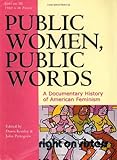
Dawn Keetley, John Pettegrew, eds. Public Women, Public Words: A Documentary History of American Feminism, vol. 2, 1900-1960, and vol. 3, 1960 to the Present. Lanham: Rowman & Littlefield Publishers, 2002. 552 pp. $75.00 (cloth), ISBN 978-0-7425-2224-4; $82.50 (cloth), ISBN 978-0-7425-2235-0.
Reviewed by Stephanie Gilmore (Department of History, Ohio State University)
Published on H-Women (June, 2004)
Back to the Source: U.S. Feminism over the Twentieth Century
Back to the Source: U.S. Feminism over the Twentieth Century
In 2000, self-identified third-wave feminists Jennifer Baumgardner and Amy Richards wrote that "for anyone born after the early 1960s, the presence of feminism in our lives is taken for granted. For our generation, feminism is like fluoride. We scarcely notice that we have it--it's simply in the water."[1] Although not all women have benefited uniformly from feminist gains and feminist goals, and though they remain very much contested today, there is simply no way to deny the veracity of their claim that feminism has altered the landscape of U.S. society and culture. But just how did feminism get "in the water?" In Public Women, Public Words: A Documentary History of American Feminism, Dawn Keetley and John Pettegrew have offered three volumes (two of which I review here) of feminists' treatises, strategy papers, transcribed speeches, and other documents to help us contemplate answers to this question. By bringing together so many documents into one collection, they have done much of the legwork for us, offering texts that allow us to reconsider feminist activism and think about different approaches to understand the many women (no feminist men's works appear in these two volumes) who, individually and collectively, sought to improve the status of women in U.S. society.
Some of the documents in these volumes have been anthologized elsewhere; others are published for the first time here. Through their careful selection and organization, Keetley and Pettegrew have provided an important resource for us to use as we write the histories of feminism in the United States. With these documents, the editors combat the idea that feminism was, and is, "the battle of a homogenous group of women in the name of a single cause such as suffrage or equal rights with men" (vol. 2, p. xiii).
In volume 2, which begins at the turn of the twentieth century, they document how the so-called first wave of feminism was far more than the fight for suffrage. Instead, they marshal evidence to illustrate that feminism from the end of the nineteenth century and into the first half of the twentieth century included peace activism, scholarly and popular discussions about sex and gender, education, public housekeeping, political mobilization, and the vote--both securing it and using it effectively for women's issues and rights. (Writings on free love, birth control, and sexuality are largely absent from volume 2, but these topics may be covered in volume 1.) Part 1, entitled "Varieties of Modern Feminism," allows readers to read first-hand debates over feminism--what it meant, whether it was just about women, and how to educate others about feminism. For example, we can hear various perspectives on feminism across the decades as we move from Emma Goldman's musings on "The Tragedy of Women's Liberation" (vol. 2, pp. 12-15) to Ellen Glasgow's exploration of "Feminism" (vol. 2, pp. 19-22) to M. Carey Thomas's defense of women's university education (vol. 2, pp. 55-63)--all of which evaluate women's contemporary roles in the context of broader social institutions. Through such writings, it is clear that women from a variety of backgrounds and political affiliations saw feminism as a perspective or framework through which to understand contemporary issues.
Looking backward, it likely appears that the pursuit of "equality" with white middle-class, educated men was an effective route to political, social, and economic change for women, but for feminists one hundred years ago, this was not a foregone conclusion. Although most feminists saw the vote as a necessary step, many debated the efficacy of the vote in overhauling the system. For example, black women explored questions of what the nineteenth amendment meant for black enfranchisement (Robert M. Patterson, "The Negro Woman in Politics" [1922], vol. 2, pp. 256-258), while union women queried whether or not the vote would amount to significant change for female workers (Corinne Roosevelt Robinson, et al., "Is Woman Suffrage Failing?" [1924], vol. 2, pp. 262-267). Socialist feminists grappled with problems facing turn-of-the-twentieth-century society, raising theoretical and practical questions about the relationship between socialism and feminism (Mary White Ovington, "Socialism and the Feminist Movement" [1924], vol. 2, pp. 363-366). The intricacies of such debates about with whom women should align their votes or how they could (or should) use the vote to effect greater change has been the subject of several monographs, but the selections in this volume offer some of the sources necessary to initiate a sophisticated classroom discussion or to consider such issues in different ways.
Beyond the vote, of course, this volume illuminates how feminists of the early twentieth century debated two issues that resonate with feminists today: work and war. Keetley and Pettegrew offer twenty selections on "work, labor, and socialism." This multifaceted discourse on women's labors suggests that feminists in the first half of the twentieth century dealt more effectively with class than feminists of later years. Although feminists of the second and third waves have been criticized for not giving necessary attention to class, it may be the case that we need to broaden more modern conceptions of feminism so as to recognize those whom historian Susan Hartmann calls "the other feminists" in labor unions and other non-mainstream feminist organizations. In the earlier decades of feminist activism, both prior to the vote and during the "doldrums," feminist labor activism was vibrant and documents from authors across the political spectrum, from Mother Jones ("You Don't Need a Vote to Raise Hell" [1925], vol. 2, pp. 400-404) to Mary McLeod Bethune ("Faith That Moved a Dump Heap" [1941], vol. 2, pp. 380-386) and policymakers in the Women's Bureau ("What the Women's Bureau Has Accomplished" [1930], vol. 2, pp. 391-394), demonstrate the ways in which feminists debated issues of labor and how they saw themselves as both a part of and apart from socialism, labor unions, and activism.
The sixteen final selections of volume 2 demonstrate the ways in which women sought to understand international and domestic issues of war and peace. Whether appealing to women's patriotism and encouraging women to enlist and fight in World War II (Daisy Harriman, "Women Enlist Now!" [1941], vol. 2, pp. 469-470; Minnie L. Maffett, M.D., "We Too Must Fight This War" [1942], vol. 2, pp. 470-475) or pursuing a prewar and postwar agenda of peace (Jane Addams, "Women and War" [1915], vol. 2, pp. 457-459; Charlotta A. Bass, "You Can Vote for Peace" [1952], vol. 2, pp. 480-482; Sophia Wyatt, "One Day Strike for Peace" [1962], vol. 2, pp. 482-484), for a variety of women, feminism offered a critical lens through which to see and understand war abroad and "homeland security." It is striking to compare arguments some feminists used for public housekeeping with those arguments that other feminists used against the war--both clearly indicate that "equality" feminism was not the only way women pursued change for women and for the world in which they lived. Although U.S. feminism has been discussed historically as a philosophy rooted in equality, documents on these subjects indicate that many feminists saw difference as their path to social and cultural change, and there is much more research to be done on this topic.
If volume 2 illustrates the ways in which feminists in the first half of the twentieth century coalesced around a variety of issues, volume 3 demonstrates the importance of identity politics in the century's second half. Keetley and Pettegrew outline two important distinctions from "mainstream" feminism (which, here, encompasses liberal feminism, women's liberation, and radical feminism): black feminism and lesbian feminism. Although this is a collection of documents, I wish the editors had explored the ways in which black feminism and lesbian feminism were not merely responses to white, heterosexual feminism but also how they grew up in response to challenges among African Americans and gay men (obviously not mutually exclusive categories)--what sociologist Benita Roth calls "separate roads to feminism." That they did not, of course, does not detract from the important works they chronicle here. Instead, the compiling of these primary sources raises significant questions about the rise of identity politics in postwar U.S. society, about how we distinguish the feminist "waves" from one another, and about the ways that feminism was related to contemporaneous social movements.
The twenty-two documents that comprise "black feminism" and "lesbian identities and critiques of heterosexuality" call up the importance of identity politics in postwar social movements. As Frances Beal made clear when she spoke of the "double jeopardy" of being black and female (vol. 3, pp. 60-66) and "Radicalesbians" demonstrated when they wrote of "the woman-identified woman" (vol. 3, pp. 109-112), "woman" was never a singular category--a point that feminists articulated forcefully. Although self-identification is too important a feminist project to deny, cataloging feminist activism around identity obscures the important ways in which feminists from a variety of backgrounds dealt with the same issues--rape, workplace issues, sexual desire and love, racism, and reproductive freedom. Divorcing black, lesbian, and multicultural feminists from "mainstream" feminism denies the important and obvious coalitions and continuities among feminists. Perhaps scholars will use these documents to move beyond the sisterhood/difference debate and analyze important issues around which second-wave feminists coalesced in spite of, and because of, differences.
That said, the editors do offer a section on some "second-wave issues." Keetley and Pettegrew have pulled together important treatises, documents, and calls to action on such issues as child care (Louise Gross and Phyllis MacEwan, "On Day Care" [1970], vol. 3, pp. 197-201), welfare (Johnnie Tillmon [with Nancy Stephan], "Welfare is a Women's Issue" [1972], vol. 3 pp. 201-204), women's health (Women's Health Collective, "The Male-Feasance of Health" [1970], vol. 3, pp. 204-206), the Equal Rights Amendment (National Organization for Women, "ERA Position Paper" [1967], vol. 3, pp. 251-58), housework (Pat Mainardi, "The Politics of Housework" [1968/1970], vol. 3, pp. 190-194), and even the role and responsibility of historians to feminism and to feminists (Linda Gordon, "What Should Women's Historians Do: Politics, Social Theory, and Women's History" [1978], vol. 3, pp. 286-291; Gerda Lerner, "New Approaches to the Study of Women in American History" [1969], vol. 3, pp. 280-286). They also offer twenty selections on "pop culture feminism," which documents the ways in which feminists claim, assign, and challenge media images of women, feminists, and feminism. Feminists discuss the politics of identifying with such cultural phenomena as the Riot Grrls (Punkgrrrl, "I Wanna Riot" [1998], vol. 3, p. 425), hip-hop (Joan Morgan, "The Bad Girls of Hip-Hop" [1997], vol. 3, pp. 426-427), Xena (Wendy Bryan, "Xenatopia" [1998], vol. 3, pp. 386-388), or Barbie (Virginia Eubanks, "Hacking Barbie with the Barbie Liberation Organization" [1998], vol. 3, pp. 408-411), demonstrating the importance of culture in women's lives. The editors provide these selections to give a thumbnail sketch of the media in late-twentieth-century U.S. culture, and these documents suggest that culture and politics are not at odds with one another but are, instead, reflections of one another. The pursuit of cultural issues is, in many ways, the pursuit of political issues--an important element of third-wave feminism.
With sixteen selections on the future of feminism, it is clear that feminists are saying much about where feminism is at the turn of the twenty-first century and where it is headed. Although younger feminists are represented in the section on "Pop Culture Feminism," very few of the authors whose works are cataloged in "Toward a Third Wave" are age-representative of the third wave. Instead of seeing many young women's names, Keetley and Pettegrew offer writings by bell hooks ("Black Students Who Reject Feminism" [1994], vol. 3, pp. 490-492), Katha Pollitt ("Are Women Morally Superior to Men?" [1992], vol. 3, pp. 450-458), Wendy Kaminer ("Feminism's Identity Crisis" [1993], vol. 3, pp. 458-466), Barbara Ehrenreich ("Beyond Gender Equality: Toward the New Feminism" [1993], vol. 3, pp. 447-450), and Gloria Steinem (with bell hooks, Urvashi Vaid, and Naomi Wolf, "Let's Get Real about Feminism-The Backlash, the Myths, the Movement" [1993], vol. 3, pp. 467-476). Of course, this is not to suggest that these feminists are somehow "past their prime" and need to be relegated to the "second wave." In fact, I am quite pleased to see that many scholars and activists who began their careers in the era of the second wave are identifying with (or at least not distancing themselves from) so-called third-wave feminism, and the writings Keetley and Pettegrew have chronicled here are landmark pieces on the current state of U.S. feminism. However, aside from Rebecca Walker and Anastasia Higginbotham, young feminists' writings--including work by Baumgardner, Richards, Inga Muscio, Barbara Findlen, and many others--are curiously absent.
The criticisms of this edited collection, then, are minor and deal only with the choices Keetley and Pettegrew made when undertaking this compendium of feminist thought--and some of the choices may reflect external issues, such as copyright. Although the two volumes, even in textbook binding, might make assigning this collection in a classroom cost prohibitive (volumes 2 and 3 currently are available only in hardbound editions at $75.00 each; volume 1 is available textbook-bound for $26.95), this collection is a valuable resource for both researching and teaching feminist movements in the United States. Scholars will surely find it useful to have in one place a variety of documents, many of which are rarely seen in documentary collections.
As the documents in Public Women, Public Words: A Documentary History of American Feminism make clear, feminism did not just "get" into the water; feminists struggled to get it there. Reading (or re-reading) these documents invites us to raise vital questions about what we know about the history of U.S. feminism. Historians could use this rich documentary collection to explore questions about continuities, differences, and ideological shifts among feminists across the twentieth century. Where did feminist attention to work and labor go, and why? At what times was the body a site of feminist rhetoric, writing, identity, and activism, and to what ends? When and why did feminists start to debate who was an appropriate sex partner and what was feminist sex? How did identity politics transform feminism? At what costs? (How) Did feminists transcend them, and if they did, were they successful? Having all of these documents at one's fingertips can only enhance one's ability to ask and answer such questions.
Notes
[1]. Jennifer Baumgardner and Amy Richards, Manifesta: Young Women, Feminism, and the Future (New York: Farrar, Straus and Giroux, 2000): 17.
[2]. Susan M. Hartmann, The Other Feminists: Activists in the Liberal Establishment (New Haven: Yale University Press, 1998).
[3]. Benita Roth, Separate Roads to Feminism: Black, Chicana, and White Feminist Movements in America's Second Wave (Cambridge: Cambridge University Press, 2004).
If there is additional discussion of this review, you may access it through the network, at: https://networks.h-net.org/h-women.
Citation:
Stephanie Gilmore. Review of Keetley, Dawn; Pettegrew, John, eds., Public Women, Public Words: A Documentary History of American Feminism, vol. 2, 1900-1960, and vol. 3, 1960 to the Present.
H-Women, H-Net Reviews.
June, 2004.
URL: http://www.h-net.org/reviews/showrev.php?id=9514
Copyright © 2004 by H-Net, all rights reserved. H-Net permits the redistribution and reprinting of this work for nonprofit, educational purposes, with full and accurate attribution to the author, web location, date of publication, originating list, and H-Net: Humanities & Social Sciences Online. For any other proposed use, contact the Reviews editorial staff at hbooks@mail.h-net.org.

