



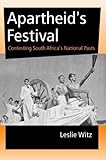
Leslie Witz. Apartheid's Festival: Contesting South Africa's National Pasts. Bloomington: Indiana University Press, 2003. xii + 324 pp. $59.95 (cloth), ISBN 978-0-253-34271-3.
Reviewed by Saul Dubow (University of Sussex)
Published on H-SAfrica (June, 2004)
Jan van Riebeeck has proved a less than ideal founding figure on which to base national myths of origin for white South Africa. A pragmatic Dutch East India Company servant who set out to establish an outpost of a trading empire in workmanlike fashion, he evidently had little sense of historical destiny and little taste for heroism. Although gaps in the biographical record are not necessarily a bar to romantic myth-making, the combination of Van Riebeeck's opaque personal background, doubts about the authorship of his diaries, and a certain dourness of character, have combined to make him an unlikely figure for adulation.
Until the nineteenth century, when attempts were made to reconstruct his moldering diaries and company reports in order to dignify white settlement with historical provenance and providential purpose, Van Riebeeck was a neglected if not a forgotten figure. Thereafter, prodigious efforts were made to cast Van Riebeeck in the role of national father figure, culminating in the rather muted, not to say bathetic, reenactment of colonial settlement on the occasion of the 1952 Tercentenary. Yet, as Leslie Witz shows so persuasively, Van Riebeeck has never managed to generate genuine popular response or attract emotional resonance. If anything, the reaction against Van Riebeeck on the part of those excluded from the white national community has been more deeply-felt and creative.
Witz weaves considered discussions of national identity, memory, and the production of history into a painstakingly researched consideration of Van Riebeeck's many historical legacies. The publication of excerpts from Van Riebeeck's diaries, first by Abraham Faure's journal Het Nederduitsch Zuid-Afrikaansche Tydschrift in the 1820s, and thereafter by Donald Moodie in his officially-sanctioned collection of Official Papers, provided initial opportunities to imagine national historical narratives of white settlement.[1] In the 1860s, the Cape Monthly Magazine sought to revive interest in the annals of Van Riebeeck in order to cement a shared sense of Anglo-Dutch civic patriotism. The memorialization of Van Riebeeck at mid-century by the painter Charles Bell, and then by Cecil Rhodes, who commissioned the Adderley Street statue of Van Riebeeck in 1896, showed how readily Van Riebeeck could be appropriated to the shared settler cause of European civilization in Africa.
Repeated efforts to harness Van Riebeeck to the cause of more exclusive Dutch or Afrikaner nationalism--for example, Van der Lingen's attempts at religio-ethnic mobilization in the 1850s, which cast the founder of the Colony as a biblical figure akin to Joseph in Egypt--made little headway. In the early-twentieth century, Van Riebeeck received close scholarly attention by Afrikaner historians such as S. F. N. Gie and H. B. Thom. These efforts were accompanied by campaigns to establish Van Riebeeck as the Volksplanter and to assign him a prominent role in the landmark 1938 Eeufees celebrations. However, Van Riebeeck was never quite equal to the role. Lacking the republican associations of the Voortrekker leaders, or the appeal of Paul Kruger, he was too easily assimilated into the Cape-Dutch inflections of South Africanism, as exemplified by Dorothea Fairbridge's use of him in her History of South Africa.[2]
Perhaps Van Riebeeck was too closely associated with Cape Town to serve either as a satisfactory national or a nationalist icon. In the planning of the great pageant to celebrate the tercentenary of Van Riebeeck's 1652 arrival, the Broederbond-dominated and Transvaal-based Federasie van Afrikaans Kultuurbewegings found itself in continuous conflict with the Cape Town City Council. At issue was how the planned festival would incorporate "all sections of the population" and how Cape Town should or could support this "national" event. Suspicion of Transvaal-based ultra-nationalism also played a role. Arthur Keppel Jones's brilliantly prescient 1946 exercise in futuristic history, where an Afrikaner Nationalist victory over Smuts follows a reenactment of Van Riebeeck's landing in Table Bay, soured the experience for many South African Party-supporters (including Smuts who was far more invested in the 1947 Royal Visit than in plans for the 1952 event). This may have opened the way for Afrikaner nationalists to reclaim Van Riebeeck for their own, as Keppel Jones intimated. Yet, even their commitment wavered after Malan's electoral triumph in 1948, when Van Riebeeck's propagandist potential was occluded by the more compelling anti-imperial and pro-republican imagery provided by the Trek.
Witz's detailed account of the disputes and intrigues that surrounded the 1952 pageant helps to explain why the enactment of South African history turned out to be so contrived and lacking in passion. The organizers' fears that a solemn historical procession through the streets of Cape Town might degenerate into unseemly public frivolity or inter-racial "hysteria" was one reason to orchestrate the pageant in the most controlled way possible. Heated discussion about how best to represent the festival's underlying theme--the bringing of enlightenment to Africa and the development of a united white nation--only resulted in insipid compromise.
The necessity to underline the apartheid message of separate peoples required holding a separate Malay and Griqua day of pageantry. This element of the celebrations, held in a large stadium, was almost entirely ignored by the "non-Europeans" for whom it was staged. The boycott (a Cape tradition as long-standing as the holding of public processions and pageants) was encouraged by the Non-European Unity Movement and the African National Congress, buoyed up by the events of the Defiance Campaign. Indeed, one of the most interesting aspects of the 1952 Tercentenary and one of the most engaging chapters of this book is Witz's discussion of the counter-history that emerged in response to attempts at official history-making. On behalf of the ANC, Silas Molema traced processes of land dispossession back to Van Riebeeck. Concerted efforts to rewrite South African history were made by marxisant intellectuals associated with the Cape-based Unity Movement, such as Hosea Jaffe, Dora Taylor, Ben Kies, and Kenny Jordaan. Their publications retold the history of white settlement in terms of a legacy of oppression, national dispossession, and slavery. Collectively, these efforts represented a serious effort to overturn the South African master-narrative of settlement and civilization.
The final chapters in the book deal with the 1952 Van Riebeeck Festival Fair and the journeys of Mail Coaches from various parts of the country to celebrate the Festival at Cape Town. Perhaps they would work better condensed into one. The popular attractions of the Fair, which showcased South African achievements and triumphs, was only tangentially connected with Van Riebeeck. And, despite the organizers' attempts to orchestrate a common narrative in the procession of the mail-coaches back to Cape Town, a preoccupation with local histories and regional sub-themes in the national story worked to subvert the coherence of the central message and to dilute the authority of Van Riebeeck himself.
Witz is good on the inner contradictions of the Festival but there is a paradox at play here: the driving force and coherence of the book depends to some extent on the existence of an identifiable cult of Van Riebeeck, or on several competing versions of history based on his mythology. Yet, the Founder of South Africa seems to have aroused little genuine enthusiasm or committed adherents. This does not undermine the book's underlying interest or strengths, which lie in the author's discussion of how public history is constructed and contested. Witz's theoretical take on issues of public display, memory, commemoration, and imagery is sophisticated and convincingly argued, though his phrasing can be prolix or confusing. What exactly is meant, for instance, by "indigent nationalism" (p. 52) and why was the 1870s "the most imminent History that Nationalists could draw on" (p. 97)? These reservations aside, Witz has produced an absorbing and deeply-researched study of the construction of historical myth and memory that is especially good on the 1950s and on the ambivalent position of the Mother City in the new Vaderland. It is a serious piece of scholarship and deserves wide readership.
Notes
[1]. Donald Moodie, The Record (Amsterdam: A.A. Balkema, 1960).
[2]. Dorothea Fairbridge, A History of South Africa (London: Oxford University Press/H. Milford, 1918).
If there is additional discussion of this review, you may access it through the network, at: https://networks.h-net.org/h-safrica.
Citation:
Saul Dubow. Review of Witz, Leslie, Apartheid's Festival: Contesting South Africa's National Pasts.
H-SAfrica, H-Net Reviews.
June, 2004.
URL: http://www.h-net.org/reviews/showrev.php?id=9510
Copyright © 2004 by H-Net, all rights reserved. H-Net permits the redistribution and reprinting of this work for nonprofit, educational purposes, with full and accurate attribution to the author, web location, date of publication, originating list, and H-Net: Humanities & Social Sciences Online. For any other proposed use, contact the Reviews editorial staff at hbooks@mail.h-net.org.

