



Ann Stoler. Carnal Knowledge and Imperial Power: Race and the Intimate in Colonial Rule. Berkeley: University of California Press, 2002. xi + 335 pp. $21.95 (paper), ISBN 978-0-520-23111-5.
Reviewed by Dawn Ottevaere (Michigan State University)
Published on H-Women (June, 2004)
Theories of Power and the Intimate
Ann Stoler's book Carnal Knowledge and Imperial Power is more a collection of interrelated essays than a progressive narrative, illustrating the complexity of colonial culture and politics. She dedicated more than a decade to research, and her approach questions the traditions of colonial history while introducing an evolution of gender theory. Focusing on European colonies, with an emphasis on the Dutch Indies, Stoler utilizes an impressive range of Dutch and French archival sources and an extensive bibliography of primary and secondary works. As a unique addition, she incorporates photographic images of private life, visually satisfying her "basic commitment to identifying the political stakes lodged in what is defined as public or private, to studying the quotidian shaping of racialized colonial worlds and their disparate sites of production" (p. 9). Stoler relies heavily on theory and philosophy, particularly Foucault, with nods to scholars such as Pierre Bordieu, Franz Fanon, George Lakoff, and James Scott. As a result, the strength of this text is not in its stories of colonial life (though well-researched and thoughtfully presented), but in its instructive method of assessing the historian's role in gender studies and the creation of colonial history.
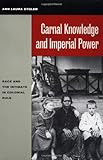
Stoler's approach is immediately apparent in her choice of a provocative cover photograph that offers the reader an initial glimpse of the book's central themes. Three people sit on porch steps, dog in the background; a young blond Dutch girl has her arm around her stoic dark-skinned baboe, gazing at her with a half-smile, while her equally fair-skinned brother sits slightly apart, hands clasped, staring straight ahead. The smooth bare, white feet of the girl occupy more space than the long brown feet of the servant, and the boy is firmly laced into heavy tall boots. The picture speaks volumes about intimacy, power, masculinity, womanhood, race, belonging, not belonging, and the complex development of these ideas within a fluid colonial atmosphere. Stoler argues that these ideas are not pre-ordained within the structure, but are careful political constructs that focus not only on the suppression of the colonized, but the "apparatus that kept potentially subversive white colonials in line" (p. 13). The seven chapters of this ethnographic history look comprehensively at the intricacies involved in gender and colonial studies, and the multifaceted task of colonial historians. The approach is inclusive to race, class, and gender and tries to illustrate the multiplicity of issues.
The first chapter is an introduction that outlines the book's format, the author's ideas about intimacy in the colonial structure, and the theories and scholarly work associated with colonial studies. Chapter 2 offers an explanation of Stoler's central theme, that "students of colonialism, anthropologists in particular, have taken the politically constructed dichotomy colonizer/colonized as a given rather than as a historically shifting pair of social categories that needs to be explained" (p. 13) and "argues for deeper historical engagement with the range of practices in which racisms were produced and thus with the cultural framing of political categories" (p. 15). Herein lies the strength of the book, in Stoler's questioning of questions and call for historians to reexamine colonial studies with the idea that these issues were and are open-ended.
Chapter 3 examines sexuality, gender, and race, including miscegenation, European womanhood, childrearing and abandonment, rape, morality, and eugenics. Stoler again takes her analysis and links it to a call for future research: "Ethnographies of empire should attend both to changing sensibilities and to sex, to racialized regimes that were realized on a macro and micro scale.... Such investigations may show that sexual control was both an instrumental image for the body politic ... and itself fundamental to how racial policies were secured and how colonial policies were carried out" (p. 78). Heavily steeped in theory, one of the most important methodologies that Stoler advocates is the exploration of race, class, and gender in both colonial and post-colonial society. She encourages scholars to approach renderings of white European womanhood, morality, and indigenous people with the idea that sexual access and domestic arrangements were not only private and intimate, but central to the formation of colonial power structures.
Chapters 4 and 5 expand these themes, looking particularly at women and children--European, native, and mixed race-in the colonial structure. Stoler continues to examine the framing of categories and the meaning making processes involved in the creation of racial identity. She explains the inherent problem of miscegenation: "Discourses of metissage expressed more pervasive if inchoate dilemmas of colonial rule and a fundamental contradiction of imperial domination: the tension between a form of authority simultaneously predicated on incorporating and distancing. Some metis were candidates for incorporation. Others were categorically denied. In either case, the decision to grant citizenship or subject status could not be made on the basis of race alone as all metis shared some degree of European descent by definition" (p. 83).
The chapters give short illustrations of the complexities involved; Stoler looks at court records, marriage laws, political movements, and educational practices, as well as other events that demonstrate the mutual constitutiveness of colonial identities. Again, the value of this text lies in the author's ability to use her research to promote theoretical and methodological lessons. Like Joan Scott, Stoler advocates the careful evaluation of historically designated categories, and cautions against the casual assumption of traditional colonial divisions.
Chapter 6 explores the application of Foucault to colonial studies. Stoler asks "why Foucault's elusive and suggestive treatment of race still remains so marginal to what colonial historians take from him today" (p. 141). As she examines these issues, she establishes the groundwork for the final chapter that changes the direction of her ethnographic history in a literal sense. The first six chapters focus more on the European-influenced colonial cultural development, but chapter 7 "situates memories of domestic service by those who served against the density of the archives around them" (p. 162) and "invites more work on colonial memory itself while making the 'colonial' a subject rather than an assumed category of analysis" (p. 203). As a final call to scholars and writers of history, Stoler's desire to move beyond "assumed categories" is an important idea that resonates throughout colonial and gender studies.
Readers should not pick up Carnal Knowledge and Imperial Power looking for a tidy narrative about the social history of Java at the turn of the century. Instead, scholars and advanced students of history will value its contribution to the theoretical development of colonial and gender studies, as well as its careful presentation of questions inspiring future research. The weakness of this book is its inaccessibility to casual readers or undergraduates, who might find it daunting. The language creates a challenging read ("quotidian" and "hermeneutic" are used more than once), and the supposition of theoretical knowledge may intimidate those unfamiliar with historiography. As a part of a graduate reading seminar, however, it provides an excellent foundation for discussion and critical analysis.
If there is additional discussion of this review, you may access it through the network, at: https://networks.h-net.org/h-women.
Citation:
Dawn Ottevaere. Review of Stoler, Ann, Carnal Knowledge and Imperial Power: Race and the Intimate in Colonial Rule.
H-Women, H-Net Reviews.
June, 2004.
URL: http://www.h-net.org/reviews/showrev.php?id=9492
Copyright © 2004 by H-Net, all rights reserved. H-Net permits the redistribution and reprinting of this work for nonprofit, educational purposes, with full and accurate attribution to the author, web location, date of publication, originating list, and H-Net: Humanities & Social Sciences Online. For any other proposed use, contact the Reviews editorial staff at hbooks@mail.h-net.org.

