



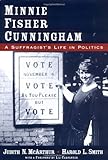
Judith N. McArthur, Harold L. Smith. Minnie Fisher Cunningham: A Suffragist's Life in Politics. New York: Oxford University Press, 2003. vii + 266 pp. $38.00 (cloth), ISBN 978-0-19-512215-2.
Reviewed by Yvonne Davis Frear (Department of History, Texas A&M University)
Published on H-Women (May, 2004)
An Indefatigable Activist
During the latter decades of the last century, the study of women's history became quite the cosmopolitan exercise. Scholars, academics, and laypersons were captivated by the history that lingered on the edges, and yet penetrated the integral interior themes of economics, culture, and politics. Judith N. McArthur and Harold L. Smith's excellently written and well-documented biography, Minnie Fisher Cunningham: A Suffragist's Life in Politics, exceeds the pre-defined edges and examines the many roles that a successful Texan, female, grassroots political activist performed from the Progressive Era to the feminist movement in the 1960s. McArthur and Smith contend that Cunningham's "story helps fill in the still-emerging narrative of women's political activism between the demise of the first women's movement after 1920 and the rebirth of feminism in the 1960s" (p. 6). According to the authors, Cunningham's life exemplifies how suffrage movement participation developed into left feminism and shifted conservative Texas politics into Texas liberalism.
McArthur and Smith argue that Cunningham's early interest in politics began in the late 1880s as she accompanied her father, Justice of Peace Horatio Fisher, to political meetings in Huntsville, Texas. Cunningham observed, even as a youngster, that grassroots organization and activism came in the form of rallies, parades, homegrown barbecues, and political oratory. Accordingly, she realized that women were omitted from the practice of "universal" suffrage, as men were the primary voting participants in this era of Populist politics (p. 16). The authors suggest that her early exposure to the inequities in politics and suffrage girded her for successful political activism campaigns as an adult.
Cunningham began her adult career of civic responsibility by joining a citywide organization, the Women's Health Protective Association (WHPA) in Galveston, Texas. The early Progressive Era activities of WHPA members centered on sanitization and beautification of the city after the Great Storm of 1900. Cunningham's membership in the WHPA propelled her into leadership action when she and other members organized a heavily publicized pure milk campaign that protested against dairy producers in Galveston for supplying spoiled milk. Their relentless protests, lobbying, and legal actions forced the city leaders to pass a pure milk ordinance. The success of the pure milk campaign weighed heavily on Cunningham, as she deduced that women were excluded from the very democratic process that could demand change in matters social and political.
The authors maintain that political success for Cunningham came after she founded the Galveston Equal Suffrage Association (GESA) and presided over the Texas Woman Suffrage Association (TWSA), that would later be renamed the Texas Equal Suffrage Association (TESA). Her involvement and leadership direction with GESA and TESA launched the political fervor and initiative that Cunningham needed to influence support for and passage of a Texas primary suffrage bill in 1918. On many occasions, Cunningham was beset with financial woes and inactive membership, but she continued to stress the importance of monetary support and political legwork as a means to woman's suffrage in Texas. Her ability to walk "a careful line between assertiveness and deference" allowed her to maintain an image of southern womanhood while manipulating the one-party political system in the Texas legislature into a "backstairs bargain" (p. 67).
Additional evidence of Cunningham's success as a grassroots activist is revealed in her roles as a Washington lobbyist for the National American Woman Suffrage Association (NAWSA), a chairperson for the Texas League of Women Voters (TLWV), and executive secretary for the national League of Women Voters (LWV). As a lobbyist, Cunningham negotiated and worked tirelessly for the ratification of the federal suffrage amendment. However, even after the passage of the amendment, Cunningham discovered that the right to the ballot was not synonymous with political equality or gender harmony. Her involvement with the League of Women Voters, both statewide and nationally, left her equally exhausted as she battled internally with "antisouthern snobbery" and black disfranchisement, and externally with her mother's failing health (p. 108).
Cunningham exhibited that she was the "very heart and soul of Texas liberalism" during the mid-1940s to the 1960s (p. 4). During this time span, she ran for governor of Texas, fought against the elite Democratic machine, the Texas Regulars, and actively spoke out against segregation. Cunningham valued democracy with a "little d" and believed that women were entitled to equal opportunity and participation in political life. McArthur and Smith inform readers that Cunningham advocated strengthening political liberalism because it was integral to women's opportunities and because liberals believed in democracy and "it is only in a democracy that women are regarded as people at all" (p. 186).
Although the book weaves a seamless tapestry of Cunningham's life as a suffragist, it is limiting in its discussion of her familial relationships during her periods of activism. Familial traditions often complement or interrupt the course of events in a person's life, so it would have been interesting to read any detailed correspondence or commentary between her spouse, siblings, or parents that might shed light on their reactions to her suffragist activity. The authors present a closely woven cadre of friendships and professional acquaintances over the years, which suggests a semblance of extended family. However, the limited detail regarding familial bonds almost makes Cunningham appear self-contained and isolated in areas that are not of a political nature.
In the contemporary context, alongside movies like Iron Jawed Angels, Minnie Fisher Cunningham: A Suffragist's Life in Politics serves as a welcome and substantive contribution to the study of women's political activism in the fight for state and federal suffrage laws. The authors have convincingly abandoned last century's cosmopolitan interests in women's history and embraced the twenty-first century challenge to educate readers about more than the "ideal Victorian woman" or "southern belle" by offering readers insight into the background of a female historical participant who was a pivotal strategist in state and national suffragist movements. Scholars will do well to continue investigating and publishing studies that illuminate the fundamental importance of women's grassroots political influence at the state and local levels as these two historians have done.
If there is additional discussion of this review, you may access it through the network, at: https://networks.h-net.org/h-women.
Citation:
Yvonne Davis Frear. Review of McArthur, Judith N.; Smith, Harold L., Minnie Fisher Cunningham: A Suffragist's Life in Politics.
H-Women, H-Net Reviews.
May, 2004.
URL: http://www.h-net.org/reviews/showrev.php?id=9387
Copyright © 2004 by H-Net, all rights reserved. H-Net permits the redistribution and reprinting of this work for nonprofit, educational purposes, with full and accurate attribution to the author, web location, date of publication, originating list, and H-Net: Humanities & Social Sciences Online. For any other proposed use, contact the Reviews editorial staff at hbooks@mail.h-net.org.

