



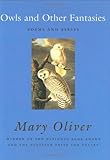
Mary Oliver. Owls and Other Fantasies: Poems and Essays. Boston: Beacon Press, 2003. 67 pp. $22.00 (cloth), ISBN 978-0-8070-6868-7.
Reviewed by Chris Holland (Independent Scholar)
Published on (May, 2004)
A Small Delight for Bird Lovers and Mary Oliver Fans
I've been carrying Mary Oliver's Owls and Other Fantasies with me recently as I care for a loved one with a serious illness, and have found it a most comfortable companion. It contains twenty-six poems, with ten previously uncollected (and a couple of previously unpublished) pieces, and two essays. The first essay, "Owls," was included in Blue Pastures (Harcourt, 1995) and appeared in The Best American Essays, 1996 (Robert Atwan, series editor). The second essay, "Bird," a moving tribute to an injured gull that Oliver and her longtime companion cared for until its death, is available nowhere else. In addition, the book is illustrated with lovely pencil drawings of feathers. The illustrator is uncredited.
The poems mark a sort of year's cycle, starting with the springtime migration of "Wild Geese" and ending back in that fecund season with "Long Afternoon at the Edge of Little Sister Pond," in which the speaker tells us, "As for life, / I'm humbled, / I'm without words / sufficient to say // how it has been hard as flint, / and soft as a spring pond, / both of these / and over and over" (p. 60). In a last poem, "Backyard," that serves as an afterword, a garden has been left to grow undisciplined and unattended: "Blackberries, ferns, leaves, litter / totally without direction management / supervision." It's a lovely grace note, leaving the reader with an image of a place both domestic and wild existing in a long, soft summer; the book ends with "The birds loved it" (p. 65).
A large part of Oliver's enduring appeal is her ability to convey the ecstatic engagement she feels with nature; the attentive reader of her poems may even experience something of the same feeling of transcendent union with the natural world, which she achieves by attending closely enough to enter imaginatively into it. For example, "The Dipper" describes that bird as seen by the speaker when she was a child: "I had to / bend forward, as it were, / into his frame of mind, catching / everything I could in the tone, // cadence, sweetness, and briskness / of his affirmative report" (p. 2). And again, in "Long Afternoon at the Edge of Little Sister Pond": "Every day I walk out into the world / to be dazzled, then to be reflective" (p. 60). Each poem in this little book reiterates that experience of "bending forward" to listen, of being dazzled, and reflective. The reader is invited to hear and reflect along with the speaker, to feel the dazzlement; and every time the experience is different, as particular as the individual birds being observed.
This book would make a lovely gift for a bird-loving friend or a good choice to introduce young students to Oliver's work. The poems are accessible and cover a range of the poet's abiding themes: that "the world is full of leaves and feathers, / and comfort, and instruction" (p. 3); that careful attention to other-than-human lives (in this case, bird lives) provides consolation for the heart, mind, and imagination in a world where death is a constant, looming presence like the owls that fly through several poems; the "pragmatic mysticism" explored by Laird Christensen in his essay in Ecopoetry, which is a pantheistic apprehension of the energy that fuels the cycles of life, death, and seasons in the world around us as holy mystery;[1] and the delights of listening to and translating into human language the feats of love and survival played out in these small lives.
One can (and I will) quibble with the raison d'etre of this collection. It breaks no new ground for the poet--more than half of its poems have been published in earlier books, and no obvious thematic or literary force drives its content beyond the idea of collecting poems and essays about birds. Oliver's most recent book of new poems, What Do We Know , appeared in 2002, and this handsome little book has the feeling of being "filler" until she has enough material for another book-length collection.
These objections notwithstanding, I've enjoyed the book and have turned to it for solace and distraction in emergency wards and hospital rooms. In "Singapore" (first published in House of Light, and not in this collection) Oliver writes, "A poem should always have birds in it."[2] Birds, for Oliver, embody the qualities of courage, playfulness, rhythm, and joy that seem to drive her poetry. At their best, these poems about birds evoke their subjects so precisely and with such affection that, for this reader at least, they create a space in the mind where the beauty and drama of the more-than-human world come alive.
Notes
[1]. Laird Christensen, "The Pragmatic Mysticism of Mary Oliver," in Ecopoetry: A Critical Introduction, ed. J. Scott Bryson (Salt Lake City: The University of Utah Press, 2002), pp. 135-152.
[2]. Mary Oliver, House of Light, reprint ed. (Boston: Beacon Press, 1992).
If there is additional discussion of this review, you may access it through the network, at: .
Citation:
Chris Holland. Review of Oliver, Mary, Owls and Other Fantasies: Poems and Essays.
H-Net Reviews.
May, 2004.
URL: http://www.h-net.org/reviews/showrev.php?id=9336
Copyright © 2004 by H-Net, all rights reserved. H-Net permits the redistribution and reprinting of this work for nonprofit, educational purposes, with full and accurate attribution to the author, web location, date of publication, originating list, and H-Net: Humanities & Social Sciences Online. For any other proposed use, contact the Reviews editorial staff at hbooks@mail.h-net.org.

