



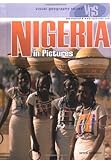
Janice Hamilton. Nigeria in Pictures (Visual Geography. Second Series). Minneapolis: Lerner Publications, 2003. 80 pp. $29.27 (cloth), ISBN 978-0-8225-0373-6.
Reviewed by Kunbi Oni (Independent Scholar)
Published on H-AfrTeach (May, 2004)
About My Country
Nigeria in Pictures does a good job of culling information and putting it together in a clear and accessible format. It offers a cross section of topics about the country--its land, people and places, culture, history, and economy--and is concise in its descriptions of the country's past, summarizing it all in a timeline at the end of the book. The text is generally laid out well and easy to read for its targeted audience. A feature that works well is dotting circles of highlighted text in the corner of a page. The circles direct students to facts that can be quickly read. Diversity within the Nigerian culture (ethnic groups, religion, and lifestyles) is also well communicated. My favorite feature of the book is its web-enhanced bibliography that provides additional ways to learn about the country.
Unfortunately the positive features of the book are marred by significant problems. Although the country's history is well written, contemporary life in Nigeria seems mostly sad and impoverished. The country certainly has a great deal of poverty, a lack of education, inadequate health care, and poor economic conditions, but these negative conditions need to be balanced with positive ways that readers can connect with Nigeria. Perhaps there was an attempt made on this last point where Hakeem Olajuwon (former National Basketball Association player) was listed in the famous people section, but it is too little in my opinion. Where culture is spoken of it comes across as rather flat, heavy on history, with little mind paid to contemporary life or how the more traditional life practices function today. Nigeria is multi-layered like any country, colorful, rich, and vibrant. None of this comes across in the book. Most conspicuously absent is the second Black and African Festival of Art and Culture (FESTAC '77). In 1977 when the festival was held in Nigeria, large numbers of people of African descent from all over the world gathered to celebrate their cultural heritage. Also missing is information on textile production and processing. Waxed prints, woven cloth, and dyed cottons form an important part of life, economically and culturally.
Based on the title, I expected to see far more pictures. Also there seems to be a presumption of prior knowledge. Many of the things written about are probably unfamiliar to most American students, who would not know what they look like, including the iroko tree, cocoa beans, cassava, mangrove crabs, and Nok sculpture. Including interesting facts that the reader could connect with is one of the ways readers could identify with the country.
Finally, the book reads like articles in a newspaper, a style that does not make it interesting, especially to its targeted age group. It is very much a dry textbook that is unlikely to be read outside a classroom. The book is appropriate for geography and social science classes, but there is enough left out of the book for me to give it an advisory rating (i.e., useful if the problem areas are avoided and gaps are supplemented with appropriate information).
If there is additional discussion of this review, you may access it through the network, at: https://networks.h-net.org/h-afrteach.
Citation:
Kunbi Oni. Review of Hamilton, Janice, Nigeria in Pictures (Visual Geography. Second Series).
H-AfrTeach, H-Net Reviews.
May, 2004.
URL: http://www.h-net.org/reviews/showrev.php?id=9320
Copyright © 2004 by H-Net, all rights reserved. H-Net permits the redistribution and reprinting of this work for nonprofit, educational purposes, with full and accurate attribution to the author, web location, date of publication, originating list, and H-Net: Humanities & Social Sciences Online. For any other proposed use, contact the Reviews editorial staff at hbooks@mail.h-net.org.

