



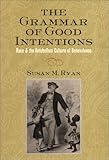
Susan M. Ryan. The Grammar of Good Intentions: Race and the Antebellum Culture of Benevolence. Ithaca: Cornell University Press, 2003. xii + 235 pp. $42.50 (cloth), ISBN 978-0-8014-3955-1.
Reviewed by A. James Fuller (Department of History, University of Indianapolis)
Published on H-CivWar (April, 2004)
A Complicated Grammar That Most Historians Will Not Use
This is not a book that most Civil War historians will want to read. A venture in literary criticism, The Grammar of Good Intentions presents a complex reading of benevolence literature in a nearly impenetrable style that will leave even the most dedicated reader exhausted from the daunting task of wading through pages of turgid prose. Furthermore, most subscribers to H-CivWar will find little of interest to them, as the book does not directly address the nation's greatest conflict or even its causes. Still, despite all of this, the book does offer fresh insights into the nature of antebellum reform and has implications for historical scholarship on that important subject.
Susan M. Ryan, an English professor at the University of Louisville, argues that far from being a monolithic "cult of benevolence," authors of the various types of benevolence literature were deeply involved in a complicated debate over the contested meaning of charity in American society. She asserts that antebellum white Americans were plagued by racial guilt and blinded by prejudices of class, race, gender, and ethnicity. These underlying tensions shaped the ways in which benevolence was understood and enacted. In the end, language became a means to reinforce cultural values, as terms like "blackness" and "foreignness" came to define the need for benevolence. While most charitable organizations focused on helping those of like color, even those efforts were influenced by race, as the poor were compared to slaves or the lack of success was blamed on a need to help end the oppression of slavery before whites could be helped. Thus, the world of reform was a messy place, filled with contested meaning and conflicting tensions. Even good intentions were infused with mixed motives and the resulting actions brought further ambivalence and conflict, as charity always implied power relationships between those who gave and those who received.
To support her claims, Ryan examines the literature of benevolence, including works on the subject of Indian Removal, fiction by Herman Melville, and pamphlets dedicated to the education of emancipated slaves. She also delves into Harriet Beecher Stowe's antislavery novels and the Emersonian ideal of self-reliance. Ryan finds that the language of benevolence was used to support the violent removal of Native Americans from their tribal lands. This idea of removal as a reform movement will come as no surprise to historians of the period, but scholars interested in Indian removal will do well to peruse Ryan's demonstration of how the policy was couched in the vocabulary of doing good. Similarly, many historians will not be surprised to find that supporters of benevolence often racialized and sexualized their arguments in ways that reflected an inner ambivalence over whether or not charity was, indeed, a good thing. Many white Americans feared that those who claimed to be in need were duping them. Others worried that helping an Indian or African American might lead to the destruction of their own families or the degradation of white women at the hands of a male of a different race. Meanwhile, the era's fascination with Emerson's idea of self-reliance meant that Americans held independence as a moral good. A man had not only to make a living, he also had to be morally and socially mature. In the decades before the Civil War, Ryan argues, blacks were seen as a group that was incapable of self-reliance, while whites were expected to be self-reliant. The answer for poor white men, then, was self-help. But many white reformers thought that black men were part of a race that needed mutual aid. For many, benevolence meant encouraging self-reliance through education and correction. At the same time, though, the very idea of teaching blacks to be self-reliant took on a "monstrous quality" in "whites' imaginations" (p. 93).
Her last chapter and epilogue are the most interesting parts of Ryan's book. The final chapter, "Save Us From Our Friends," is dedicated to free African Americans' views on benevolence. Here we find more analysis of a theme that is a touchstone throughout the volume: the impact of benevolence on those who receive it. Ryan argues that free blacks were also conflicted over "the theory and practice of benevolence" and engaged in a heated conversation about it (p. 164). Some were grateful for white help, but argued that justice would serve African Americans better than charity. Others pushed for intraracial aid that would allow blacks to help blacks. Most free African Americans supported some sort of benevolence as an ideal, but "rejected its infantilizing or coercive elements" (p. 164). From this debate within the free black community came arguments over how to proceed--should African Americans work for good in the United States or should they try to establish separate communities elsewhere? This issue brought forward ideas that had been proposed in regard to colonization and foreshadowed later "Back to Africa" movements, but most writers in the free black community wanted African Americans to remain in the United States and work for change as citizens. In her epilogue, Ryan links her reading of antebellum benevolence to contemporary debates over welfare, compassionate conservatism, and going to war in the name of doing good. This serves as a timely reminder that studying the past informs the present and that the complexity of our national identity is not a new problem.
Ryan, then, offers a fresh interpretation of reform in the early nineteenth century. Her analysis balances the power of elites with the agency of the downtrodden through a dialogic reading of texts. In this view, nothing remains simple, as race, class, gender, and ethnicity all intertwine in a complex mix of self-interest and genuine desires to help others. Although she does refer to religion, it is possible she has missed the important element of faith in benevolence by relegating it to a rather simplistic "pan-Protestantism" that ignores the full power of Christian charity and the ways in which different kinds of Christians interpret that concept. It might also go a long way toward resolving the problem of determining what people in the past actually thought and believed, a matter which Ryan herself posits as a dilemma (p. 4). Despite this, scholars of reform will find this a provocative volume and may pick and choose among the various chapters for arguments with which to agree or contend. Intellectual and cultural historians may also find it useful. But The Grammar of Good Intentions is too esoteric for a broader audience and the vast majority of scholars and students of the Civil War would not want or need to read it.
If there is additional discussion of this review, you may access it through the network, at: https://networks.h-net.org/h-civwar.
Citation:
A. James Fuller. Review of Ryan, Susan M., The Grammar of Good Intentions: Race and the Antebellum Culture of Benevolence.
H-CivWar, H-Net Reviews.
April, 2004.
URL: http://www.h-net.org/reviews/showrev.php?id=9236
Copyright © 2004 by H-Net, all rights reserved. H-Net permits the redistribution and reprinting of this work for nonprofit, educational purposes, with full and accurate attribution to the author, web location, date of publication, originating list, and H-Net: Humanities & Social Sciences Online. For any other proposed use, contact the Reviews editorial staff at hbooks@mail.h-net.org.

