



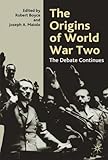
Robert Boyce, Joseph A. Maiolo, eds. The Origins of World War Two: The Debate Continues. New York: Palgrave Macmillan, 2003. vii + 397 pp. $100.00 (cloth), ISBN 978-0-333-94526-1; $33.95 (paper), ISBN 978-0-333-94539-1.
Reviewed by David J. Ulbrich (Department of History, Temple University)
Published on H-War (April, 2004)
Clarifying the Long- and Short-Term Causes of World War II
Clarifying the Long- and Short-Term Causes of World War II
In The Origins of World War Two: The Debate Continues, Robert Boyce and Joseph A. Maiolo bring together distinguished scholars to discuss the causes of the Second World War. The editors believe that it is too simple to blame the entry of the United States into the conflict merely on the Japanese attack on Pearl Harbor or to argue that appeasement of Adolf Hitler was a sufficient cause for war in Europe. The reality was much more complex. This anthology draws the historiographical map using two approaches: national studies and thematic studies.
The chapters in part 1 of this book focus on the major and minor powers that became involved in the Second World War.
The chapters on Germany and Italy reject previous interpretations holding that these powers reacted to developments in the international arena. Instead, Christian Leitz and John Gooch respectively show that Hitler and Mussolini long possessed ambitious plans for territorial expansion. Hitler added a diabolical racist twist to his plan for domination of Western Europe; his plan succeeded until 1941 because of his shrewd diplomacy and other nations' errors. Mussolini, for his part, exercised a remarkable level of flexibility as he maneuvered to extract the best position for Italy in European affairs. Both nations, however, suffered from serious internal weaknesses which hurt their warmaking capabilities once the conflict started.
Japan is expertly discussed by Antony Best. He brings the historiographical debate about the origins of the Second World War in Asia up to date. No more can Japan's high-ranking militarist clique be solely blamed for starting the war. Nor can the attack on Pearl Harbor be treated as resulting from American and Japanese competition. Best seeks to place Japan into technological and geographical contexts. He believes that many problems were caused because Japan had been "wrestling with the effects of late industrialization and the tensions created by the modernization process" (p. 53). Expansion in Asia occurred because of a thirst for raw materials and because of opportunities in those regions. After completing their conquests, the Japanese wished to recast their nation as an autarky. Its leaders expected that a short war with China in the late 1930s would yield that nation's resources with little cost. Chinese communism also needed to be contained. However, according to Best, "Japan found itself trapped in a conflagration from which it could not escape" (p. 66). Likewise, the Japanese hoped to move into Southeast Asia with little trouble because of declining European influence in that region. Instead, Japan increasingly aroused the ire of the United States which in turn led to embargoes and eventually the attack on Pearl Harbor.
Jonathan G. Haslam addresses the enigmatic Soviet Union and the problematic Spanish Civil War in his chapter. Insuring the survival of the Soviet Union stood as a major goal for Josef Stalin in the late 1920s and 1930s. Towards that goal, Stalin worked to increase Soviet industrial and military capabilities. His ideology doubtlessly helped to shape his attitudes of fear and hatred for Nazism and thus made him participate in the Spanish Civil War. Yet, the same Stalin would later shrewdly join with Hitler in the Nazi-Soviet Non-Aggression Pact because the English and French were too slow to oppose Germany.
Peter Jackson and Williamson Murray examine France and Britain in their respective chapters. These two so-called status quo powers worked to maintain peace and stability in Europe. The leaders of both nations desired to use multilateralism rather than realpolitik to avoid future conflicts. Yet, those same leaders were limited by particular assumptions, ideas, and perceptions. Both nations retained horrific images of trench warfare in their public memories. Such a world view meant that neither France nor Britain directly challenged Hitler's Germany until it was too late. As much as anything else, Jackson and Murray show that Edouard Daladier and Neville Chamberlain lacked the distance or objectivity with which to interpret actions by Germany, Italy, or Japan.
According to Warren F. Kimball in his chapter, the United States remained locked in a Wilsonian mindset throughout the interwar period. The mindset embodied by the Treaty of Versailles and the League of Nations contained two fatal expectations: a single global system, and equality among nations. If the problems caused by the Great Depression are added into the mix, the isolationism of the United States can be understood. For Kimball American isolationism needs clarification; it aimed to avoid entangling alliances but still strongly affect global politics and economics. He also denies the common historical argument that American isolationism played a major role in starting the Second World War; he puts the responsibility on German and Japanese aggression combined with French and British timidity. Nevertheless, Kimball points out, Franklin D. Roosevelt certainly did recognize the increasing dangers to peace in Europe and Asia. He wanted to protect democracy, "the code word for American political liberty and economic opportunity" (p. 139). Roosevelt cleverly modified American neutrality to allow expanded assistance to Britain, most critically after the fall of France in 1940. He hoped to keep the United States out of the European conflict while preventing Germany from winning that war. Simultaneously, he tried to deter Japanese expansion in Asia, based on the assumption that they would not wish to fight the superior United States. This assumption about Japan turned out to be disastrously incorrect.
The chapters on the small powers share several similarities. Poland, Czechoslovakia, China, and various neutral nations exerted more agency and independence of action than is often presented in histories. None were helpless victims who lacked foresight and succumbed to overbearing neighbors. For example, Poland, in Anita J. Prazmowska's chapter, possessed a complex foreign policy which was driven by a need to find allies. France and Britain waited until 1939, when it was too late, to offer concrete support to the Poles. For Igor Lukes, Czechoslovakia maintained a sizable military force yet failed to reach out to other nations in Europe. In fact, during the 1920s and early 1930s, Czechoslovakians feared Austria and Hungary more than Germany. Having allowed itself to become isolated, Czechoslovakia made an easy mark for Hitler. According to John W. Garver, a weak and divided China contributed to Japanese-American conflict. Chinese leaders attempted to play the great powers off against one another, and they tried to organize a coalition against Japan. All these schemes failed by 1937, but the Chinese nonetheless showed amazing tenacity in resisting Japanese invaders; indeed, as Garver concludes, Japan became "bogged down in an open-ended, costly and essentially unwinnable war" in China (p. 194). Other neutral nations such as Belgium also possessed agency, despite being targets of the great powers. Yet, as Neville Wylie reveals, the neutrals remained on shaky ground. The First World War had ruined the concept of neutrality because Germany had invaded Belgium in 1914. Likewise, collective security as espoused in the Treaty of Versailles also undermined neutrality as an option because no nation could remain truly aloof in a war of aggression.
In part 2 of the book, titled "Themes," the contributors explore how various topics factored into starting the Second World War.
Robert Jervis employs methodologies from international relations and political science to help illuminate the years before the Second World War. As a political scientist, he is concerned with finding a model that accurately represents international behavior and then applying the 1930s to that model. He tracks the ways in which those pre-war years might fit into the international systems model, the domestic sources of foreign policy model, and the decision-making model. All have virtues in helpful analysis. The first model shows that realpolitik motivates nations; the second model points to the unique government or societal structures as possible factors in foreign policies; and the last model speaks to the need to analyze personality, perception, and beliefs of the national leaders. Ultimately, Jervis admits that political science offers no single explanation about why the Second World War started. He does, however, believe the model and perspectives can be useful in analyzing the historical record.
In a chapter on "Peace Movements," P. M. H. Bell focuses on anti-war tendencies in Britain and France between the world wars. People in both nations became disillusioned by war following the slaughter of 1914-1918. Too many British and French men had fallen. Reactions took two forms: a pacifism in which all wars were seen as immoral, and a peace-minded internationalism in which wars were seen as catastrophes to be avoided. While minorities in France and Britain embraced pacifism, most tried to avoid war by finding alternatives to it. Britain's Neville Chamberlain, for example, tried to appease Germany's Adolf Hitler in hopes of satisfying him. Bell traces the development of peace movements until 1939 when the conflict started. Many anti-war elements in France and Britain then rallied around their flags in nationalistic fervor.
Philip M. Taylor's chapter on propaganda illuminates an interesting topic. In a matter-of-fact tone, he reveals that both dictatorships and democracies employed propaganda to their respective advantages. Soviet, German, and Italian regimes usurped control of media and embarked on a calculated campaign to ensure domestic support or international sympathy. British and French regimes also utilized propaganda, albeit in a more benign way, to persuade their citizens to support government policies and to fear other nations. For example, the British government used publicity to promote its policy of appeasement as an alternative to realpolitik. Chamberlain, for example, was publicly heralded as the "peacemaker" after Munich in 1938. Once the conflict started, propaganda served as a significant means of maintaining popular support for total war efforts.
The several remaining chapters offer useful insights on different themes. Alan Cassels outlines how ideologies served as mental frameworks that helped determine perceptions and actions of various leaders and nations. Robert Boyce addresses economics as a factor in Germany's and Japan's territorial expansions during the Great Depression and the United States's, Britain's, and France's failures to resist them until too late. He expands economics to include industrial mobilization. Joseph A. Maiolo delves into a related topic in his chapter on arms competition as a possible precipitant for the Second World War. He finds that Japan and Germany moved too quickly toward war, whereas France, the United States, and Britain moved too slowly. In both cases, preparations and doctrines did not always keep pace with new armaments. Nor could they be applied in reality on the battlefield. In his chapter, John Ferris argues that gathering and analysis of intelligence were colored by various national, psychological, and ideological assumptions. Moreover, tracing the impact of intelligence on decision-making can be problematic because of hindsight. Ferris concludes that all military and political leaders made mistakes regarding analysis of intelligence; their failures helped create the volatile environment in which the conflict erupted. Donald Cameron Watt covers the diplomatic causes for the Second World War, a more traditional theme with a large body of historiography. He surprises the reader, though, by showing that the First World War had severely limited the effectiveness of career diplomats--"diplomatists" as Watt calls them. This in turn largely removed their expertise from the diplomatic process. Instead, political leaders like Chamberlain, Stalin, or Roosevelt carried on personal diplomacy with other leaders, either directly or through close associates.
There is much to praise about this anthology edited by Boyce and Maiolo. Almost every chapter includes extensive endnotes drawing on sources in multiple languages. Scholars and students alike can learn much from reading this volume. If it does not contain much that will surprise scholars studying the period, the essays nonetheless present a clear snapshot of the historiographical and historical contexts of the years leading up to the Second World War.
If there is additional discussion of this review, you may access it through the network, at: https://networks.h-net.org/h-war.
Citation:
David J. Ulbrich. Review of Boyce, Robert; Maiolo, Joseph A., eds., The Origins of World War Two: The Debate Continues.
H-War, H-Net Reviews.
April, 2004.
URL: http://www.h-net.org/reviews/showrev.php?id=9181
Copyright © 2004 by H-Net, all rights reserved. H-Net permits the redistribution and reprinting of this work for nonprofit, educational purposes, with full and accurate attribution to the author, web location, date of publication, originating list, and H-Net: Humanities & Social Sciences Online. For any other proposed use, contact the Reviews editorial staff at hbooks@mail.h-net.org.

