



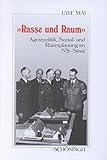
Uwe Mai. Rasse und Raum: Agrarpolitik, Sozial- und Raumplanung im NS-Staat. Paderborn: Ferdinand Schöningh Verlag, 2002. 445 S. (gebunden), ISBN 978-3-506-77514-6.
Reviewed by Gesine Gerhard (History Department, University of the Pacific)
Published on H-German (March, 2004)
Mai's book is a ground-breaking study of the connection between Nazi racial ideology, agrarian policy, and regional planning, both within the borders of the "Old Reich" and in the newly occupied territories in the East. The concept of "Rasse und Raum"--race and space or territory--provided the ideological background for an expansive and murderous policy until the end of the war. The plan built on the ideology of "Blood and Soil" that idealized the rural population as the healthy and racial backbone of the German people. German peasants were regarded as the potential future elite of the envisioned new German Reich. Mai argues that this approach was closely linked with and tied into the larger plan of territorial conquest and the settlement of Germans in the occupied lands. Throughout the war, the plan became more radical. With the need for a much larger number of German settlers in the conquered territories, Nazi settlement policy turned into a "global plan" that included Germans from overseas, and other Germanic or "Nordic" peoples. "Positive" demographic policies were combined with "negative" measures that meant the expulsion and killing of people who were regarded as racially inferior. In this way, agrarian policy and regional planning became linked to and fed into the annihilation of millions of non-Germans.
Mai looks at the origins of the policy of rural settlement. Already during the German Empire, peasants were used for political goals. First, peasants were regarded as a conservative barrier that could slow the process of modernization and its alleged negative effects. By the 1930s, peasants had become the "carriers of social and racial qualities" invaluable for the future of the German people. During the Weimar Republic, "inner colonization" and settlement programs for the eastern borders were promoted. The Nazis, once in power, expanded the racial component of the policy of rural settlement. Settlers were to be selected following strict racial criteria and their presence in regions along the Reich's borders was supposed to "Germanize" the areas. It was the achievement of the agrarian expert Richard Walter Darre to mold these ideas into an elaborate plan to "breed" a future German elite from the best peasant blood. Legislation followed that regulated land inheritance and ownership to implement these goals.
Hitler never developed a strong agrarian program, but his interest in agriculture was sparked by Darre's ideas. Darre's meteoric career within the Nazi elite shows the potential that Hitler saw in this agrarian vision for the implementation of his goals. Six months after the Nazis had come to power, Darre served as the Reichsminister of Food and Agriculture, Director of the Reich and Settlement Office (RuSHA), Reich Peasant Leader and head of the Reich Food Estate (RNS). Despite the enormous administrative apparatus at his disposal, Darre was unable to implement his racial plan. According to Mai, Darre failed not because of a lack of support or because of his estrangement from Hitler and Himmler--as it has often been portrayed in historical interpretations. Darre was unable to introduce far-reaching agrarian reform because of the contradictions inherent in his agrarian policy. Germans were reluctant to settle in new areas and local leaders cared more about economic developments in their respective regions than about national interests. Mai's case studies in the areas of Thuringia or Saxony, in the Saar region and Lorraine illuminate the conflicts between local leaders and central Reich institutions that hindered the realization of Darre's plan.
Mai emphasizes that despite his difficulties, Darre did not lose any power until 1939. On the contrary, he was in charge of desperately needed German settlers, a responsibility that strengthened his position and made him invaluable to Hitler and Himmler. Mai argues that the enfolding conflict between Darre and Himmler should not be interpreted in light of Darre's dismissal in 1942, as most studies have done.[1] Following Darre's own defense in the war crime trials after 1945, some of these interpretations apologetically describe Darre as an outsider and romantic idealist within the Nazi elite, who lost his power when the preparation for war made economic planning a priority after 1936.[2] Mai argues strongly that the actual conflict was not about Darre's alleged romantic understanding of peasants. Himmler and Darre had different visions for the future of a German Reich and the role settlement played for this scheme. Himmler envisioned the establishment of a large German Reich, that over the next five hundred years would consist of six hundred million racially pure Germans. In order to realize his plan, Himmler was willing and determined to expel and kill millions of non-Germans in the occupied areas. Darre's priority, on the other hand, was rural settlement and the reorganization of rural areas in the existing German Reich. Through his racial policies he wanted to create a rural elite. Territorial expansion was certainly part of this vision, but it was not the primary goal.
Himmler and Darre split over the implementation of their respective settlement policies, and both fought for increased influence. During the first years of the war, Himmler was able to win this battle and he was put in charge of occupation and settlement policies in the occupied territories. Agrarian policy became part of large-scale regional planning and spatial politics for a pan-German Reich. Darre did not lose his power yet, but his position was weakened by Himmler's increased responsibilities. Until Darre's "retirement" in 1942, when Herbert Backe, the long-serving food expert in Darre's administration, replaced his former boss, Darre continued to interfere with and influence Himmler's policies. Darre's replacement was a sign of the decision to prioritize the creation of a larger German Reich over agrarian reform and settlement.
Mai's book (based on his 1998 dissertation submitted at the Technische Universitaet in Berlin) is carefully researched and convincingly argued. His claim that scientists complied with the Nazi state because of personal career motives, ideological convictions or personal empowerment is intriguing but could be analyzed further.[3] Overall, Mai's conclusions challenge existing interpretations of agrarian policy in the Third Reich. His interpretation of a large number of primary documents sheds new light on the connection between rural settlement, agrarian reform and occupation policy during the Nazi period. While the general audience and students of Nazi Germany might be less fascinated with the details of the struggle over agrarian policy, the book is essential for historians of the Nazi era. Mai's book will enrich the understanding of the workings of the Nazi power structure and revise existing perceptions of the role agrarian policies played in the Third Reich.
Notes
[1]. The best studies of R. W. Darre and Nazi agrarian policies are Gustavo Corni and Herbert Gies' "Blut und Boden": Rassenideologie und Agrarpolitik im Staat Hitlers (Idstein: Schulz-Kirchner Verlag, 1994) and Brot--Butter--Kanonen. Die Ernaehrungswirtschaft in Deutschland unter der Diktatur Hitlers (Berlin: Akademie Verlag, 1997).
[2]. Anna Bramwell, Blood and Soil: Richard Walther Darre and Hitler's "Green Party" (Abbotsbrook: Kensal Press, 1985).
[3]. Susanne Heim's Kalorien, Kautschuk, Karrieren. Pflanzenzuechtung und landwirtschaftliche Forschung in Kaiser-Wilhelm-Instituten 1933-1945 (Goettingen: Wallstein Verlag, 2003) is an insightful study of the cooperation between agrarian scientists and the Nazi state.
Copyright (c) 2004 by H-Net, all rights reserved. H-Net permits the redistribution and reprinting of this work for nonprofit, educational purposes, with full and accurate attribution to the author, web location, date of publication, originating list, and H-Net: Humanities & Social Sciences Online. For other uses contact the Reviews editorial staff: hbooks@mail.h-net.msu.edu.
If there is additional discussion of this review, you may access it through the network, at: https://networks.h-net.org/h-german.
Citation:
Gesine Gerhard. Review of Mai, Uwe, Rasse und Raum: Agrarpolitik, Sozial- und Raumplanung im NS-Staat.
H-German, H-Net Reviews.
March, 2004.
URL: http://www.h-net.org/reviews/showrev.php?id=9010
Copyright © 2004 by H-Net, all rights reserved. H-Net permits the redistribution and reprinting of this work for nonprofit, educational purposes, with full and accurate attribution to the author, web location, date of publication, originating list, and H-Net: Humanities & Social Sciences Online. For any other proposed use, contact the Reviews editorial staff at hbooks@mail.h-net.org.

