



Zeev W. Mankowitz. Life between Memory and Hope: The Survivors of the Holocaust in Occupied Germany (Studies in the Social and Cultural History of Modern Warfare). New York: Cambridge University Press, 2002. xii + 335 pp. $48.00 (cloth), ISBN 978-0-521-81105-7.
Reviewed by Michael Berkowitz (Department of Hebrew and Jewish Studies, University College London)
Published on H-German (March, 2004)
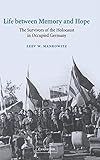
At first glance it might appear that Zeev W. Mankowitz has veered in the direction of hagiography in his study of Holocaust survivors in the American zone of postwar Germany. The front cover shows a group beneath Zionist flags, mainly women with baby carriages. We have survived, we have persisted, we will carry on, it seems to say. But the photograph, like this book, is more complex. The picture is not of a celebration, but rather a protest, directed at gaining the right to emigrate to Palestine. Still, there are sentiments of personal and national pride evoked--as fits the subject. There is little doubt that Mankowitz analyzes the "She-erith Hapleitah" (surviving remnant) of European Jewry with profound empathy. His study, however, is a rigorous, judicious, and nuanced analysis of a dimension of the Holocaust that receives sparse attention in comparison to the attempted annihilation of Europe's Jews. He investigates a devastated community in the throes of recovery, transition, and mourning for lost loved ones and a vanished world. On the one hand the "surviving remnant" was scarred and still persecuted by those who had tried to murder them. Although nearly everyone in postwar Germany participated in the "black market" to some degree, Jews were singled out for allegedly having instigated and reaping exorbitant profits from the ubiquitous (and essential) dealing beyond the law. Although blatant racism was discredited, it was still possible, and even good form in many circles, to decry a Jewish menace in Germany and worldwide. The Jews in Germany, however, had to struggle ardently simply to survive, as well as to comply with the occupation forces and Jewish organizations that belatedly arrived on the scene. The "surviving remnant" was animated mainly as a self-defined "community of memory," hoping that they would be able to re-create their lives in a new land. But even before reaching Palestine or the United States, they showed remarkable resourcefulness and strength of will by organizing newspapers, schools, clinics, libraries, institutions guaranteeing the rule of law and order, and concern for aesthetic sensibilities, while forging themselves into a community with some control over their fate.
Works in post-World War II German history rarely grapple with the fact that in addition to the problems of memory and accountability vis-a-vis the Nazis' Jewish victims, there were real, live Jews to deal with in Germany, and their ranks swelled considerably in the few years after the war. Originally the DPs ("Displaced Persons") were survivors of the camps, and after mid-1946, they were joined by those repatriated from the Soviet Union to Poland. With Polish and Hungarian Jews in the majority, they numbered around 250,000 in 1947, and by that point were centered in Germany. Thousands of survivors, whether they eventually landed in Israel (before 1948, Palestine), the United States, or elsewhere, spent periods from several days to several years in DP camps, or else lived on their own as DPs in German cities and towns. Although a number of scholars, including Yehuda Bauer, Michael Marrus, Leonard Dinnerstein, Mark Wyman, Angelika Eder, Jael Geis, and Angelika Königseder and Juliane Wetzel have produced important studies of the DPs, Mankowitz is one of the few scholars of the current generation (not being a survivor or "liberator" himself) to approach the subject mainly from the perspective of the survivors.[1]
Contrasting his study with another recent book on the "surviving remnant" by Idith Zertal, Mankowitz argues that despite their impairments and severely limited political clout, their existence was marked by a number of attempts to radically reconstruct their individual, communal, and national bodies and minds. They were not unwitting pawns in Zionist politics to the extent as construed by Zertal, according to Mankowitz.[2]
Beginning with an "overview" of "the occupation of Germany and suvivors," Mankowitz goes on to discuss the establishment of the She'erith Hapleitah as a political, social, and cultural body from the winter of 1944 to the summer of 1945. He then traces the attempt of the organization to engage world politics in July-October 1945 followed by activities directly related to rallying survivors under the banner of Zionism and gaining admission to Palestine from September 1945 to January 1946. Mankowitz vividly reconstructs the effort to forge a consensus, as well as the articulation of dissenting opinions and options, and specifically details the work of "the Central Committee of the Liberated Jews in Bavaria" and the educational endeavors of the She'erith Hapleitah. He further addresses the politicization of schooling and vocational training, the specific visions, apprehensions, and contributions of Rudolf Valsonok and Samuel Gringauz, and the attempts to memorialize the destroyed communities. The final chapters discuss the strained relations with their reluctant German host community and complicated tensions with the U.S. Army, and last, the growing orientation of survivors toward imagining and preparing themselves to join the Jewish community in Palestine, under the auspices of the Zionist movement.
In exploring each of these topics, the greatest strength of Mankowitz's research is his use of publications and accounts in Yiddish. Although Jewish survivors knew a vast number of languages between them, speaking and writing in Yiddish--the mother tongue, or mame-loshn of most of the murdered--was prized as a symbolic, defiant act. Hebrew, vital in the Zionist project and the language in which many memoirs and later scholarship was (and is) written, often was used in demonstrations and drills, and also held tremendous symbolic value. Memoirs and newspaper accounts are complemented by a huge array of documents that Mankowitz uncovered in Yad Vashem and several other archives in Israel, Europe, and the United States. His book will be the authoritative study for many years to come.
There are, however, a few points which merit further consideration. Because much of the research for this book apparently was conducted some years ago, Mankowitz has not fully used the rich resources of the Archives of the U.S. Holocaust Memorial Museum, open since 1993, which contains hundreds of memoirs and a huge range of documents pertinent to his study. Had he consulted these, he might have modified somewhat his argument concerning the dominance of Zionist ideology among survivors. The myths of the United States competed with those of the Holy Land in the imagination of many in the She'erith Hapleitah. Perhaps more important, Mankowitz might have paid more attention to the fluctuation of the population in the American zone, especially in the wake of the Kielce pogrom in 1946, which prompted thousands of Jews to flee Poland. Those with Communist or Bundist sympathies may have been accorded greater voice. Although briefly mentioned, the German Jews who came out of hiding or survived the camps might have been better incorporated into the study, as some, such as Erwin Tichauer--seen in the famous photograph with General Eisenhower at Feldafing--had crucial roles in the She'erith Hapleitah.[3] Last, although his intention to restore the agency of the survivors is deftly conceived, Mankowitz might have given more thought to the impact of the U.S. Army, especially the Jewish chaplains in their service, as their role in the life of survivors was far from negligible.[4] The extensive archive of Rabbi Philip S. Bernstein, the second advisor to the U.S. occupation forces on Jewish affairs, is now well-catalogued at the University of Rochester.
However much there is ample room for investigation of discrete topics beyond those addressed by Mankowitz, Life between Memory and Hope is a compelling achievement that will enrich immeasurably our comprehension of the Holocaust and its aftermath. It is vital for understanding not only the Holocaust, but also postwar Europe--as the DP phenomenon was far from short-lived--and the complex relationship between Europe, Palestine, and modern Israel. All too often the connection between the Holocaust and the State of Israel is expressed in the form of cliches (sympathetic or hostile to Zionism), but rarely has the experience of the survivors themselves been fully examined by scholars in this context. Mankowitz's book is virtually in a class of its own, and scholars of German and European history, as well as Jewish and Middle Eastern history, are certain to be enlightened by it.[5]
Notes
[1]. Yehuda Bauer, Out of the Ashes: The Impact of American Jews on Post-Holocaust European Jewry (Oxford: Permagon Press, 1988); Leonard Dinnerstein, America and the Survivors of the Holocaust (New York: Columbia University Press, 1982); Michael Marrus, The Unwanted: European Refugees in the Twentieth Century (New York and Oxford: Oxford University Press, 1985); Mark Wyman, DPs: Europe's Displaced Persons, 1945-1951 (Ithaca: Cornell University Press, 1998); Angelika Eder, Fluechtige Heimat: juedische displaced Persons in Landsberg am Lech 1945 bis 1950 (Munich: Kommissionsverlag UNI-Druck, 1998); Jael Geis, Uebrig sein--Leben "danach." Juden deutscher Herkunft in der britischen und amerikanischen Zone Deutschlands 1945-1949 (Berlin u.a.: Philo Verlagsgesellschaft, 2000); and, Angelika Koenigseder and Juliane Wetzel, Waiting for Hope: Jewish Displaced Persons in Post-World War II Germany (Evanston: Northwestern University Press, 2001).
[2]. Idith Zertal, From Catastrophe to Power: Holocaust Survivors and the Emergence of Israel (Berkeley: University of California Press, 1998).
[3]. Leo W. Schwarz, The Redeemers: Saga of the Years 1945 to 1952 (New York: Farrar, Straus & Young, 1953), pp. 181-182.
[4]. Joseph Bendersky, The "Jewish Threat": Anti-semitic Politics of the U.S. Army (New York: Basic Books, 2000); Alex Grobman, Rekindling the Flame: American Jewish Chaplains and the Survivors of European Jewry, 1944-1948 (Detroit: Wayne State University Press, 1993). See also the iconoclastic account of Abraham J. Klausner, A Letter to My Children, from the Edge of the Holocaust (San Francisco: Holocaust Center of Northern California, 2002); Philip S. Bernstein, Rabbis at War: The CANRA Story (Waltham, MA: American Jewish Historical Society, 1971); and Abraham S. Hyman, The Undefeated (Jerusalem: Gefen, and Hewlett; NY: Gefen, 1993). Also see Robert L. Hilliard, Surviving the Americans: The Continued Struggle of the Jews after Liberation: A Memoir (New York: Seven Stories Press, 1997).
[5]. On Jewish DPs in the British zone, see the outstanding work of Hagit Lavsky, New Beginnings: Holocaust Survivors in Bergen-Belsen and the British Zone in Germany, 1945-1950 (Detroit: Wayne State University Press, 2002).
Copyright (c) 2004 by H-Net, all rights reserved. H-Net permits the redistribution and reprinting of this work for nonprofit, educational purposes, with full and accurate attribution to the author, web location, date of publication, originating list, and H-Net: Humanities & Social Sciences Online. For other uses contact the Reviews editorial staff: hbooks@mail.h-net.msu.edu.
If there is additional discussion of this review, you may access it through the network, at: https://networks.h-net.org/h-german.
Citation:
Michael Berkowitz. Review of Mankowitz, Zeev W., Life between Memory and Hope: The Survivors of the Holocaust in Occupied Germany (Studies in the Social and Cultural History of Modern Warfare).
H-German, H-Net Reviews.
March, 2004.
URL: http://www.h-net.org/reviews/showrev.php?id=8979
Copyright © 2004 by H-Net, all rights reserved. H-Net permits the redistribution and reprinting of this work for nonprofit, educational purposes, with full and accurate attribution to the author, web location, date of publication, originating list, and H-Net: Humanities & Social Sciences Online. For any other proposed use, contact the Reviews editorial staff at hbooks@mail.h-net.org.

