



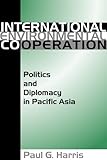
Paul G. Harris, ed. International Environmental Cooperation: Politics and Diplomacy in Pacific Asia. Boulder: University Press of Colorado, 2002. xiii + 320 pp. $29.95 (cloth), ISBN 978-0-87081-678-9.
Reviewed by Gregory J. Dehler (Front Range Community College)
Published on H-Diplo (January, 2004)
Environmental Cooperation in Asia
Environmental Cooperation in Asia
In January 1997 satellites first detected fires in the forests of Indonesia. By May the fires had grown in size and number thanks to dry conditions and heat provided by the El Nino effect. The Indonesian fires continued to burn throughout 1997 and into 1998. It was a regional ecological disaster. Over 200 million people were affected as the smoke drifted over the Philippines, Thailand, Singapore, and Malaysia. Those with acute respiratory ailments were hospitalized, schools and businesses closed. The total cost of between $8 and $10 billion, as estimated by the World Bank, exceeded the combined financial damage resulting from the Exxon Valdez and Bhopal disasters. It is estimated that there were over 500 deaths; 234 alone came when an Indonesian airplane crashed in the smoke. It was a tricky international situation, and it did not help matters that most of the fires had been set deliberately by Indonesian timber companies with close political ties to the government. What could be done? The International Monetary Fund (IMF) tied a $43 billion bail-out package for Indonesia to reform in forestry practices, but little else was done.
The Indonesia forest fires are one example of how trans-national environmental policies and natural resource use are affecting the security of the region. There are many other examples of conflict in the thirteen essays that make up International Environmental Cooperation: Politics and Diplomacy in Pacific Asia, edited by Paul Harris, professor of politics at Lingnan University in Hong Kong and director of the Project on Environmental Change and Foreign Policy. Harris's introduction is chapter 1.
Six essays, or chapters, make up part 1 of International Environmental Cooperation, entitled "Issues, Themes, and Actors in International Environmental Cooperation." In chapter 2 Lorraine Elliott takes on the issue of "Environmental Security in East Asia." Although ecological issues tend to be ignored in national security circles, Elliott argues that the environmental component needs to be addressed. Although the odds of environmental differences leading directly to war are remote, ecological scarcity and natural resource depletion cause insecurity among the state and its population and instability which dramatically increases other tensions in the region. In the third chapter Paul Harris examines the role of the United States in "Environmental Security, International Cooperation, and United States Foreign Policy toward North East Asia." Harris concludes that there is a big role for the United States to play in the environmental diplomacy of the region. Harris is optimistic that George W. Bush will follow--perhaps even being forced to do so--the policies of the Clinton administration, which recognized the importance of the environment in Asia relations. Harris seems to stretch his arguments a bit here and even suggests that the Bush administration will come around to support the Kyoto Treaty on Global Warming to build support with Japan and weaken China. "Reconciling Trade and Environment in East Asia," by Jack Barkenbus, is chapter 4. Barkenbus points out the difficulties in linking trade policy to environmental standards. Asian countries, Barkenbus points out, tend to see environmental standards as old-fashioned Western economic protectionism in a new wrapper. Asian nations feel insulted by Western arrogance for suggesting it was okay for the European and American nations to indiscriminately pollute their environments as they industrialized in the nineteenth century, but Asian countries in the twenty-first century have to restrict their growth and surrender their sovereignty to Western standards and demands. Barkenbus concludes, however, that trade and environmental issues must be linked in future discussions. The Asian nations must learn the importance of a sustainable environment. Asia favors trade liberalization and that is a lever to pry open discussions on environmental issues. In chapter 5, "The Asian Development Bank and Environmental Diplomacy," Morten Boas discusses the role of regional financial institutions. The Asian Development Bank (ADB) funded mainly by Japan and the United States made a mistake, according to Boas, in depoliticizing its loans and grants. The ADB has an important role to play in funding projects that are important to bringing ecological stability to the region. NGOs should apply pressure on donor countries to link environmental sustainability to needed ADB loans. Giok Ling Ooi, Simon S. C. Tay, and Yue Choong Kog take on the issue of Southeast Asia in chapter 6, "Environmental Agreements in Southeast Asia." Singapore serves as an interesting case study because, as a city-state, it is dependent on other nations for all its natural resources and has a strong stake in international agreements that protect the ecology of other countries. As a case in point, Singapore is totally dependent upon Malaysia for its supply of drinking water. But Singapore is also dependent on foreign markets for trade and competes aggressively for foreign capital. The authors of chapter 6 conclude that foreign investment can be used as a lever to gain favorable environmental policies throughout Southeast Asia. Finally, chapter 7 by Donald Brown wraps up part 1. In "Emerging Norms of International Justice," Brown examines the issue of global warming in China's foreign policy. China is in a tricky position. Soon it will surpass the United States as the world's biggest emitter of greenhouse gasses. China wants the ability to blame its ecological problems on others, but does not want to be perceived as being responsible for the pollution in other states. Brown believes that there has to be some sort of fund established to provide financial compensation to those states that are producing less than their quota of green house gases, funded by those that are over their quotas. This plan hinges on an effective international agreement.
Six chapters make up part 2, "Regime Building, Interstate Cooperation, and Environmental Diplomacy." Sangmin Nam's essay, "Ecological Interdependence and Environmental Governance in Northeast Asia," makes up chapter 8. Nam argues that since the mid-1990s a myriad of confusing and conflicting regional organizations for environmental governance have proliferated throughout Asia. Nam sees them as moribund, lacking in goals or significant state support. Nam believes that NGOs are essential to reviving them. In chapter 9 Shin-wha Lee's essay "Building Environmental Cooperation in Northeast Asia" focuses on the importance of building trust among the various nations and need for them to understand that they share the same problems. Since they are trans-border problems, they cannot be solved unilaterally. Lee looks to the Yellow Sea, second in pollution only to the Black Sea and one of the Earth's seven dying seas. Cooperation is the key to their shared destiny. He also points out in greater detail than most of the other contributors to this volume the challenges involved in placing an effective international control in place. He lists five necessary factors: strong national leadership (currently sorely lacking), involvement of international institutions (there are roles for existing global agencies to play), trans-scientific networks to create an understanding of the enormity and depth of the problem of international degradation (there is still much denial), active NGOs, and a genuine and significant public concern. A tall order to be sure, but Lee does not believe that a band-aid approach will work. He makes several other suggestions at the end of his essay, including significant population control, more American involvement, and the establishment of a new regional environmental agency with a grievance mechanism. In chapter 10 Wakana Takahashi examines the issue of acid rain in his essay, "Problems of Environmental Cooperation in Northeast Asia." Like Nam, Takahashi believes that there are too many conflicting organizations and that NGOs can push the Asian governments towards cooperation. Chapter 11, by Stephanie Tai, Andrew Lowenstein, Todd Bissett, and Eric O'Malley addresses the issue of nuclear energy in an essay entitled "Toward a Greener Peace?" The authors argue that Asia nations will grow more dependent upon nuclear energy because it is more efficient than coal. As Chinese population and industrial capacity grow, it will require a stronger energy source. The big question, though, is what Pandora's Box does the disposal of nuclear waste open? Tom Naess addresses the South China Sea in his essay, "Politics of the South China Sea," in chapter 12. Like the Yellow Sea, the South China Sea is overly polluted and nations are starting to aggressively compete for what resources remain. Naess sees the confusion and potential for conflict originating in the lack of interest in the highest political levels. In fact, Naess hits on one key question that reading these essays prompts: How much do the leaders of the Asian countries care about the environment and cooperation? Having read these essays, one is left to conclude that they are not that concerned, or at least, are not willing to politically commit themselves to international agreements or institutions. The plethora of agencies for environmental governance with their conflicting mandates seem to be the construct not of statesman seeking to solve a problem, but those seeking to avoid having to deal with one. The last essay, "Indonesian Forest Fires," by Allen Springer was covered in the introduction to this review.
One problem that few seem to even hint at--Brown, Boas, and Lee come the closest to hitting it directly--is the lack of money in Asian states for the kind of projects necessary to reverse the trend of pollution. With rampant poverty, it would be difficult for governments even in the most authoritarian governments to explain resources being diverted from jobs to environmental cleanup. International financial institutions, as Boas suggests, have a role to play in supplying cash, but there seems, as Harris and Brown hint, an understanding that the United States should fund much of the needed changes. After spending billions of dollars in Iraq I doubt that American taxpayers are going to be willing to fund a large environmental reconstruction of Asia.
One thing totally absent from this book is any sense of what a third of the world's population actually thinks about international environmental cooperation. Granted without polling or democracy in many parts of Asia it is hard to tell, but so is how high it can get on the priority of the reluctant government ministers unless there is a strong domestic desire to protect the environment and conserve natural resources.
If there is additional discussion of this review, you may access it through the network, at: https://networks.h-net.org/h-diplo.
Citation:
Gregory J. Dehler. Review of Harris, Paul G., ed., International Environmental Cooperation: Politics and Diplomacy in Pacific Asia.
H-Diplo, H-Net Reviews.
January, 2004.
URL: http://www.h-net.org/reviews/showrev.php?id=8737
Copyright © 2004 by H-Net, all rights reserved. H-Net permits the redistribution and reprinting of this work for nonprofit, educational purposes, with full and accurate attribution to the author, web location, date of publication, originating list, and H-Net: Humanities & Social Sciences Online. For any other proposed use, contact the Reviews editorial staff at hbooks@mail.h-net.org.

