



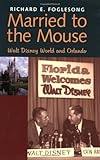
Richard E. Foglesong. Married to the Mouse: Walt Disney World and Orlando. New Haven: Yale University Press, 2001. xvi + 251 pp. $35.00 (cloth), ISBN 978-0-300-08707-9; $19.00 (paper), ISBN 978-0-300-09828-0.
Reviewed by James B. Crooks (Professor Emeritus, Department of History, University of North Florida)
Published on H-Florida (January, 2004)
A One-Sided Marriage
A One-Sided Marriage
Rollins College political scientist Richard Foglesong examines the relationship between Walt Disney World and Orlando on several levels. First is the historical narrative of the founder selecting the central Florida site, in part because of the prior successful efforts by local business leaders to develop transportation links to Orlando providing easy access. Disney's super-secret efforts in purchasing large blocks of land totaling almost 28,000 acres combined with special governmental perks by the Florida legislature led to the construction and opening of the amusement park in 1971. There followed the expansion into Epcot and hotel construction within Disney in the 1980s, and the opening of night clubs and the development of Celebration as a model of the "new urbanism" in the 1990s. Along the way Orlando became transformed from what the author calls "a citrus town to a world-class tourist destination" (p. 10).
At a second level, Fogelson raises three questions to assess the significance of Disney World's relations with Orlando for "city-building and urban governance" in the twenty-first century. The first question concerns the power of global corporations relative to local governments, and whether local governments can resist corporate demands. In the early years, Orlando, its surrounding counties (Orange and Osceola), and the state gave Disney virtually everything it wanted. They built new interchanges connecting the amusement park to the Florida Turnpike and Interstate I-4. The state authorized the creation of two cities (Lake Buena Vista and City of Blue Lake) and the Reedy Creek Improvement District to exempt Disney from neighboring city and county building, zoning, and land use regulation. This action gave Disney the authority to build roads, lay sewer lines, provide police and fire protection, and more. In effect, Disney with its forty-three square miles (twice the size of Manhattan and equal to San Francisco) became a self-sufficient, self-governing city. Its twenty-seven residents were largely Disney supervisory personnel. The corporation ran the district with little outside governmental interference. Its 55,000 workers (two-thirds were low-wage) required housing, schools, and other social services in the adjoining counties. Its 100,000 daily visitors clogged the highways and byways of the metropolitan area. In the 1980s, Orlando and the counties challenged Disney control, particularly when hotel keepers adjacent to Disney and competing entertainment centers like Universal Studios found themselves constricted by local laws while Disney was not. In time, the competition pressured Orlando and the counties to force Disney to make concessions. Still, over the years, this extremely profitable entertainment center did little to provide affordable housing for its low-wage employees, cooperate to ease traffic congestion, or share in the overall growth and development occurring in the metropolitan area.
Fogelson next questions the division of labor "between public and private, government and market, in city building and municipal service provision" (p. 11). In Disney's case, the question became whether the entire business of city-building--Lake Buena Vista, Bay Lake, and the Reedy Creek Improvement District--could be done better by market-driven private enterprise, or by democratically elected city and county officials. Disney's provision of infrastructure and services were very efficient, as any visitor to the Magic Kingdom can attest. But again the author calls attention to the large low-wage employee base where the private sector did not provide affordable housing, schools, and other services, either in Disney or beyond, and the traffic congestion which fell largely upon Orlando and the neighboring counties. In creating the model city of Celebration, Disney found it had to partner with the Osceola County school board leading to compromises frustrating to both county voters and new town residents. In effect, what worked well for visitors to the Disney domain did not include responsibility for company employees, traffic, schools, infrastructure, or social services.
Fogleson's third question focuses on the impact of Disney upon Orlando. Did decisions on behalf of Disney and other tourist attractions limit the central Florida city to tourist development at the expense of diversified growth? Mel Martinez, chair of the Orange County Commission in 1998, and later President George W. Bush's Secretary of Housing and Urban Development, thought so. A tourist-dominated economy, he said, "is not what we want to have as a community" (p. 182). Incentives to stimulate manufacturing and high-tech growth with high-wage jobs were limited and produced only marginal results. In sum the author concludes that Orlando and its surrounding counties probably came out second best in welcoming Disney to the area.
Finally, on a third level the author addresses political science theory comparing Paul Peterson's "development interest" of external factors pushing growth versus regime theorists led by Clarence Stone who suggest that internal forces do more to shape a city's growth. Fogelson gives credit to Peterson, but concludes with some qualifications that internal regime leadership in Orlando prepared the way for Disney and responded positively to most of its initiatives.
Fogelson briefly concludes with suggestions about how the city might improve its "marriage" with Disney: by emphasizing human capital development over subsidized commercial development; passing a living-wage policy to offset market distortions; expanding the tourist tax to subsidize other development; and ending subsidized private-sector competition with downtown Orlando. Equally important the author feels that policy decisions over the past forty years have been inadequately debated in the public arena. The future of Orlando as with other American cities requires ongoing public dialogue about government's support and regulation of the private sector for the sake of future generations.
Fogelson's study is thorough, well written, and enriched by numerous personal interviews as well as by printed sources. It is also one-sided. He assumes (my interpretation) that readers know the positive impact of Disney upon Orlando (world-class city, etc.), and need to learn about the dysfunctional consequences. He may be right. Cities across the country offer incentives almost daily to recruit major corporations to their communities. Married to the Mouse suggests that city officials may want to spend more time discussing their impact, both intended and possibly unintended, before opening their coffers to them.
If there is additional discussion of this review, you may access it through the network, at: https://networks.h-net.org/h-florida.
Citation:
James B. Crooks. Review of Foglesong, Richard E., Married to the Mouse: Walt Disney World and Orlando.
H-Florida, H-Net Reviews.
January, 2004.
URL: http://www.h-net.org/reviews/showrev.php?id=8703
Copyright © 2004 by H-Net, all rights reserved. H-Net permits the redistribution and reprinting of this work for nonprofit, educational purposes, with full and accurate attribution to the author, web location, date of publication, originating list, and H-Net: Humanities & Social Sciences Online. For any other proposed use, contact the Reviews editorial staff at hbooks@mail.h-net.org.

