

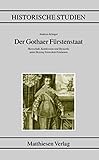
Andreas Klinger. Der Gothaer Fürstenstaat: Herrschaft, Konfession und Dynastie unter Herzog Ernst dem Frommen. Husum: Matthiesen Verlag, 2002. 399 S. ISBN 978-3-7868-1469-6.
Reviewed by Mary Venables (Department of History, Yale University)
Published on H-German (January, 2004)
The Variety of the Seventeenth Century
The Variety of the Seventeenth Century
Andreas Klinger's Der Gothaer Fürstenstaat: Herrschaft, Konfession und Dynastie unter Herzog Ernst dem Frommen studies the beginning of the reign of Duke Ernst the Pious (1601-1675) and the establishment of Saxe-Gotha-Altenburg (later Saxe-Coburg and Gotha). For Anglo-American students of German history, Klinger's book almost certainly presents an unknown figure and unfamiliar land. Most introductions to nineteenth-century German history include Heinrich von Treitschke's condemnation of Thuringian particularism, but they rarely say much about houses like Saxe-Coburg and Gotha that created the crazy-quilt of small, non-contiguous territories.
The story with German historians of German history is different. As Klinger points out in the first pages of his book, Duke Ernst is a well-known example of a patriarchal ruler, whose name frequently surfaces in German survey texts. In both recent literature and paeans from the nineteenth century, Ernst was hailed as an educational innovator, an accomplished administrator, a religious reformer, and a Protestant saint.[1] (To get Anglo-American readers up to speed, Saxe-Gotha-Altenburg was a small territory west of Erfurt with an eastern extension south of Leipzig. Ernst was born in 1601 in Altenburg to Duke Johann of non-electoral Ernestine Saxe-Weimar and Dorothea Maria of Anhalt, fought alongside Gustavus Adolphus and Bernhard of Weimar in the Thirty Years' War, took possession of Saxe-Gotha in 1640, and died March 26, 1675.)
It is this very German and very hagiographic picture of Duke Ernst that Klinger refines and corrects. He is particularly interested in how Ernst established political legitimacy in a territory that was only created in 1640, a subject that earlier works rarely discussed. Klinger meets the challenges of describing the establishment of a new territory with a method favored by Ernst and other rulers of the time: methodical and meticulous documentation. In nine chapters, well-rooted in extensive archival research, he outlines territorial divisions that led to the founding of Saxe-Gotha, Duke Ernst's relations with neighboring courts, the establishment of the administration, the construction of Ernst's new residence, relations with the estates, advancement of religious growth, Ernst's management of finances, his efforts at introducing order, and his support of charitable institutions.
Klinger confines his study to the first fifteen years of Ernst's thirty-five year reign, years in which, as Klinger argues, the tangible administration and intangible authenticity of Saxe-Gotha were established. Although all books must have limits, this decision leaves a ragged end in the 1650s. Part of the reason that Saxe-Gotha endured was that Ernst himself endured--he lived to be seventy-four and was survived by seven sons. Had Ernst died at the age of fifty, Saxe-Gotha might not have long outlived its founder. His longevity allowed him to inherit other Ernestine territories; his fertility provided him with heirs for Saxe-Gotha. Such historical contingencies play little role in Klinger's narrative.
Klinger also leaves larger questions about Ernst's surroundings unanswered. He only mentions the Thirty Years' War in passing, which is unfortunate. For the first ten years of Ernst's reign foreign troops still roamed the land, surely a threat to good government and claims to sovereignty if there ever was one. While the reader does not expect concrete casualty figures in a book on the establishment of a noble house, Klinger's failure to discuss the lingering effects of the war (except for the construction of Ernst's new castle) gives the work an atemporal feel.
In contrast to these weaknesses, Klinger shines at describing symbolic representations of authority and legitimacy. His description of Ernst's first ceremonial entrance into Gotha decodes the importance of the nobility's fealty to Ernst. His account of peace celebrations in 1650 explains the importance that Ernst gave to communal confession. Klinger's interpretation of Ernst's creation of a family burial plot in the main town church and orders for territorial mourning following the death of his children are among the best sections in the book. He clearly illustrates how the celebration of family grief emphasized Gotha's importance as Ernst's residence and the connection between Ernst's family and his subjects.
Klinger's discussion of symbolic representations of authority is one point at which his work picks up themes from early modern scholarship. He also considers how Ernst's state corresponds to the paradigm for the evolution of the early modern state. He asserts that Ernst was a transitional figure and does not fit neatly into historical categories (pp. 337-338), which suggests that historians' proclivity for periodization leads them to overlook Ernst and transitional figures like him. Klinger also takes issue with the suggestion that early modern rulers did not expect all the laws that they issued to be followed and argues that at least Ernst meant for his laws to be obeyed and created administrative structures to enforce them (pp. 272-279). He brushes past the question of confessionalism by stating that Ernst's reforms in Gotha need to be understood in the context of Lutheran orthodoxy, not a Calvinist second reformation (pp. 212-214). Klinger spends more time on the issue of social discipline within the Lutheran context and classifies Ernst as one who attempted to establish "order," even over protest from clergy and nobility (pp. 235, 261).
At all times, however, these larger questions are in the background. This is a book first and foremost about Ernst and his state, and only secondly about scholarly debates. Klinger discusses whether Ernst fits into current historical theories, but does not use the example of Ernst to reshape our understanding of the early modern period. For those familiar with Thuringia and German scholarship, Klinger's study provides a thorough outline of the foundation of Saxe-Gotha, one that illuminates areas elided in other studies. Along with two recent publications, it offers a needed corrective to the nineteenth-century heroic picture of Ernst.[2]
For those who have never encountered Ernst before, Klinger's book describes at length and detail one of the small pieces of German particularism.[3] The book does not include genealogical charts and maps, which makes the book and the period more puzzling than need be--two pages that cover the reigns of Johann Friedrich I, Johann Friedrich II, Johann Wilhelm, Johann Casimir, Johann Ernst, Friedrich Wilhelm I, Johann, Johann Ernst the younger, Bernhard, Ludwig, Friedrich Wilhelm, Albrecht, Friedrich, Wilhelm, Johann Friedrich VI, and Ernst in Coburg, Eisenach, Erfurt, Weimar, Altenburg, and Gotha bewilder even the most committed reader (pp. 21-22). But if Klinger's book serves only to illustrate the variety of the seventeenth century, when dukes like Ernst ruled alongside great kings and minor nobles, it will have broadened the field of vision of Anglo-Americans historians a great deal.
Notes
[1]. For examples of nineteenth-century works see Johann Heinrich Gelbke, Herzog Ernst der Erste genannt der Fromme zu Gotha als Mensch und Regent. Eine historische Darstellung (Gotha: Justus Perthes, 1810); and August Beck, Ernst der Fromme, Herzog zu Sachsen-Gotha und Altenburg. Ein Beitrag zur Geschichte des siebenzehnten Jahrhunderts (Weimar: Hermann Boehlau, 1865).
[2]. Veronika Albrecht-Birkner, Reformation des Lebens: Die Reformen Herzog Ernsts des Frommen von Sachsen-Gotha und ihre Auswirkungen auf Froemmigkeit, Schule und Alltag im laendlichen Raum (1640-1675) (Leipzig: Evangelische Verlagsanstalt, 2002); and Roswitha Jacobsen and Hans-Joerg Ruge, eds., Ernst der Fromme, (1601-1675) Staatsmann und Reformer. Wissenschaftliche Beitraege und Katalog zur Ausstellung (Jena: Quartus-Verlag, 2002).
[3]. The nineteenth- and twentieth-century aspects of this issue were recently discussed in Tuska Benes' H-German review of Abigail Green's Fatherlands: State-Building and Nationhood in Nineteenth-Century Germany (Cambridge and New York: Cambridge University Press, 2001), at http://www.h-net.org/reviews/showrev.cgi?path=40431067119867.
Copyright (c) 2004 by H-Net, all rights reserved. H-Net permits the redistribution and reprinting of this work for nonprofit, educational purposes, with full and accurate attribution to the author, web location, date of publication, originating list, and H-Net: Humanities & Social Sciences Online. For other uses contact the Reviews editorial staff: hbooks@mail.h-net.msu.edu.
If there is additional discussion of this review, you may access it through the network, at: https://networks.h-net.org/h-german.
Citation:
Mary Venables. Review of Klinger, Andreas, Der Gothaer Fürstenstaat: Herrschaft, Konfession und Dynastie unter Herzog Ernst dem Frommen.
H-German, H-Net Reviews.
January, 2004.
URL: http://www.h-net.org/reviews/showrev.php?id=8658
Copyright © 2004 by H-Net, all rights reserved. H-Net permits the redistribution and reprinting of this work for nonprofit, educational purposes, with full and accurate attribution to the author, web location, date of publication, originating list, and H-Net: Humanities & Social Sciences Online. For any other proposed use, contact the Reviews editorial staff at hbooks@mail.h-net.org.

