



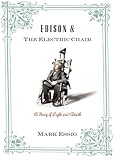
Mark Essig. Edison and the Electric Chair: A Story of Light and Death. New York: Walker and Company, 2003. 358 pp. $26.00 (cloth), ISBN 978-0-8027-1406-0.
Reviewed by Elizabeth Jozwiak (Department of History, University of Wisconsin-Rock County)
Published on H-USA (December, 2003)
Zapped
Zapped
In the somewhat misleadingly titled Edison and the Electric Chair: A Story of Light and Death, Mark Essig attempts to tell the story of the competition between two ambitious men, Thomas Edison and George Westinghouse, while explaining the science of electricity, as well as exploring debates over the death penalty and its methods. In short, the electric chair is only part of the story.
Essig begins with the story of early experiments with electricity, such as those conducted by Benjamin Franklin, Luigi Galvani, and Alessandro Volta. He then deals with Thomas Edison's early experiences as a telegrapher and fledgling inventor. Essig reveals Thomas Edison to be an extremely ambitious man who "craved the public's attention" (p. 24). Edison even seems a bit of a "snake oil" salesman. In the 1870s, he promoted the "inductorium," an induction coil system for giving mild shocks, as a way to treat rheumatism and provide family amusement. Those who know about Edison the scientist may find Essig's discussion of Edison the businessman revealing.
Edison's scientific efforts to produce an effective electric lighting system figure prominently in this work. Essig describes clearly Edison's development of the incandescent light bulb and the difficulty in finding a workable filament material. At the same time, the author shows that for Edison the potential for profit from electric lighting was as important as the spirit of invention. The first efforts at electric lighting were directed toward street lights. One early method was arc lighting, operated via small lighting stations housing dynamos every few blocks. Edison was more ambitious. He envisioned electricity being piped into homes as a utility in the same way as gas had been. To do this, his system used a central station and buried cables, implementation of which would be an expensive and time-consuming process. Though Edison's approach was more expensive in the short run, it would ultimately win out.
The next important challenge to Edison's vision of providing the lighting system for America came from the "upstart" George Westinghouse. Westinghouse had burst into the inventing world with a workable train air brake, and then turned his efforts to electricity. Edison had developed his system using direct current, which allowed fairly low voltages to be transmitted into homes. The problem with direct current, however, was that it required thick wires of low resistance to prevent the wires from overheating. These wires could be expensive. Westinghouse worked with higher voltages and thinner wires. He also found that using alternating current, which had the advantage of creating induction, allowed for thinner transmission wires. Transformers could reduce voltages as the electricity reached homes. But Edison was already committed to his approach and wanted to protect it. In order to persuade the American public and potential buyers of the value of his approach, Edison set out to show that alternating current was a high-voltage and therefore deadly approach. One way to do that was to promote its use for a new tool of execution--the electric chair. It was in this way that Edison--who was not a fan of the death penalty--became associated with this lethal instrument.
Essig tries to put the development of the electric chair into historical context by discussing the history of public executions and their role as public spectacle. He also talks about the debates over whether the condemned should be made to suffer in the process of execution. He delves into discussions of the 1870s over whether execution by electrocution (a term incidentally that outraged linguists for its lack of etymologic basis) was cruel and unusual punishment. Many people of the time questioned whether electrocution could be quick and painless, and as Essig points out in gruesome detail, many of these early electrocutions were neither. The author also tries to show how this new form of execution fit into the changing notions of the purpose of executions. By the 1870s, the public spectacle of execution apparently was seemingly less important than the quick dispatch of the convicted.
This is an ambitious book that attempts to do several things at once. Though Essig attempts to deal with social issues, such as the death penalty controversies, the book seems aimed more at an audience interested in the history of science. Those familiar with urban politics and society in the late 1800s will gain some insight into the scientific details of lighting America's cities. In order to explain the debate between the various approaches to electricity--e.g. the incandescent bulb, direct current, etc.--Essig gives the reader some of the relevant science background. The non-scientifically inclined reader may find the discussion of electrical principles a bit too detailed, but they may be rather simple to those with an understanding of electricity.
The chronological framework of this book makes for some confusion. One minute the reader is presented with yet another installment in the seemingly endless parade of animal electrocutions (as experimenters tried to determine the killing power of electricity) and the next the reader is learning about competition over electrical contracts, and then is back in the laboratory. It is probably not surprising that Essig, a specialist in the history of forensic medicine, would focus on the physiological effects of electricity. Nevertheless, those sections dealing with animal and human electrocutions are not for the squeamish. Essig has drawn from a variety of primary sources, but particularly Edison's papers and newspaper accounts of the late-nineteenth century. Overall, the same many-threaded approach that can make for confusion also makes this an interesting effort.
If there is additional discussion of this review, you may access it through the network, at: https://networks.h-net.org/h-usa.
Citation:
Elizabeth Jozwiak. Review of Essig, Mark, Edison and the Electric Chair: A Story of Light and Death.
H-USA, H-Net Reviews.
December, 2003.
URL: http://www.h-net.org/reviews/showrev.php?id=8602
Copyright © 2003 by H-Net, all rights reserved. H-Net permits the redistribution and reprinting of this work for nonprofit, educational purposes, with full and accurate attribution to the author, web location, date of publication, originating list, and H-Net: Humanities & Social Sciences Online. For any other proposed use, contact the Reviews editorial staff at hbooks@mail.h-net.org.

