



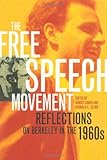
Robert Cohen, Reginald E. Zelnik, eds. The Free Speech Movement: Reflections on Berkeley in the 1960s. Berkeley: University of California Press, 2002. xx + 618 pp. $19.95 (paper), ISBN 978-0-520-23354-6; $55.00 (cloth), ISBN 978-0-520-22221-2.
Reviewed by Joseph Palermo (Department of History, California State University, Sacramento)
Published on H-California (December, 2003)
U.C. Berkeley in 1964: Free Speech and Civil Disobedience
U.C. Berkeley in 1964: Free Speech and Civil Disobedience
Scholars of America in the 1960s have long looked to 1968 as a pivotal year that forever changed the nation. Events such as the Tet Offensive in Vietnam, the assassinations of Martin Luther King Jr. and Robert F. Kennedy, and the fiasco for the Democratic Party at the convention in Chicago have loomed large in the historiography. But a few recent works have looked back four years, to 1964, for deeper consideration; 1964 was the "last innocent year," a recent title suggests. In 1964, there was also a set of pivotal events--the Freedom Summer voter registration drive in Mississippi, the passage of the Civil Rights Act, the Gulf of Tonkin incident, the silencing of the Mississippi Freedom Democratic Party delegation, and equally important, the Free Speech Movement (FSM)--which exploded on the U.C. Berkeley campus that fall.
Robert Cohen and Reginald Zelnik have compiled a superb set of essays that shed new light on the significance of the FSM. An active group of students at Berkeley had an awakening after participating in various capacities in the African-American civil rights movement that had swept the South since the Montgomery bus boycott began in late 1955. They threw themselves into organizing for social justice only to meet stiff resistance from University administrators, the UC regents, and vocal members of California's ascendant right wing. What started at Berkeley was a struggle that would ultimately transform university relations on campuses nationwide. In The Free Speech Movement: Reflections on Berkeley in the 1960s, Cohen and Zelnik have succeeded in combining a range of perspectives responding to the fact, as Leon Litwack points out in his preface, that the FSM "meant and came to mean very different things to many different people" (p. xv). The student activism on the Berkeley campus touched on something fundamental to the American notion of "liberty": freedom of speech. And the conflict energized a student body that, aside from the civil rights volunteers, had been largely docile and complacent in the 1950s.
This volume contains a lengthy and informative introduction by Robert Cohen in which he sets up each piece with care, and underscores that it is a "transitional" work, "an attempt to begin a passing of the torch of historical memory from movement veterans and their opponents to historians" (p. 4). This anthology is not another baby-boomer nostalgia trip, but rather, it is a set of scholarly writings which seamlessly juxtaposes movement memoirs with lucid interpretative essays. The book is divided into five parts: "Roots," "Experience: Fall 1964," "Legal and Constitutional Issues," "Aftermath," and "Thoughts About Mario Savio." The highlights of this work include a talk Mario Savio gave on November 15, 1995, at the University of California, Santa Cruz, entitled "Thirty Years Later: Reflections on the FSM." The Savio transcript sets up the pieces that follow, including the final part that consists of essays remembering and honoring Savio's leadership of the movement. A consensus has emerged in recent years within the general historiography of the era which points to Savio as a uniquely gifted orator and youth leader who came to personify the idealism of students in the 1960s. This set of essays adds greatly to our understanding of Savio's ideology and his role as a movement organizer. Savio's thoughtful and sensitive reflections, always intoned with a sense of outrage against social injustice, give this book a wonderful point of departure. It is clear that with regard to the FSM, Savio cannot be separated from the movement.
In his November 1995 speech, Savio links his awakening to the civil rights movement and the value of freedom of speech to the searing events he recalled from his childhood: the legacies of World War II, the Holocaust, and the atomic bombings. The gravity of these events of the mid-twentieth century informed Savio's unequivocal political stands. He had the rare ability to challenge people and to move them to take action against social wrongs that had been long tolerated but could not be ignored. Savio led the FSM with intelligence, moral certitude, and humor. "We had to work like crazy," Savio recalls, "disrupting the University, taking over buildings, having sit-ins, marches, all this sort of thing to just open up a little space where people would have a real debate. That was America" (p. 69). This transcript of Savio's talk, which was sadly given less than a year before his death at fifty-three years of age, along with the fascinating pieces interpreting his persona and role as a leader by Doug Rossinow, Lynne Hollander Savio, Suzanne Goldberg, Wendy Lesser, Greil Marcus, and Reginald Zelnik, make this work the most comprehensive exploration of Savio's legacy as an activist that has yet to be published. This aspect alone would make the book a substantial contribution to the scholarship of the 1960s, but it also includes some twenty-four other short essays that all shed new light on these pivotal events.
The pieces from former activists and participants such as Jackie Goldberg, Bettina Apthecker, Margot Adler, Martin Roysher, Henry Mayer, Steve Weisman, David Hollinger, and Kate Coleman are succinct recollections that move away from nostalgia and "story telling" to focus on the significant social change that the FSM wrought. A particularly noteworthy piece from this section comes from Jeff Lustig, who does a fine job relating the significance of the FSM to the wider vision of the New Left. At a time when the historiography of the New Left seems to be moving toward a narrative of degeneration and decline, Lustig aptly places the FSM in the context of the struggle for social justice, and the general sense of political mobilization that will forever characterize our interpretation of America in the sixties. "No one who confronted authorities and risked arrest in 1963 or 1964 knew that there would be a 'sixties,'" Lustig points out. "They could not explain their rebellion or anchor their identities with reference to a decade that had yet to be created" (p. 216) With much of the historiography of the sixties focused on the protests as if they were premeditated events unfolding "naturally," it is refreshing to see such a sober account. Cohen and Zelnik's anthology should be praised for not pandering to the popular histories of the period with embroidered portraits. (Even Savio does not come across as a "hero" in the traditional sense, but rather, he appears to be a sensitive individual who was influenced by his times and in turn influenced them himself.) Also praiseworthy is the fact that Cohen and Zelnik have chosen to include an interesting scholarly essay from former University of California president Clark Kerr. Kerr provides a unique perspective that brings to life elements of the story that are often overlooked in the standard narratives which tend to oversimplify some of the political decisions and constraints that UC administrators such as Kerr faced and could not avoid. Kerr concedes that he might have been an apparatchik of sorts for the university, but he was no Stalinist in his battles with the students. The piece by Kerr fits nicely with an excellent essay from Lawrence Levine that shows that the movement influenced far more on campus than simply freedom of speech, and ultimately seeped deep into the cultural interstices of university life.
This compilation of essays is an outstanding contribution to our understanding of the dawn of the modern student movement. Any history course with subject matter relating to America in the sixties would benefit from including this volume. Students will enjoy reading the recollections of participants and also come away with a broader understanding of the issues at stake in Berkeley in 1964: the student mobilization against social injustices, the successes and failures of the movement, and the human beings who were part of it. Through reading these essays, undergraduates can come to better understand that young people have "made history" not too long ago by standing up against injustice, organizing their peers, and employing the tactics of nonviolent civil disobedience in creative and powerful ways. What started at UC Berkeley in 1964 led eventually to the institutionalization of student political activism on campuses from coast to coast. Cohen and Zelnik have pulled together the single best volume on the FSM that has yet been published.
If there is additional discussion of this review, you may access it through the network, at: https://networks.h-net.org/h-california.
Citation:
Joseph Palermo. Review of Cohen, Robert; Zelnik, Reginald E., eds., The Free Speech Movement: Reflections on Berkeley in the 1960s.
H-California, H-Net Reviews.
December, 2003.
URL: http://www.h-net.org/reviews/showrev.php?id=8589
Copyright © 2003 by H-Net, all rights reserved. H-Net permits the redistribution and reprinting of this work for nonprofit, educational purposes, with full and accurate attribution to the author, web location, date of publication, originating list, and H-Net: Humanities & Social Sciences Online. For any other proposed use, contact the Reviews editorial staff at hbooks@mail.h-net.org.

