



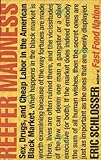
Eric Schlosser. Reefer Madness: Sex, Drugs, and Cheap Labor in the American Black Market. Boston: Houghton Mifflin Company, 2003. 310 pp. $13.00 (paper), ISBN 978-0-618-44670-4; $23.00 (cloth), ISBN 978-0-618-33466-7.
Reviewed by Lisa Magloff (Kings College, London)
Published on H-USA (December, 2003)
In Reefer Madness, Eric Schlosser cashes in on the success of Fast Food Nation with a series of reprinted and slightly rehashed articles on the subjects of sex, drugs, and cheap labor in the American black market. Despite the quality of the articles, they each come across as exactly what they are--well-written magazine pieces--and their incorporation into a book is an obvious ploy to keep the momentum going until his next book can come out. Despite the attempt to link the articles with their relationship to the black market, each one reads as a completely separate work, and you are left wondering why they could not just have been downloaded from Atlantic Monthly, Rolling Stone, and US News and World Report, where they appeared in the first place, and saved yourself the $23.00 that the book cost. Like his Fast Food Nation, the sense is that these articles made a lot more sense as magazine pieces than as a book.
Perhaps I just wanted a bit more from a book than investigative journalism. I wanted a book. Which is not to say the three articles in this book are not interesting--they are--although anyone expecting titillation or incendiary stories of vice and corruption will also be disappointed. As with Fast Food Nation, Schlosser points up the social impact of America's often short-sighted and politically motivated attitudes by concentrating on the business side of sex, drugs, and cheap labor. Yet, as interesting and well-written as the book is, it somehow falls flat. Perhaps that is because, as in Fast Food Nation, we are only getting the facts, with little or no analysis. When Schlosser gives us information about certain aspects of the marijuana, pornography, and illegal immigrant industries, these facts are not tied to larger or more complex arguments. Although factually fascinating, the stories in this book actually tell us very little about how marijuana, pornography, and illegal immigrants fit into an understanding of American society as a whole.
Schlosser's story of pornography pioneer Rueben Sturman is fascinating, but by focusing on Sturman's struggles with the federal government, it ultimately tells us nothing about the nature of the pornography industry or what drives it forward. Schlosser mentions, but glosses over, the impact of the internet and video on pornography, and vice versa, yet never addresses issues such as the role of women in pornography, feminism and pornography, pornography unions, the influence of the mob in pornography, or the social fascination with pornography that makes it one of America's largest industries while simultaneously making fighting pornography one of America's largest social crusades. Nor does he talk about the crossover between pornography, drugs, and illegal labor, yet another example of how the three sections of the book are not tied together into a coherent whole. We are left simply with an interesting story of one man and his pornography empire, but it ultimately tells us little about the role of pornography in American society.
Similarly, Schlosser focuses convincingly on the U.S. government's ill-thought-through war on marijuana, but never touches upon the role of either marijuana or anti-marijuana laws on the larger American society. Thus his chapter "Strawberry Fields" falls similarly flat. Again, we have an obviously well-researched piece which conveys specific information, but does not apply it to larger issues. The business of strawberry cultivation, and its reliance on illegal and poorly paid immigrant workers, is touchingly presented, but lacks impact and conviction. His stories of hard-working and poor immigrant laborers are heart-rending, but add little to a subject on which there has already been an enormous amount of in-depth study and research.
In the end, I am not sure exactly what purpose this book is meant to serve. As magazine articles, each of the chapters in this book was appropriate and insightful. But from a book, I expect to see either some in-depth research, some interesting conclusions, or some entertainment. Simply shoving magazine articles into a book, and tacking on the conclusion that the government's approach to each of these three subjects is short-sighted and vindictive, does not satisfy. I finished the book still hungry for more. The exact facts quickly faded from memory, but there was no deeper meaning left in their place. Although well-written and well-researched, I got the feeling that for all his work, Schlosser could have given us a deeper understanding of these crucial issues and a deeper insight into American society.
If there is additional discussion of this review, you may access it through the network, at: https://networks.h-net.org/h-usa.
Citation:
Lisa Magloff. Review of Schlosser, Eric, Reefer Madness: Sex, Drugs, and Cheap Labor in the American Black Market.
H-USA, H-Net Reviews.
December, 2003.
URL: http://www.h-net.org/reviews/showrev.php?id=8559
Copyright © 2003 by H-Net, all rights reserved. H-Net permits the redistribution and reprinting of this work for nonprofit, educational purposes, with full and accurate attribution to the author, web location, date of publication, originating list, and H-Net: Humanities & Social Sciences Online. For any other proposed use, contact the Reviews editorial staff at hbooks@mail.h-net.org.

