



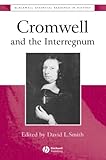
David L. Smith. Cromwell and the Interregnum. Oxford: Blackwell Publishers, 2003. vi + 226 pp. $44.95 (paper), ISBN 978-0-631-22725-0; $119.95 (cloth), ISBN 978-0-631-22724-3.
Reviewed by Martyn Bennett (Department of International Studies, Nottingham Trent University)
Published on H-Albion (October, 2003)
The "Essential" Cromwell
The "Essential" Cromwell
This collection is, by the account of several historians, a selection of the "must read" essays on Cromwell. True, the collection is in the series of Blackwell Essential Readings in History, but the eight essays included in the volume are those which make the footnotes, essential readings, or select bibliographies of a range of Cromwell biographies and texts on the British and Irish Republic. In bringing them together David Smith has saved students, tutors, and future biographers the task of tracking down this select list.
These essays concentrate on the later Cromwell, which is not unexpected. Cromwell's fifty-nine year life breaks down into three areas. For forty-two or forty-three years he was almost completely unknown outside his extended family and the region of Huntingdonshire in which he lived. He made occasional splashes in the bigger pool, a year at Cambridge University, some time spent in London, a short spell as an MP in Charles I's 1628 parliament, and an embarrassing appearance before the Privy Council, because of a dispute in Huntingdon. The second period really began in 1642, when Cromwell showed an unexpected talent for the soldier's life, which developed surprisingly into a grasp of regimental tactics and brigade-level strategy, and would eventually become a capacity for successful army command. This second part of Cromwell's life also witnessed an increasing involvement in politics, particularly when it touched on the army and the future of the victorious "regime." The third stage of Cromwell's life was the briefest, running from his expulsion of the remnants of the Long Parliament on April 20, 1653, when he effectively became head of state, through his official appointment as Lord Protector in December 1653, to his death on September 3, 1653. These essays deal with the later two stages of this amazing life and concern religion, government, and the three nations of the Republic.
Cromwell's complex religiosity is approached by several authors who try to explore it in relation to his military and political career. John Morrill and Philip Baker, in the most recent of the essays, argue that Cromwell only turned from being a "monarchist" after the first civil war and the king's refusal to make terms with the victors, his crucial conversion coming after the Putney debates, when he realized that the king had put himself beyond God's will. This of course fitted in with the view of Cromwell and providentialism so clearly related by Blair Worden's essay "Cromwell and the Sins of Achen," wherein Cromwell is shown to be convinced that God's providence was manifest in the events of the wars and the victories of the parliamentarians. Three essays, by Austin Woolrych, Peter Gaunt, and Anthony Fletcher, deal with national and local government during the 1650s. Woolrych asks the big question: was the Protectorate a military dictatorship? His answer is no, not really: if there was any sense of a dictatorship it came not because of a military aspect to government, but because Cromwell felt that he was the guardian of the peoples' route to a godly magistracy. Peter Gaunt argues forcibly, in an interesting essay, that we must be careful not to overestimate the centrality of Cromwell: the State Councillors played a crucial role in national government. These men were not simply puppets of the Lord Protector, nor overawed by him as royalists and other discountenanced critics argued. Anthony Fletcher argues that the rural government of the country was more firmly established in the hands of the gentry because central government was quite weak in its effects on the localities, not the heavy-handed behemoth represented by the brief experiment with major-generals.
The next pair of essays return to the religious issues; Colin Davis looks at Cromwell's religion and David Smith explores religious policy during the Protectorate. Davis sees Cromwell in very general terms as a providentialist and anti-formalist, believing that although Cromwell knew God to be on his side, this was no reason to enforce a single strict religious code or ordinances. This of course would lead to problems when his government had to establish some form of religious settlement in the republic. A settlement and liberty of conscience were so incompatible that Smith argues it brought an untimely end to the sittings of the first protectorate parliament because it led to intractable division between Cromwell and MPs.
The final essay puts Cromwell into the context of Britain and Ireland. In it, David Stevenson argues that Cromwell was, and would remain, English in his perspectives. His conquest of Ireland and then Scotland enabled their incorporation into the republic. Even though Cromwell had some hopes of bringing peace and justice to the two kingdoms, this would only be possible because they had been defeated to protect the core kingdom--England; and it would be English perceptions of peace and justice which would be imposed. In short, the essays in this book confirm that Cromwell believed himself to be God's man, but he really was God's Englishman.
There is so much more written on Cromwell, so while this may be essential, it is a step on a long road: there are other excellent things written on Oliver, some of them in a book from which two of these essays are taken. Read this collection and begin the journey through the life and mind of Ireland's first, and England, Wales, and Scotland's only, commoner head of state.
If there is additional discussion of this review, you may access it through the network, at: https://networks.h-net.org/h-albion.
Citation:
Martyn Bennett. Review of Smith, David L., Cromwell and the Interregnum.
H-Albion, H-Net Reviews.
October, 2003.
URL: http://www.h-net.org/reviews/showrev.php?id=8292
Copyright © 2003 by H-Net, all rights reserved. H-Net permits the redistribution and reprinting of this work for nonprofit, educational purposes, with full and accurate attribution to the author, web location, date of publication, originating list, and H-Net: Humanities & Social Sciences Online. For any other proposed use, contact the Reviews editorial staff at hbooks@mail.h-net.org.

