



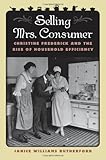
Janice Williams Rutherford. Selling Mrs. Consumer: Christine Frederick and the Rise of Household Efficiency. Athens and London: University of Georgia Press, 2003. xx + 283 pp. $22.95 (paper), ISBN 978-0-8203-2480-7; $49.95 (cloth), ISBN 978-0-8203-2449-4.
Reviewed by Irene Herold (Mason Library, Keene State College)
Published on H-Women (September, 2003)
Selling a Consuming Woman
Selling a Consuming Woman
It would be a mistake to relegate Christine Frederick to the realm of domestic advice givers. As Janice Williams Rutherford clearly establishes in her work Selling Mrs. Consumer: Christine Frederick and the Rise of Household Efficiency, Frederick was also a pioneer of advertising, a tester of household machinery and goods, and an effective writer. Furthermore, Frederick was ironically a promoter of domesticity for women, while herself active in business.
Reviewing the literature of domestic science and biographies of many of the main figures working in domestic science during Frederick's life, such as Ellen Swallow Richards and Isabel Bevier, Rutherford's work is a welcome addition to the literature. Rutherford sets Frederick's life and work in the context of the modern consumer culture, linking it to Progressive reform and the efficiency movement in tandem with scientific management (p. 1). Those who teach about Charlotte Perkins Gilman will want to read this book for the juxtaposition of Frederick to Gilman in their viewpoints on domesticity and advertising as clearly laid out in Rutherford's work. Selling Mrs. Consumer is a very readable and thoroughly documented work.
In the preface, Rutherford discusses why she refers to her subject by first name throughout the text, acknowledging that it "diminishes" the subject (p. ix). Rutherford's reason is that, in areas where there are extensive discussions of Christine Frederick and her spouse, the use of Frederick alone would be confusing. I wish Rutherford had struggled more with this "feminist dilemma," as she refers to it. She could have referred to her subject as Frederick and the other family members by their first names. She does not call those outside the family by their first names, i.e., Beecher is Beecher, Stanton is Stanton, etc. Calling Frederick "Christine" when discussing her advertising work, while calling the men she was working with by their last names, such as Harriman or Hearst, does diminish the subject through tone.
One of the gems in Rutherford's work is her seven-and-a-half page prologue succinctly covering the history of domestic spheres in a discussion of Catherine Beecher. It sets the historical context for the rise of Frederick's world and how, during a time of increasing education for women, so many would resonate to Frederick's message of fulfillment in housekeeping. Rutherford states that "Beecher's legacy to her twentieth-century sisters was the belief that woman's primary sphere of influence was in the home" (p. xx). The prologue is the kind of historical summary that would be useful in a survey course on the Progressive Era to help the modern reader understand the Cult of Domesticity. It also provides the connection between Beecher and Frederick, recognizing them both as women who promoted a "doctrine of separate spheres" while seeking for themselves work, power, and influence available mainly to the men of their eras (p. xix).
One area that could have withstood more examination is advertising or sales tactics, since Rutherford states that Frederick saw the development of modern advertising as a means to create markets, which were presented by Rutherford as relatively new issues in 1914 (p. 85). Rutherford relates what Frederick did and states how it was modern, but the author could have provided further context for what came before to help the reader understand why Frederick's activities were significant. For example, Rutherford discusses the development of modern advertising as a means to create markets, but omits any discussion of advertising and marketing prior to Frederick's work in modern advertising. A brief review of the jobber system, explaining how products were placed in stores, would have helped to clarify how a cereal company could withhold its product, versus today when wholesale distributors handle this aspect of product placement (p. 83). Also a review of testimonial ads would have aided the reader in understanding the difference between the modern advertising methods mentioned as "reason why" copy and what came before it. "Reason why" copy emphasizes how product X would transform a life, but the advertisement did not really tell the consumer about the product, just its "therapeutic value" (p. 71). For a modern example, think about drug advertisements where you hear or see a product's name while seeing a backdrop of beautiful images, but you do not know whether the product is for allergies, depression, or prostate cancer; you are just assured it will improve the quality of your life.
After reading Rutherford's work, one might say that Frederick's public presentation of her personal life was "reason why" advertising copy. What Frederick reported, wrote, and advocated for others as transforming a homemaker's life through scientific efficiency in the home was not the reality of Frederick's home life. Rutherford's book clearly presents Frederick's life as a different reality from the one she was marketing to women. Frederick improved daily routines for women doing housework, "but she never acknowledged that her life and work were no longer typical of middle-class American homemaking. When she contrasted housework to work in the public sphere, she used office work as the measure" (p. 105). Rutherford repeatedly asserts this conflict between appearance and practice as the tension between admiring Frederick's work and being appalled at what she was advocating for the women of her era.
There are a few other themes that Rutherford could have developed. For instance, the home economics extension agents who went into rural areas demonstrating products and did much to revolutionize housework in isolated areas are not mentioned as a factor until page 87. An uninformed reader might think that Frederick single-handedly transformed rural households through the power of her pen. Also, the effect of the automobile on rural homemakers is only mentioned in passing (p. 156), yet mobility was a key factor for the changing role of farm wives after the turn of the century. The role of radio is mentioned and recognized as another life-changing factor (p. 131), especially within the context of Frederick's recognition of what she could do to take advantage of it to further spread her lessons in home making.
Although Rutherford repeats the fastidious details of Frederick's grandmother laying out her husband's clothes for Sunday, Rutherford does not make any connections between the ritualization of this activity and/or church going with Frederick's later fixation on efficiency. The connection is striking, especially when juxtaposed with the description of how Frederick tells women to wash dishes and create organizational charts (pp. 9, 49-50). Frederick absorbed other details, such as--while living in Russia--celebrating Eastern Orthodox Easter by making egg-shaped cake, which Frederick was still doing later in her life (p. 174). The role of Protestantism, fundamentalism, and occultism along with having a father who was a minister and a mother described as a "refined christian woman" by the judge during child custody proceedings, although mentioned by Rutherford within her text, are not explored for the influences they played on Frederick's theories about women's roles versus her own daily life (pp. 13, 86, 154-55, 175, 182). Rutherford writes about Frederick's whole-hearted belief in Progressivism, contrasting it to the religiously based promotion of women's spheres by Beecher. Yet the author misses an opportunity to examine her subject from this viewpoint, even while including it as part of the facts of Frederick's life history.
If there is additional discussion of this review, you may access it through the network, at: https://networks.h-net.org/h-women.
Citation:
Irene Herold. Review of Rutherford, Janice Williams, Selling Mrs. Consumer: Christine Frederick and the Rise of Household Efficiency.
H-Women, H-Net Reviews.
September, 2003.
URL: http://www.h-net.org/reviews/showrev.php?id=8174
Copyright © 2003 by H-Net, all rights reserved. H-Net permits the redistribution and reprinting of this work for nonprofit, educational purposes, with full and accurate attribution to the author, web location, date of publication, originating list, and H-Net: Humanities & Social Sciences Online. For any other proposed use, contact the Reviews editorial staff at hbooks@mail.h-net.org.

