

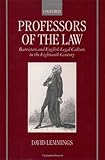
David Lemmings. Professors of the Law: Barristers and English Legal Culture in the Eighteenth Century. New York and Oxford: Oxford University Press, 2000. xiv + 399 pp. $110.00 (cloth), ISBN 978-0-19-820721-4.
Reviewed by Paul Halliday (Corcoran Department of History, University of Virginia)
Published on H-Albion (September, 2003)
Legal History and the History of Everything Else
Legal History and the History of Everything Else
Legal history: a label, thus a distinct field? All too often siphoned off into separate conferences, journals, departments, or professional schools, legal history has long bored or intimidated many who happily stood outside its bounds. That might have been a safe way to characterize the field a generation ago. Today, law seems to be invading every corner of historical analysis with great energy just as history has invaded legal analysis. History has certainly returned to the heart of American academic legal scholarship. Figures like Robert Gordon--taking cues from E. P. Thompson--and others have seen in history a way to make cogent critiques of current legal usages.[1] In English legal history, the opening of the field has been led more prominently by social historians outside of the legal academy: one thinks of scholars of recent years digging deeply into rich church court records--Laura Gowing--or into messy but equally rich conciliar court archives--Steve Hindle or Tim Stretton.[2] The list goes on and on. Legal historical approaches are poised to take the center of the early modern historiography. Indeed, legal analysis may well be the place where other varieties of analysis--social, political, and intellectual history--meet, or collide.
With the marvelous possibilities of legal history in mind, it would be a shame if so-called legal historians were the only readers of David Lemmings's book. For his exhaustive treatment of the world of barristers should shake up eighteenth-century studies, flying hard as it does in the face of continuing fascination with the seeming modernity of that century. There is little here to promote a Weberian or Habermasian approach to the eighteenth century, little to suggest that professionalization plus urbanization plus secularization equals the advent of modernity or the opening of the public sphere. "The bar's 'long-eighteenth-century' story cannot easily be reconciled with progressive Whiggish historical scenarios, whether the professional modernization argument ... or a more recent variant, associated with 'the rise of political liberalism'" (p. 317). Rather than ask the solipsistic question posed by studies concerned with the eighteenth century's modernity--where did I come from?--Lemmings asks the historian's question--where did things stand? His answer: on very shaky ground.
Having mastered the history of professional legal life in the late-seventeenth century in an earlier book, Lemmings has done more than simply move forward here. He is dealing with a more ambitious set of analytic problems. One of the knottiest puzzles presented to anyone studying legal culture across the seventeenth and eighteenth centuries is posed by the dramatic increase in litigation early in that period followed by an equally dramatic decline in the late-seventeenth century and on through most of the eighteenth.[3] Lemmings puts this puzzle at the center of his work, and asks, what impact on the profession did this sharp decline have and how did the profession respond? The short answer is that the impact was great, but the response was not.
This is a book thick with description, layer upon layer drawn not only from the usual sources for the study of the profession--court records, papers in the Inns of Court--but also from an amazing number of personal archives scattered from Aberystwyth to Maidstone and from Cumbria to Exeter. Examples culled from letters and diaries put meat on the bones of statistical analyses plotting the decline of admissions to the Inns and the rise of barristers' fees. Lemmings does more than chart the decay of a profession; he lets us hear what this meant to lawyers who succeeded nonetheless, and more often, to those who did not.
Chapters 2, 3, and 5 offer carefully constructed accounts of professional life in all its forms, from Westminster Hall to the colonies. The few who succeeded at the center did quite well: fees were higher than ever and the typical case took longer, and required more legal work, than before. The top of the profession compensated for a shrinking caseload by stringing each case along. The consequence was that fewer and fewer litigants could afford to start, much less finish, process in the courts. The rest of the profession was left trying to keep a career together on scraps offered in the Old Bailey, in palatine or local courts, or even in Ireland or America. Until the 1760s, this meant that declining numbers answered calls to the bar. To put it mildly, "the bar was not in fact an especially promising career prospect" (p. 74).
None of this was helped by the poor state of legal education, the subject of chapter 4. With readings--public lectures--in the Inns having died in the seventeenth century, little remained of the Inns' function as the seminaries of barristers. The only qualification for entry to the Inns was the ability to pay admission fees and termly duties; the only qualification for entering the profession was having stayed and dined in the Inns a sufficient spell. Neither the publication of lectures and treatises nor the creation of the Vinerian chair at Oxford did much to improve the situation. For all William Blackstone's famous efforts in mid-century, law seemed lacking: lacking in scientific organization and in the enlightening effect of more liberal modes of thought, mired as law was in rote exercises by which one acquired legal learning. This created nothing less than "a cultural crisis" for the professors of the law (p. 144). Even American lawyers, Lemmings surmises, "were better prepared by a liberal education 'to penetrate into the grounds of natural justice and human prudence' than their metropolitan counterparts" (p. 242, quoting a 1699 letter of John Evelyn). With educational attainments declining and their client base and case loads falling, Lemmings presents a picture of a profession that we could hardly say was "rising."
For the rest of English society, lawyers could not "live up to the inflated libertarian and egalitarian promises made in the name of English law after 1689" (p. 22). In a modestly argued but significant penultimate chapter, Lemmings shows how parliament's domination of political life sucked lawyers and judges into politics and into patronage networks that would help them establish and sustain careers at the top of the profession. Here was the profession's Faustian bargain. Selling its soul for political favor "eroded the bar's autonomy; and in several ways it also checked the 'independence' of the judiciary and perhaps with it the prestige of the common law after 1689" (p. 250). Seeing the eighteenth century judiciary "colonized by former MPs and placemen" (p. 282) not only helps us rethink law's supposed autonomy in the eighteenth century, but should lead us, by way of comparison, to correct facile condemnations of the Stuart bench for just the same alleged sins of political dependency. What had been a thriving participatory legal culture in the seventeenth century--hence the high rates of litigation--had succumbed to a less representative legislative regime in the eighteenth. Having capitulated to parliament, and "fundamentally out of tune" (p. 327) with middle-class commercial culture, the common law itself decayed, becoming a "'self-referencing' and obfuscatory culture" (p. 328). "Westminster Hall ultimately disappointed the community as a whole" (pp. 328-329).
This is a bleak picture, one justified by the bleak view we see if we look at the upper reaches of the profession. Matters might appear a bit less dismal were we to look beneath the barristers, to the attorneys, notaries, and others who handled the mountains of legal work in the provinces. Looking there, we might get a rather different picture of law's place in social life. In particular, most of these provincial professionals were concerned primarily with the non-litigious aspects of lawyering. Then as now, the point of a well-composed will, deed, or contract was to avoid judicial combat. But studying the lesser members of the profession, scattered much more widely throughout the land, is a job for another book. Given the performance of the task taken up here, and given the analytic results, we can only applaud David Lemmings for the accomplishment.
Notes
[1]. For a summary of Robert Gordon's views about the critical uses of legal history, see especially "The Past as Authority and as Social Critic: Stabilizing and Destabilizing Functions of History in Legal Argument," in The Historic Turn in the Human Sciences, ed. Terrence J. McDonald (Ann Arbor, 1996), pp. 339-378.
[2]. Laura Gowing, Domestic Dangers: Women, Words, and Sex in Early Modern London (Oxford and New York, 1996); Steve Hindle, The State and Social Control in Early Modern England, 1550-1640 (Basingstoke, 2000); and Tim Stretton, Women Waging Law in Elizabethan England (Cambridge and New York, 1998).
[3]. Here Lemmings, like so many others, builds on the pioneering work of Christopher Brooks. See especially his Lawyers, Litigation and English Society Since 1450 (London, 1998), chapter 4.
If there is additional discussion of this review, you may access it through the network, at: https://networks.h-net.org/h-albion.
Citation:
Paul Halliday. Review of Lemmings, David, Professors of the Law: Barristers and English Legal Culture in the Eighteenth Century.
H-Albion, H-Net Reviews.
September, 2003.
URL: http://www.h-net.org/reviews/showrev.php?id=8173
Copyright © 2003 by H-Net, all rights reserved. H-Net permits the redistribution and reprinting of this work for nonprofit, educational purposes, with full and accurate attribution to the author, web location, date of publication, originating list, and H-Net: Humanities & Social Sciences Online. For any other proposed use, contact the Reviews editorial staff at hbooks@mail.h-net.org.

