



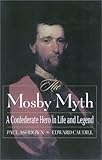
Paul Ashdown, Edward Caudill. The Mosby Myth: A Confederate Hero in Life and Legend. Wilmington: Scholarly Resources, 2002. xxxvi + 231 pp. $84.00 (cloth), ISBN 978-0-8420-2928-5; $25.95 (paper), ISBN 978-0-8420-2929-2.
Reviewed by Derek W. Frisby (Department of History, University of Alabama)
Published on H-CivWar (August, 2003)
John Singleton Mosby: A Self-Made Myth?
By all contemporary accounts and extant photographs, John Singleton Mosby was an unlikely looking hero. His drawn, gaunt visage and thin, diminutive frame masked a sharp mind, quick wit, strong constitution, and a ferocious martial spirit. Like Mosby, Paul Ashdown and Edward Caudill's latest tome comes in a deceptively small, no-frills package that provides little indication of the wealth of information that lies within it.
Two previous books have attracted the nation's attention to the relationship between history and memory. David Blight's Race and Reunion (2002) carried Americans' Civil War historical memory (or lack thereof) to the World War I era and Tony Horowitz's Confederates in the Attic (1999) examined the cottage industry that had sprung up around the Civil War, particularly in the South, at the close of the twentieth century. Ashdown and Caudill's excellent, tightly focused case study of Mosby bridges the temporal gap in "historical memory" studies created by these two works. By elucidating how Mosby shaped his own legend and how subsequent generations employed the "Mosby myth" for various and sometimes sordid purposes, a more complete picture develops of how Americans have formed and utilized their memories of the Civil War.
The first half of this book highlights incidents that would later become crucial components of the Mosby myth. It chronicles Mosby's early background as a frontier barrister, his journey towards becoming a reluctant Confederate, his wartime exploits, and his postwar pursuits. But this section is more a historiographical tour de force of Mosby's career than a biographical sketch. The authors have eschewed the traditional monograph by opting to examine Mosby's life and myth via several self-contained, concise vignettes, each offering a brief outline of the event interlaced with potent analysis. Admittedly, some might be skeptical that such a highly compartmentalized organizational approach can be effective, yet Ashdown and Caudill apply this technique throughout with expert efficiency.
Mosby's myth, according to the authors, slid down "the slippery path of cultural values on the firm footing of events" (p. xxv). Skipping episodically down the path of his life, Mosby's predilection for being a "contrarian, a rebel in all respects" becomes vividly clear (p. xxv). From his remarkable childhood and education in the shadows of Jefferson's Monticello to his imprisonment following the "unlawful shooting" of a classmate, Mosby demonstrated not only the southern characteristics of chivalry and honor but unrestrained emotion as well (p. 11). He vowed to strike back at the system that confined him and while imprisoned, he began to study law by reading books in his cell. Owing to his charismatic personality, Mosby convinced the prosecuting attorney in his case to provide the materials necessary to satiate his thirst for legal knowledge. Eventually, Mosby did indeed secure his early release, and posted his barrister's shingle on the Virginia-Tennessee border until the secession crisis. Although initially a staunch Unionist, he became swept up in the "delirium" for war after Fort Sumter and became a reluctant Confederate in defense of his native Virginia (p. 15).
Mosby, the "frailest and most delicate" of his unit, soon rose through the ranks to became a scout under J. E. B. Stuart, gaining some popular notoriety for raids around Richmond just prior to the Seven Days engagement (p. 16). In the aftermath of the Peninsula Campaign, the Union Army inaugurated war upon southern society as well as its army. Mosby, already impatient with the generals and politicians' way of waging war, vowed to defend his boyhood home using partisan regiments, but Stuart initially denied his request for an independent command. Soon thereafter, a small detachment of Union soldiers captured Mosby and placed him in a Washington prison. In characteristic style, he spent the next ten days reading Blackstone and Napoleon. To the later chagrin of the Union forces, Mosby was then exchanged and returned to Richmond. He reported what enemy activity he had observed while in custody to none other than Marse Robert. Mosby claimed that his intelligence was a decisive factor in the Second Manassas campaign, but the truth was as elusive as Mosby himself would soon prove to be. Ashdown and Caudill convincingly argue that this incident was merely the first of a series of events where Mosby seemingly placed himself at the center of events, initiating a "mythmaking apparatus" (p. 31).
By the beginning of 1863, Mosby had finally received an independent command in northern Virginia's Fauquier and Loudon counties (soon to be known as Mosby's Confederacy), albeit more by chance than direct commission. Nevertheless, the press on both sides became increasingly drawn to Mosby's panache, knight-errant qualities, and daring raids. Mosby soon realized that if judiciously manipulated these often exaggerated press accounts of his actions could be used as a force multiplier, causing his enemies to allocate an inordinate amount of men and resources to stopping his small band of partisans. These reports became the foundation for the Mosby myth. Rumors of his abilities to cheat death, avoid capture, and attack Federal columns with impunity filled the newspapers, earning Mosby the nickname "The Gray Ghost." Every Federal effort to ensnare Mosby and his band ended in frustration and embarrassment, and with each raid, the sensationalized press coverage continued to grow. In perhaps the most infamous incident, Mosby dashed through a gap in the Federal lines, capturing a slumbering Union Brigadier General, Edwin Stoughton. "Once a myth is unleashed," say the authors, "it has no fixed boundaries" (p. 96). This maxim is aptly illustrated in the conspiracy theories surrounding Mosby's involvement in Abraham Lincoln's assassination, theories that Ashdown and Caudill forcefully debunk. Nevertheless, the ever-expanding Mosby myth had become so pervasive by 1865 that Mosby and the nation developed a distorted sense of the reality of the Gray Ghost's overall place in the war's history.
Only thirty-one years old at the war's end, Mosby continued fighting for his place in history with the same zeal with which he had fought the enemy. He continued to denounce the rigidity of the Confederate government and slavery, earning him the stern censure of Lost Cause boosters. Cast out by his former comrades-in-arms, he went to work for his former adversary, U. S. Grant's Republican administration, and served as ambassador to China. In Hong Kong, Mosby quickly became disenchanted with the corruption of the civil service system and earned the ire of many politicians at home and abroad for advocating its reform. Mosby returned to the United States in some financial trouble but used his continuing broad-based popularity to capitalize on his fame. In order to perpetuate his myth, Mosby published and lectured on his wartime adventures, practicing what one Mosby biographer has termed "guerrilla history," or "an overly tendentious, highly selective interpretation of documents and events as well as an intemperate attack on his critics" (p. 63). He even expanded the targets of his criticisms to include college football (which he decried as bringing "all the dignity of a cockfight to college campuses"), dances, bicycles, and World War I (p. 106). Mosby's death in 1916 earned him the title of the Civil War's longest living protagonist, but his longevity had also given him a decided advantage in molding his legend and ingraining it in the public's historical memory.
The process through which the fusion of fact and myth combined to make Mosby the embodiment of the southern, and even the American, spirit occupies the second half of this book. It is a fascinating and revealing look at the formation of historical memory and the effort to form a "usable past" (p. 113). Ashdown and Caudill have culled nearly every form of popular media and culture (poetry, literature, comic books, film, television, board games, memorabilia, and historical preservation debates) to compile an extraordinary array of Mosby-related material. Their trenchant analysis of these reincarnations and resurrections of the Mosby myth forms the heart and soul of the argument that Mosby represents "a microcosm of the larger national mythology, which embraced individualism and rebellion, the conquest of frontiers, whether geographic or political, constantly recommitting itself to the idealized notions of democracy, and taking full advantage of practical politics and economics" (p. xxv). His character personified the paradox of the mythical American man, symbolizing both the common and uncommon (p. 141). The best example of the Mosby myth's endurance concerns the controversy over the short-lived CBS television series The Gray Ghost. In placing the rancorous debate over the series within the context of Frederick Jackson Turner's frontier thesis, the Cold War, the Civil Rights movement, and the evolution of the American western genre, Ashdown and Caudill masterfully exhibit the "temporal elasticity" of both the Mosby Myth and the Civil War's ability to influence American culture well into the twenty-first century (p. 180).
Biographies and histories of Mosby are numerous, but The Mosby Myth explores more than just the man and his mortal life. It explains the myth that transcended Mosby from mere Confederate guerrilla into national hero. Ashdown and Caudill have produced an innovative and refreshing piece of historical scholarship. They have avoided the biographer's pitfall of inflating their subject's role in history (if that is possible in Mosby's case) and brought him back to an earthly plane. The Mosby Myth belongs on the reading list for all Civil War scholars and those interested in the formation and influence of historical memory.
If there is additional discussion of this review, you may access it through the network, at: https://networks.h-net.org/h-civwar.
Citation:
Derek W. Frisby. Review of Ashdown, Paul; Caudill, Edward, The Mosby Myth: A Confederate Hero in Life and Legend.
H-CivWar, H-Net Reviews.
August, 2003.
URL: http://www.h-net.org/reviews/showrev.php?id=8083
Copyright © 2003 by H-Net, all rights reserved. H-Net permits the redistribution and reprinting of this work for nonprofit, educational purposes, with full and accurate attribution to the author, web location, date of publication, originating list, and H-Net: Humanities & Social Sciences Online. For any other proposed use, contact the Reviews editorial staff at hbooks@mail.h-net.org.

