



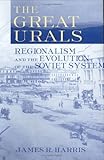
James R. Harris. The Great Urals: Regionalism and the Evolution of the Soviet System. Ithaca and London: Cornell University Press, 1999. viii + 235 pp. $43.50 (cloth), ISBN 978-0-8014-3478-5.
Reviewed by Eva M. Stolberg (Bonn University)
Published on H-Russia (July, 2003)
Ukraine-Moscow-Urals-Western Siberia: The Quadrangle's Struggle for Resources, or "Easterners" against "Westerners"
Ukraine-Moscow-Urals-Western Siberia: The Quadrangle's Struggle for Resources, or "Easterners" against "Westerners"
James Harris's volume on the Great Urals is dedicated to exploring the impact of regionalism on the development of the Soviet system at decisive stages from the October Revolution to Stalinism and the Gorbachev era. His study sets a high standard for those to follow in the regionalist tendency of current historiography.
Harris demonstrates an impressive command of archival documents on the Urals that permits an extremely accurate and refreshing analysis of the Urals' contribution to the development of the Soviet Union. The book demonstrates a strength that is not indicated by the title. It is more than a history of the Urals: it explores the mighty and dynamic shape of power among the players in the center-periphery relationship Ukraine-Moscow-Urals-Western Siberia.
The author examines the web of alliances and rivalries that date back to Tsarist times, and conflicting views of resource control. One gets the impression that the central government in Moscow was not the leading actor, but instead was caught in the ping-pong play between Ukraine and the Urals. Harris obliges us to rethink decisive periods of Soviet history like the "New Economic Policy," Stalin's forced industrialization, and Gorbachev's perestroika. The regions were those players who pushed the center for economic changes, often proceeding without Moscow's formal approval. Regionalism was an important counterweight to autocratic/centralist rule in the Tsarist and Soviet periods alike. One should remember that under Peter the Great the "iron magnates"--Demidovs and Stroganovs--made the Urals an important regional player. Like later party secretaries, the Demidovs and Stroganovs became regional chieftains. Harris is right in arguing that "regional interests each have their own historical evolution and identity" (p. 7.).
Chapter 1, "Regional Interests," outlines the rise and decline of metallurgy in the Urals between 1700 and 1900. By 1800 the Urals had become the world's largest iron producer, but fifty years later the boom was over, because regional entrepreneurs were slow in investing in new technologies to exploit the region's resources more efficiently. The abundance of forests and wood gave no incentive to use coal in metallurgy. The Urals became the great loser in Russia's industrialization; instead Ukraine stood on the winner's side. With the use of Donbas coal entrepreneurs in Ukraine succeeded by 1900 in producing 60 percent more metal than the Urals with higher mechanization thanks to foreign investors. This economic prosperity explains why Ukraine won a mighty position in the center-periphery relationship in the Tsarist regime and also why the government considered Ukraine as its pet, but the Urals as its stepchild.
The situation changed for a short time during the Civil War in 1918 when the Germans occupied Ukraine. The Bolsheviks in those years shifted investment plans to the heavy industry of the Urals, for strategic considerations. Four years later the interest of the central government in the Urals vanished. At the Eleventh Party Congress in 1922 Lenin made no secret of his preference: "The Donbas is the center, the real foundation of our industry. We cannot speak of the reconstruction of heavy industry in Russia, of any kind of real construction of socialism ... unless we give appropriate priority to the Donbas" (p. 24). This judgment proved to be realistic: Lenin's "New Economic Policy" could not rely on old metallurgy in the faraway Urals.
Chapter 2, "Regional Influences," examines the center-periphery relationship during the "industrialization debates" of the 1920s. Regional party secretaries demanded more economic control and financial autonomy. They also continually criticized the bureaucratism of VSNKh and demanded a transfer of administrative functions from the center to the regions (mesta), because the center's bureaucratic grip on the regions had a damaging effect on the supply of raw materials, financing, etc., to industry. This is clear evidence that regional elites were an influential pressure group in the Soviet system, which underlines its evolutionary character. Harris argues that the shift from "war communism" to NEP came from the periphery. Regional bosses had realized that the ruin of the Soviet economy in 1920 was the result of hypercentralized control. At least the New Economic Policy meant greater autonomy for the regions.
In chapter 3, "The Great Urals Plan," Harris describes the rise of the Urals-Kuznetsk industrial combine on the eve of the First Five-Year Plan. As the author points out, it was not just economic and technological cooperation: Urals and West Siberian regional bosses formed a kind of "Urals-West Siberian connection" as a counter to the Ukrainian monopoly on heavy industrial production. In V. V. Kuibyshev, chairman of VSNKh, they found an influential protector at the center who preferred an industrial shift to the east for strategic considerations, whereas Gosplan was very critical of Kuibyshev's idea. That is not surprising as Gosplan was a stronghold of Ukrainian bosses like Ia. B. Dimanshtein. In this tug of war over policy in 1927 regional bosses sought scapegoats among those who were not doing enough for regional interests. Indeed, rivalries among regional bosses were the real reason for campaigns that started in 1928 against "counterrevolutionaries" like the "Shakhty Affair" in the Ukraine and the "Uralplatina" in the Urals. The tempo of industrialization in the peripheries was heatedly debated. Harris gives proof that high-tempo industrialization, a long-cherished dream of regional bosses in Ukraine and the Urals, met increasing opposition from "bourgeois" specialists. Against the realism of the specialists regional party leaders pressed for maximizing industrial investments, at least, in order to strengthen their political prestige.
Chapter 4, "The Gulag," discusses the regional origins of the Gulag. It is well known that labor camps played a decisive role in Stalinist industrialization. Harris argues that Ural leaders pushed the center to expedite the camp system because of labor shortages. Labor shortages were not surprising for the underpopulated eastern periphery. Against the background of Ukrainian-Urals rivalry it is worth mentioning that dekulakized Ukrainian peasants contributed to the Urals industrialization and, therefore, Ukraine was forced to fill the deficits of the eastern periphery.
In chapter 5, "Breakdown," Harris convincingly shows that the industrialization of the Urals was quite ineffective, with the symptoms that were so typical for the planned economy: overspending on one side, poor organization and underfulfillment on the other side. Therefore, it is not surprising that near the end of the Second Five-Year Plan regional bosses sought again for scapegoats. Through the winter of 1935-36 the Urals were struck by campaigns against "wreckers." Obviously, a Stalinist economy that had permanent deficits inevitably required permanent scapegoats. From Harris's account one can judge that the atmosphere of mutual denunciation was not conducive for a successful industrialization.
The last chapter, "The Origins of the Urals Republic," presents a kind of conclusion and also opens windows into the process of decentralization from Khrushchev to Gorbachev. The contribution of the Urals to the victory in the "Great Patriotic War" resulted in a further rise of regional pride under Khrushchev and his successors. In the period of postwar reconstruction Khrushchev, who himself had started his career in a province, had an ear for regional interests and he convened a central commission that discussed with regional leaders their increasing participation in central administration. As Harris convincingly argues, Khrushchev thereby introduced a "Thaw" into the center-periphery relationship. But in his policy toward the regions Khrushchev followed a selfish interest like his successors Brezhnev and Gorbachev. As Harris convincingly argues, central leaders after Stalin saw in the regions a source for their own power.
Harris's study is a pathbreaking foray into Soviet regional history. It provides us with the new insight that the dynamic policy making of the regional elites like that of the Urals lets us rethink the character of autocratic and centralist rule in Russian history.
If there is additional discussion of this review, you may access it through the network, at: https://networks.h-net.org/h-russia.
Citation:
Eva M. Stolberg. Review of Harris, James R., The Great Urals: Regionalism and the Evolution of the Soviet System.
H-Russia, H-Net Reviews.
July, 2003.
URL: http://www.h-net.org/reviews/showrev.php?id=7848
Copyright © 2003 by H-Net, all rights reserved. H-Net permits the redistribution and reprinting of this work for nonprofit, educational purposes, with full and accurate attribution to the author, web location, date of publication, originating list, and H-Net: Humanities & Social Sciences Online. For any other proposed use, contact the Reviews editorial staff at hbooks@mail.h-net.org.

