



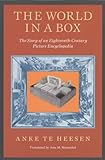
Anke te Heesen. The World in a Box: The Story of an Eighteenth-Century Picture Encyclopedia. Chicago and London: University of Chicago Press, 2002. xii + 237 pp. $60.00 (cloth), ISBN 978-0-226-32287-2.
Reviewed by Christine R. Johnson (Department of History, Washington University in St. Louis)
Published on H-German (July, 2003)
The Object in a Book
The Object in a Book
This is a book about the Bilder-Akademie fuer die Jugend of Johann Siegmund Stoy, an eighteenth-century Nuremberg pastor turned pedagogical entrepreneur. This picture encyclopedia lived up to its name: each of its fifty-four sheets of copperplate engravings contained nine separate images, for a grand total of 468 pictures. The central field always featured a Biblical story, while the encircling ones addressed such themes as secular history, nature, occupations, mythology, and moral lessons, with each image supposedly reflecting some aspect of the central image. With these lavish engravings came supplemental volumes of brief explanatory texts, often drawn largely or even verbatim from other elementary or encyclopedic works. Most intriguingly, after first being sold as entire sheets, the pictures were separated into 468 cards, a set that came complete with an organizing box whose nine compartments corresponded to the nine sections on each page. The individual cards could thus be taken out, handled, reorganized, and replaced.
Anke te Heesen advances two reasons for her microhistorical study of this object. First, that there is nothing special about Stoy's Bilder-Akademie. This turns out to be a good thing, because it allows her to use the picture encyclopedia as "an epitome of the Enlightenment" (p. 6), illustrating some of the basic pedagogical principles and practices of this crucial period in the history of education, when new theories of psychological development, rising standards of living, and the increasing prominence and self-confidence of the Buergertum created unprecedented interest (and opportunities for indulging that interest) in the formative possibilities of childhood. Second, te Heesen asks, if Stoy's work is representative of Enlightenment culture, why were the original engravings "transferred into a box?" (p. 8). What did the box contribute to the pedagogical mission of the work, and what does this development signal about the relationship between intellectual and material culture in the Enlightenment?
The World in a Box proceeds to establish these points carefully, methodically, and, in the end, persuasively. In the first section, "Book," te Heesen sketches the biographies of the book and its author and places them in the context of their peers, which more than adequately demonstrates their embeddedness within the traditions of children's encyclopedic literature and within eighteenth-century culture. (Stoy even suffers from the quintessential ailment of the period, namely hypochondria.) While this conclusion is hardly surprising, its demonstration gives te Heesen an opportunity to introduce readers to the world of eighteenth-century pedagogy; Comenius and Basedow make appearances, as do sensational psychology, the history of toys, and the Encyclopedie. Specialists in these individual fields may find themselves nodding at some points and quibbling about others, but most everyone will learn something new about the eighteenth century from this collection of information. This reader, for example, gained a real sense of the economic landscape of Enlightenment publishing in the important, but not central, city of Nuremberg. Te Heesen's approach does sometimes leave the individual components of her descriptions unconnected to each other or to the book's larger narrative. Stoy's hypochondria, for example, prompts a discussion of the link between the rise of this imaginary malady and the decline of (imaginary) witchcraft, not an examination of its relationship to the medical illustrations in his work.
The pictures take center stage in the second section, "Image," which analyzes their pedagogical role. Te Heesen again considers Stoy as part of a larger historical phenomenon, in this case, a tradition of educational images that stretches back to medieval stained glass windows. However, te Heesen then begins to offer original interpretations based on detailed examinations of the images in the Bilder-Akademie: where they came from (many were copied from other sources), how they were changed, and how well they transmitted information and ideas by themselves and in conjunction with the accompanying texts. The value of this narrow focus is evident in te Heesen's ability to trace the disjunctures and competing elements in the picture encyclopedia. One Biblical image, for example, is altered to focus more on the human element in the story, while another emphasizes the role of sudden, divine providence even more than its original source. The refreshing conclusion, therefore, is that the Bilder-Akademie "failed" in certain signal respects, a view supported not only through te Heesen's own reading of these images, but through quotations from contemporary reviews. In particular, Stoy's reliance on older traditions of Biblical imagery and emblematics is revealed as outdated, confusing readers rather than working in harmony with the text and the larger purpose of the work. In the end, knowledge and morality could not be harmoniously fused in late eighteenth-century Germany.
However inadequately fulfilled, Stoy's larger purpose was to valorize man's role in Creation: Creation is the work of God made for the benefit of man and under his control. And not just any man but, as te Heesen argues in the second part of the "Images" section, the upright, sober, rational Buerger. Through the gestural program of the pictures, proper behavior, centered on restraint, was supposed to be idealized and transmitted. Again, this strategy was imperfectly realized, and the resulting "heterogeneity in the pictorial effect" (p. 126) meant that the picture plates in both content and form teetered on the edge of uselessness.
What happened when these images were transferred into the box is examined in the final section, "Box." This material change, which made order tangible as well as visible, was the culmination of the Enlightenment educational project. The metaphysical and physical properties of the compartmentalized box, which te Heesen traces from its origin in printers' typesetting boxes through cabinets of curiosities and merchants' sample boxes, provided the training for the idealized Buergertum that the picture encyclopedia in its original form was unable to achieve. Substantiating this claim through comparisons with Enlightenment mnemonic theory, the encouragement of children's collecting by leading pedagogues, and the psychological effects of the haptic (tactile) sense, te Heesen gives the box an active role in the shaping of modern forms of knowledge.
If there is an overall argument in this book, it is that the box solves the problems that the page could not. And yet, as te Heesen briefly acknowledges at the end, many of the original problems (the small, cluttered images, the inconsistencies in depiction) still remained; the box could not create perfect order. While the sections on "Image" and "Box" sometimes work at cross-purposes, their individual contributions to the history of ideas and their dissemination are powerful and thought-provoking. Te Heesen demonstrates both the difficulties of realizing ideal (pedagogical) programs and the importance of manufactured material culture in these endeavors, suggesting how much can be drawn from a nuanced study of a single object. If she had continued to discuss the box's failure, te Heesen could have perhaps advanced our understanding of the frailties and tensions of late Enlightenment culture and the anxieties of Buergerlichkeit even further.
As a material artifact, The World in a Box is itself handsomely constructed, with generous allocations for plates and for a state-of-the-art appendix on the "Bibliographic Record of the Picture Academy." Although its contents are somewhat fragmented, this book (like a box), fits everything in eventually, with one signal exception: despite many references to the rise of pedagogical entrepreneurs, the development of new products, and the growing influence of mercantile and consumer culture (including te Heesen's insight that collections involved the ordering of private property), no section examines the Bilder-Akademie as an artifact of capitalism.
This, then, is less a book about eighteenth-century pedagogy (although it does serve as a genial introduction to this topic) than a contribution to the history of ideas and the history of material culture. It performs a valuable service to both fields in sensitively examining a distinctly middle-brow object, which was subject to due recognition in its time and undue obscurity since. In addition to specialists in these fields, The World in a Box will be of interest to graduate students and advanced undergraduates as a model of an object history.
Copyright (c) 2003 by H-Net, all rights reserved. H-Net permits the redistribution and reprinting of this work for nonprofit, educational purposes, with full and accurate attribution to the author, web location, date of publication, originating list, and H-Net: Humanities & Social Sciences Online. For other uses contact the Reviews editorial staff: hbooks@mail.h-net.msu.edu.
If there is additional discussion of this review, you may access it through the network, at: https://networks.h-net.org/h-german.
Citation:
Christine R. Johnson. Review of te Heesen, Anke, The World in a Box: The Story of an Eighteenth-Century Picture Encyclopedia.
H-German, H-Net Reviews.
July, 2003.
URL: http://www.h-net.org/reviews/showrev.php?id=7822
Copyright © 2003 by H-Net, all rights reserved. H-Net permits the redistribution and reprinting of this work for nonprofit, educational purposes, with full and accurate attribution to the author, web location, date of publication, originating list, and H-Net: Humanities & Social Sciences Online. For any other proposed use, contact the Reviews editorial staff at hbooks@mail.h-net.org.

