



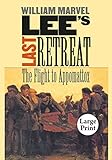
William Marvel. Lee's Last Retreat: The Flight to Appomattox. Chapel Hill and London: University of North Carolina Press, 2002. xiii + 328 pp. $29.95 (cloth), ISBN 978-0-8078-2745-1.
Reviewed by Terry L. Jones (Department of History and Government, University of Louisiana at Monroe)
Published on H-CivWar (June, 2003)
It is odd that the Appomattox Campaign has been largely ignored by the hundreds of scholars who have written thousands of books that have been published on the Civil War. Most studies that do cover the campaign give short shrift to Robert E. Lee's week-long flight in order to get to the drama of the Appomattox surrender on April 9, 1865. William Marvel, who previously wrote of the surrender in A Place Called Appomattox, now turns his considerable talents to the events leading up to that pivotal moment.
On March 25, 1865, Lee attempted to break out of the Petersburg siege by punching a hole through Ulysses S. Grant's line at Fort Stedman. Although initially successful, the attack stalled, and the Confederates were driven back into their own lines. Correctly guessing that Lee had stripped other parts of his defenses for this assault, Grant sent Philip Sheridan's command to Lee's far right on April 1 and crushed George Pickett's division at Five Forks. A general advance the following day sent the Confederates reeling and forced Lee to abandon Petersburg and Richmond. Lee hoped to move west to Amelia Court House and then south to join forces with Joseph E. Johnston in North Carolina. A race began between the Confederates and the pursuing Federal armies.
Marvel points out that the fighting did not end just because the Confederates were on the run. He recounts numerous clashes that occurred in the confused flight. The author also notes that Lee's army was still a potent force. Many students of the war believe the Confederates had little fight left during the retreat, but Marvel depicts several encounters where the Rebels fought effectively. At High Bridge, for example, Confederate cavalry trounced a Union detachment and captured approximately eight hundred men. A little-known fact is that Lee's army herded with it a large number of Union prisoners captured during the campaign.
Lee's retreat progressed fairly well until April 4. When expected rations and a critical pontoon bridge failed to arrive at the Amelia Court House area, Lee was forced to halt for a day. This gave Grant's armies the needed time to close in on the Confederates. Realizing the enemy had cut off his southern escape route, Lee resumed his flight on April 5 and headed west toward Lynchburg. The following day, Richard S. Ewell's command was cut to pieces at Sailor's Creek, and nearly the entire Confederate rearguard was captured.
On April 7, the situation was getting desperate, and Marvel communicates this effectively. On that day, Lee rejected a surrender demand sent by Grant, but did ask what terms Grant might seek. By now, the Confederates were disorganized and straggling badly. Sheridan's cavalry managed to gallop ahead and cut off Lee's route at Appomattox Court House. Fighting erupted in the area on April 8, and Lee made one last attempt to cut his way through on the morning of April 9. When it quickly became apparent that escape was impossible, Lee met with Grant at Wilmer McLean's house and surrendered.
Although largely ignored, the Appomattox Campaign was one of the war's most dramatic weeks. Marvel tells the story well, using soldiers' letters and diaries to recount the harrowing retreat and all of its suffering. One effective technique he uses is recounting the experiences of individual soldiers day by day throughout the campaign. It quickly becomes apparent that not every Confederate soldier experienced the same hardships. Some suffered greatly from exhaustion and hunger, while others were able to ride horses and forage quite well from surrounding civilians. The Union experience is also recounted, but not in as great detail. Still, the activities of Grant, Sheridan, George Custer, and others are told well.
The real value of this book is Marvel's confronting what he believes to be numerous myths about Appomattox. He claims the flight and surrender became a big part of the "Lost Cause" mentality, and former Confederates developed their own politically correct account of the event. Among the stories Marvel takes issue with is the popular belief that Union soldiers willingly shared their rations with the surrendered enemy and Joshua Lawrence Chamberlain's memorable story of saluting the defeated enemy at the final ceremony. The two greatest myths Marvel attacks, however, are the number of Confederates under Lee's command during the campaign and Lee's assertion that the missing supplies at Amelia Court House caused the fatal one-day delay. Both of these questions are addressed in the main text, but for more detail see the appendices.
In his memoirs, Lee's aide Walter Taylor wrote that only 25,000 Confederates reached Amelia Court House and only about 8,000 were paroled at Appomattox. He also stated that Grant had 162,239 men during the pursuit. This set the tone for the popular belief that Lee was cornered and captured because he faced six-to-one odds. Marvel claims these figures are incorrect because Taylor manipulated the data. For example, Taylor was citing Lee's "effective" strength (or those men carrying muskets) and not his "aggregate" strength (or those actually present). According to Marvel, Lee had as many as 57,200 men at the campaign's beginning, about 45,000 at Amelia Court House (which were more than he brought out of Maryland in the Antietam Campaign), and that some 28,000 Confederates actually accepted parole. Taylor explained that the additional 20,000 men who were paroled in the days following the surrender were non-infantrymen and stragglers who finally caught up with the army. Marvel, however, points out that the pursuing Yankees allowed few stragglers to escape capture on the road. He claims that Taylor and other former Confederates threw out their figures before the publication of the Official Records showed the correct numbers. They then were forced to explain the discrepancies. In fact, Marvel believes between 14,400 and 20,400 Confederates "disappeared without an honorable explanation" (p.105) during the month preceding the surrender.
Marvel claims Taylor also manipulated his figures for the Union army. Instead of Grant giving chase with 162,239 men, he actually had about 80,000 available. In other words, Marvel contends Lee faced less than two-to-one odds.
The author also takes issue with Lee's contention that a missing supply train led to the fatal one-day delay at Amelia Court House. Marvel believes that a missing pontoon bridge actually caused the delay. Lee had ordered the bridge to span the Appomattox River, but apparently his staff (perhaps Taylor) failed to follow up and it never arrived. Thus, when Ewell reached the river, he was forced to spend most of April 4 finding another way across. It was essential for Lee to keep the army concentrated to fight his way out of the closing trap, and he had to postpone the retreat until Ewell crossed over. If the missing rations were so important, Marvel argues, Lee could have continued on to Burkeville Station that day and received rations from Danville.
This reviewer's criticisms are rather minor. Although out of the author's control, one has to wonder why such an outstanding press cannot use footnotes instead of endnotes. Marvel has a wealth of information in the endnotes, but it becomes tedious flipping back and forth to find it. Also, the author's excessive use of his thesaurus becomes distracting. The reader finds that soldiers traipse, sally, tilt, sidle, lope, and canter. It is important to write descriptively, but sometimes soldiers just march or advance. Finally, whether intentional or not, Marvel seems to be overly critical of the Confederates who failed to be there for Lee's surrender. Exhaustion, hunger, blisters, and myriad other reasons caused devoted men to fall out. The author notes this but implies that most stragglers dropped out because they were cowards or just lost heart. To state, without knowing the circumstances, that as many as 20,000 soldiers disappeared without an honorable reason seems unfair.
These quibbles aside, Marvel effectively captures the drama and controversy of the Appomattox Campaign. The book is highly recommended, and its assertions no doubt will lead to considerable debate.
If there is additional discussion of this review, you may access it through the network, at: https://networks.h-net.org/h-civwar.
Citation:
Terry L. Jones. Review of Marvel, William, Lee's Last Retreat: The Flight to Appomattox.
H-CivWar, H-Net Reviews.
June, 2003.
URL: http://www.h-net.org/reviews/showrev.php?id=7791
Copyright © 2003 by H-Net, all rights reserved. H-Net permits the redistribution and reprinting of this work for nonprofit, educational purposes, with full and accurate attribution to the author, web location, date of publication, originating list, and H-Net: Humanities & Social Sciences Online. For any other proposed use, contact the Reviews editorial staff at hbooks@mail.h-net.org.

