



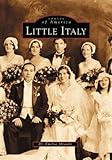
Emelise Aleandri. Little Italy. Charleston, S.C.: Arcadia Publishing, 2002. 128 pp. $19.99 (paper), ISBN 978-0-7385-1062-0.
Reviewed by Francis T. Ventre (Professor Emeritus, Architecture and Urban Planning, Virginia Tech)
Published on H-Italy (May, 2003)
Ever wonder where Il Progresso Italo-Americano came from, or Ferrara's torrone, or the Amato Opera Theater, or the Academy Award-winning actor Vincent Gardenia? Straddling Manhattan's Canal Street, east and west, and all along Mulberry Street, is New York's Little Italy--the best-known Italian neighborhood in America. The author, Emelise Aleandri, takes us from the 1880s to the present by way of 230 black-and-white photographs in a pictorial history of La Piccola Italia.
Only 3 percent of New York City residents were born in Italy in 1855. In 1900, the Italians grew by 225,000, far exceeding the growth of Rome. In 1904, 575,000 Italians came to New York City. What happened? Sicily and Southern Italy's grinding poverty met America's emerging need for unskilled and semi-skilled laborers and artisans. Enter Little Italy.
Most of the emigrants were from "south of Rome": Abruzzi, Molise, Puglia, Campania, Basilicata, Calabria, and Sicilia; and the emigrants did not speak the same language. Italy as a unified country was twenty years old by the 1880s, which was barely enough time to put an "Italian identity" on the map. There was no language that reigned supreme--rather, there were dialects. The people of the Little Italies wherever they were situated--Boston's West End, San Francisco's North Beach, St. Louis's The Hill, Philadelphia's Bella Vista neighborhood---were forced into an "Italian American identity," because there was no single language that predominated. This is where Little Italy is misleading: regional dialect precedes national language, especially in a post Risorgimento Italy. As Maddalena Tirabassi points out: "One need only mention the fact that dialects were, to all extents, the native language of most migrants, given the lack of a national language, and this in turn made any form of communication, and cohesion, more difficult" (emphasis added).[1]
This reviewer's paternal grandparents were from Felitto, near Salerno, and maternal grandparents were from Borgetto, near Palermo, in Sicily. They could not have understood one another. Of the 230 photographs contained in Little Italy, only 30 have the regions where the Italians came from. This is an important omission, particularly when many of the immigrants whose photographs were identified--your reviewer counted nine--came from "north of Rome," while most of the immigrants came from "south of Rome."
Little Italy contains these chapters: "Early Days," "Community" (here is where you will find Il Progresso Italo-Americano), "Religion," "Banking," "Food," "Entertainment" (Gardenia and the Amato Opera), "Business" (Ferrara's toronne), and "Exodus." It is in the final chapter that we get an idea of the spread of the Little Italies. The other four boroughs of New York City have their Little Italies too and that is where the Italians migrated from Manhattan's Little Italy. Some even moved back to Italy where the italoamericano could even speak their dialect. But, what about New Jersey, upstate New York, California, Pennsylvania, Illinois, and Washington? I am afraid Ms. Aleandri did not go far enough with her final chapter, "Exodus."
"The immigration quota laws that went into effect in 1924 restricted the annual importation of new Italians into the United States to two percent of the number that entered in 1890.... Little Italy was eventually greatly affected," writes Ms. Aleandri. "Today Little Italy, La Piccola Italia, is more piccola than ever." If you saw Martin Scorsese's Gangs of New York, you will know that Five Points, near Little Italy, is the place for immigrants to congregate: English, German, Irish, Italians, Chinese, and Asians. There is a photograph on page 123 that shows 198 Grand Street, between Mott and Mulberry, near Five Points. Six Italian places of business from 1894 until now are shown in the caption; Grand Sausages, Inc., a Chinese entrepreneur, now owns 198 Grand Street, where he and the Asian community are the majority.
It is the immigrant's third, fourth, and fifth generations that will buy Little Italy. Ms. Aleandi should be proud of what she has done. But those of us who need a more profound treatment of the subject will have to wait until some scholar has pieced together what Tirabassi has shown: that, for the Italians, dialect precedes national language. The result was to make it doubly difficult to communicate in their new nation. For that, the Italian immigrants needed their children--the Italian Americans--to lead the way.
Note
[1]. Maddalena Tirabassi, "Italian Cultural Identity and Migration," in The Essence of Italian Culture and the Challenge of a Global Age, ed. Paolo Janni and George F. McLean, The Council for Research in Values and Philosophy (Washington, D.C.: Catholic University, 2002), pp. 69-92.
If there is additional discussion of this review, you may access it through the network, at: https://networks.h-net.org/h-italy.
Citation:
Francis T. Ventre. Review of Aleandri, Emelise, Little Italy.
H-Italy, H-Net Reviews.
May, 2003.
URL: http://www.h-net.org/reviews/showrev.php?id=7609
Copyright © 2003 by H-Net, all rights reserved. H-Net permits the redistribution and reprinting of this work for nonprofit, educational purposes, with full and accurate attribution to the author, web location, date of publication, originating list, and H-Net: Humanities & Social Sciences Online. For any other proposed use, contact the Reviews editorial staff at hbooks@mail.h-net.org.

