



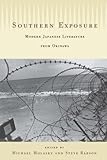
Michael Molasky, Steve Rabson, eds. Southern Exposure: Modern Japanese Literature from Okinawa. Honolulu: University of Hawaii Press, 2000. xii + 362 pp. $27.95 (paper), ISBN 978-0-8248-2300-9.
Reviewed by Monika Wacker (Freelance Interpreter and Translator, Munich, Germany)
Published on H-Japan (May, 2003)
So far scholars of Japanese Studies have mostly concentrated on the history, literature, religion, sociology, and politics of the main islands of Honsh=, Shikoku and Ky=sh=. Since the Meiji Era, Hokkaid= was added to the field of interest. The minority culture of the Ainu or Okinawans was a different field preferred by social anthropologists, for example. Now, at last, it seems that a new tendency for interdisciplinary studies has arisen. This anthology is an excellent example of such work, edited by Michael Molasky and Steve Rabson, both associate professors of Japanese Studies who have previously published works on Japan and Okimawa.[1]
This anthology of modern Japanese literature introduces eight poems and twelve short stories or novellas. All of the authors but one, Shimokawa Hiroshi, are of Okinawan descent and have been awarded regional or national prizes for their publications, including the three Okinawans who were awarded the Akutagawa Prize: =shiro Tatsuhiro, Medoruma Shun, and Matayoshi Eiki.
In an annotated introduction, the editors not only summarize the history of Okinawan literature of the twentieth century but also discuss intensively the use of, and the translation strategies for, dialect passages. As dialect is one of the ways to express identity it is used to some extent in the work of Okinawan authors. Depending on the context, each translator was free to choose the strategy "he or she felt best served the work at hand" (p. 9). Thus we find strategies ranging from a translation "into standard English with little of no textual indication that dialect is used" to romanization with or without explanations of the dialect terms (p. 9). We even find a translation using an English-language dialect "based loosely on the speech patterns of Appalachia" (p. 10), a choice closely linked to the personal experience of the translator. Brief information on the translators, both of Japanese and non-Japanese ancestry, is given at the end of the volume. Most teach Japanese or Japanese literature at various U.S. universities. Their experience is reflected in the high quality of the translations offered to a general readership unfamiliar with Japanese or Okinawan dialects.
Two-thirds of this introduction is dedicated to Okinawa's landscape, history, and culture with occasional reference to specific authors and their works. Here, the brief discussion of the tale "Cocktail Party" by =shiro Tatsuhiro, which is not included in this anthology, is confusing and a footnote would have been sufficient to draw the reader's attention to more readings in English. The historical and cultural facts are summarized very briefly, with the focus on the twentieth century after 1920, when the oldest of the translated materials was published. The only cultural issue not touched upon, although it plays a major role in some of the stories (for example, "Turtleback Tombs" by =shiro Tatsuhiro, and "Dream Relevations" by Takara Ben), is religion. Nowhere in the introduction is there mention of traditional religion, the ancestor cult or the existence of a state religion based on the belief in women's spiritual power, even though basic literature about Okinawan autochthonous religion is readily available in Lebras monography, for example. This lack of information on pre-Meiji culture and society also shows in the brief mention of high divorce rates and single-parent households, a statement which should not be over-interpreted in the light of war and post-war developments, since it has roots in a different attitude toward marriage and children born out of wedlock dating back to the Era of the Kingdom of Ry=ky=.
The themes of the poetry and short stories, included by virtue of the authors' identity, focus on traditional and modern historical and cultural issues of Okinawa prefecture, primarily the main island itself. They illustrate well the identity problems of twentieth-century Okinawans, including forced integration into the Japanese state from the 1870s onward, their experiences during the battle of Okinawa, and occupation by the United States until 1972. There are only two stories, "Will o' the Wisp" by Yamanoha Sueko and "Fortunes by the Sea" that build Okinawan characteristics around features other than those of war and post-war occupational experiences; these are built around Okinawan folk-beliefs and social relations. Before each work, the poet or author is introduced in a short note, optically distinguished by a frame. As one of the authors is represented in both categories, his introductory note appears twice--a redundancy that could have been replaced by a reference to the first introduction. However, the editors must have considered selective readers important enough to spare them the hassle of turning more pages than their precious time might permit.
The eight examples of poetry by five poets range in style from a Japanese translation of a traditional Ry=ky=an poetry (ry=ka) by Serei Kunio to very modern forms exemplified by Takara Ben's "Dream Relevations." Publication dates range from 1922 (Serei) to 1984 (Takara) with a strong emphasize on pre-war poetry, as six out of the eight examples are dated before 1940.
The focus of the anthology, however, is on the twelve short stories and novellas, each by a different author, which cover experiences of Okinawans under Japanese authority ("Officer Ukuma" by Ikemiyagi Sekih=, 1922) in prewar times; Okinawan and other minorities, such as Koreans in mainland Japan ("Memoirs of a Declining Ryukyuan Woman," including a defense of her work by Kushi Fusako, 1932; and "Mr. Sait= of Heaven Building" by Yamanokuchi Baku, 1938); wartime drama ("Turtleback Tombs" by =shiro Tatsuhiro, 1966); postwar experiences of women and their families with U.S. soldiers before and after the reversion to Japan in 1972 ("Dark Flowers" by Kishaba Jun, 1955; "The Silver Motorcycle" by Nakahara Shin, 1977; "Love Letter from L.A." by Shimokawa Hiroshi, 1978; and "Love Suicide at Kamaara" by Yoshida Sueko, 1984); post-war memories ("Bones" by Shima Tsuyoshi, 1973; and "Droplets" by Medoruma Shun, 1997); an unhappy love affair ("Will o' the Wisp" by Yamanoha Nobuko, 1985); and the identity problems of an adopted husband in modern society ("Fortunes by the Sea" by Matayoshi Eiki, 1998).
Here the emphasis is on the post-war period as only two examples were published before 1940, two during the occupation time (1945-1972), and the remaining eight after reversion to Japan and as recently as 1998. The order is strictly by date of publication, a first dramatic highlight being reached in "Turtleback Tombs" by =shiro Tatsuhiro. Of all the war- and occupation-related stories, "Droplets" by Medoruma Shun is outstanding. It does not lament the hopeless situation, but shows the pitfalls of refusing to deal with memories in a sincere way, and of using over-dramatized accounts to gain pity with an audience. Surely this new approach warranted the Akutagawa Prize.
With the main theme of the anthology as war and post-war experiences, the cover photograph showing a view of a beach through barbed wire is quite appropriate, although shocking. The anthology, however, clearly shows a tendency for issues dealing with the Okinawans' sense of alienation in the Japanese and American worlds, and favors a concentration on the uniqueness of local solutions to global problems, such as the brutal end of a love affair ("Will o' the Wisp" by Yoshida Sueko) or Japanese social conventions ("Fortunes by the Sea" by Matayoshi Eiki).
The volume is intended for the general reader interested in Japan, Japanese literature, or Okinawa and its literature. However, the last two pages meticulously list the sources for the original texts, so that interested scholars can easily go back to the original.
This anthology is a wonderful introduction to modern Okinawa not only for the student of Japanese literature or regional culture. Each of the translations is designed to help the western reader to understand the cultural background in an unobtrusive way. I would like to congratulate the translators and editors on the publication of such a wonderful anthology which leaves the reader eager for more.
Note
[1]. Michael Molasky, The American Occupation of Japan and Okinawa: Literature and Memory (Routledge, 2001); and Steve Rabson, Righteous Cause or Tragic Folly (University of Michigan, 1998). He also co-edited Okinawa: Two Postwar Novellas (University of California Press, 1989).
If there is additional discussion of this review, you may access it through the network, at: https://networks.h-net.org/h-japan.
Citation:
Monika Wacker. Review of Molasky, Michael; Rabson, Steve, eds., Southern Exposure: Modern Japanese Literature from Okinawa.
H-Japan, H-Net Reviews.
May, 2003.
URL: http://www.h-net.org/reviews/showrev.php?id=7546
Copyright © 2003 by H-Net, all rights reserved. H-Net permits the redistribution and reprinting of this work for nonprofit, educational purposes, with full and accurate attribution to the author, web location, date of publication, originating list, and H-Net: Humanities & Social Sciences Online. For any other proposed use, contact the Reviews editorial staff at hbooks@mail.h-net.org.

