



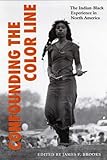
James F. Brooks, ed. Confounding the Color Line: The Indian-Black Experience in North America. Lincoln: University of Nebraska Press, 2002. xiii + 390 pp. $29.95 (paper), ISBN 978-0-8032-6194-5; $70.00 (cloth), ISBN 978-0-8032-1329-6.
Reviewed by Stephanie Gordon (Department of English, University of Georgia)
Published on H-AmIndian (May, 2003)
Intricate Connections: Indians and Blacks in North America
Intricate Connections: Indians and Blacks in North America
James Brooks's new edited volume is a welcome addition to the growing scholarship on the fascinating connections between Natives and African Americans in North America. The essays in Brooks's book discuss this topic from both Indian and black points of view and focus primarily on racial interaction through sexual liaisons and slavery (including the marriages and children that often resulted), and in communities. Of these categories, slavery and its legacy receives the most space. This interdisciplinary book contains thirteen essays and an introduction, and includes contributions from historians, ethnographers, legal scholars, literary critics, and Native and ethnic studies scholars. The essays are organized into three broadly overlapping sections: "Forging Relations," "The Legacy of Slavery," and "Complicating Identities." Chronologically, the sections move roughly from the past, when Natives and blacks first came into contact, to the present. Brooks notes in his introduction that the shared Indian-black experience of racial marginalization suggests a common area of analysis. While the first generation of scholars working with the intricate connections between Indians and blacks in North America were quick to see the commonalities between the races, they tended to focus more on the pathology and effects of racism--necessary, even unavoidable for the scholars beginning to open the field for study. Racial marginalization, white conquest, violence, and enslavement are certainly discussed in many of the book's essays, but this group of scholars attempts to move past these issues in an effort to widen and complicate the field of study.
Dedra McDonald begins part 1 with a discussion of Estaban, the enslaved Black Moor who was, as far as we know, the first black to set foot on this continent in 1539. This essay analyzes the ramifications of cultural contact between the two races in Northern New Spain; this contact came in the form of intermarriage and other sexual liaisons that led to the formation of racially mixed communities, although any African influence was later to become almost erased from Pueblo life. Claudio Saunt's award-winning essay explores the beginnings of plantation slavery among the Deep South Interior tribes of the Creek and Seminole as well as the different attitudes that developed between the tribes concerning their African slaves and other fugitive blacks. Russel Lawrence Barsh finds real community between black and Indian whalers in his essay on New England whaling communities, although their mutual pasts were ultimately effaced in favor of separating those backgrounds into either black or Indian identities (his graph on intermarriage between Africans and ninety-four Mohegan and Pequot families illustrates the book's basic theme of the racial ties in a particularly effective way). The final author in this section, Daniel Calhoun, sees the 1820 community of Parras, Coahula, as a microcosm for Native-African relations in North America and analyzes the ever-shifting strategies used to develop these racially mixed identities.
The second section looks at slavery and its aftermath, with a focus on African interaction with the Cherokee. Both Tiya Miles and Celia Naylor-Ojurongbe incorporate discussion of the WPA interviews with former slaves done in Oklahoma (the Oklahoma narratives are widely believed to be among the best of the WPA interviews) in the 1930s. Miles charts the influence of slavery on the removed southeastern nations and believes that while it is common to assert a less victimizing kind of slavery in relation to these tribes, this was not necessarily the case, while Naylor-Ojurongbe discusses the adjustments slaves made to their Indian owners and finds these same adjustments to often be complementary. Also referencing the WPA interviews, Laura Lovett notes that Crow-era African Americans claimed Indian ancestry in order to negate racial stereotyping, although the eastern Native groups eventually disassociated themselves from their African kinspeople and neighbors. Circe Sturm closes this section with an analysis of the Cherokee's relationship with the African slaves who would eventually become the freedmen and women and concludes that the tribe's blood politics are highly problematic because the Cherokee have always been more inclusive of whites than of blacks.
The final section brings us to the present. Ann McMullen's essay investigates blood politics in an Indian Country New England, arguing that black descent is seen as more compromising to Indianness than white descent, a pattern beginning to emerge from previous essays. Looking at the matter from an African American point of view, Ron Wellburn indicates that black pride in the Northeast has worked to subvert and subsume Indianness in African Americans. Racial reconciliation (a much-needed idea at this juncture) is Maylinda Maynor's overriding theme; her essay analyzes the Lumbee's borrowing of black influences in their church music. C. Richard King takes on the difficult subject of Indian mascots, noting that Natives find little support at the local or national level from African American leaders concerning the use of Indian mascots. The final essay in this book is by Valerie Phillips and references her attendance at a 2000 Dartmouth conference devoted to relations between Natives and blacks. In a low key, wide-ranging essay, Professor Phillips, who is of Cherokee and Black descent, discusses her racially mixed background and her views concerning some of the papers read, films seen, and heated discussions overheard at the Dartmouth conference. She concludes that Africans and Indians are both fundamentally tribal people who must push past seeing each other through the white man's eyes--a fitting ending to a fascinating and troubling collection.
The book raises some concerns. The essays tend to privilege discussion of interaction between Cherokees and Africans; this seems primarily due to the wealth of information contained in the WPA interviews regarding slavery in Cherokee Territory. Although Claudio Saunt's essay does provide an engaging, complicated synthesis of Creek and Seminole attitudes regarding slavery, the book also could have benefited from extended discussion of the Choctaws and Chickasaws, since they were also slave-owning Nations. In addition, I found almost no information on the western tribes, even though they too interacted heavily with blacks. Finally, although one would expect a literary scholar to say as much, the lack of information about William Apess, a Pequot minister and activist who died in approximately 1839, was also a concern. What little I read--referenced primarily in Barsh's excellent essay--only increased my desire for more. In his edited volume of Apess's works, Barry O'Connell makes a convincing case for Apess having had a racially mixed mother. Apess is also well-known for tackling post-Puritan racism against Africans (and Natives); an analysis of why he chose to do so while subverting his own black ancestry would have made a riveting addition to this volume. But my concerns are few, overall, because this book surpassed what it set out to do: complicate the color line and open our eyes to the difficulties inherent in Native-black interaction.
If there is additional discussion of this review, you may access it through the network, at: https://networks.h-net.org/h-amindian.
Citation:
Stephanie Gordon. Review of Brooks, James F., ed., Confounding the Color Line: The Indian-Black Experience in North America.
H-AmIndian, H-Net Reviews.
May, 2003.
URL: http://www.h-net.org/reviews/showrev.php?id=7531
Copyright © 2003 by H-Net, all rights reserved. H-Net permits the redistribution and reprinting of this work for nonprofit, educational purposes, with full and accurate attribution to the author, web location, date of publication, originating list, and H-Net: Humanities & Social Sciences Online. For any other proposed use, contact the Reviews editorial staff at hbooks@mail.h-net.org.

