



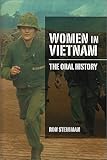
Ron Steinman. Women in Vietnam: The Oral History. New York: TV Books, 2000. 271 pp. $26.00 (cloth), ISBN 978-1-57500-139-5.
Reviewed by Donna M. Dean (Independent Scholar)
Published on H-Minerva (April, 2003)
Lest They Be Forgotten
Lest They Be Forgotten
Women tend to be forgotten as warriors and participants on the battlefield and in war zones, although that may change somewhat with the war in Iraq and the high-profile individual women who have been killed, taken prisoners, or are missing in action. The Vietnam War was far different. Many people, including veterans, did not and do not realize that there were many American women in Vietnam, both in and out of uniform. It is this neglect that the author seeks to correct, at least to some degree. Sadly, a theme that appears repeatedly in the stories is the fact that even some male veterans who served in Vietnam deny there were ever any women there, thus further exacerbating the feelings of exclusion and neglect many of the women express.
This book is comprised of interviews conducted by Ron Steinman for a television documentary, "Women at War." Steinman is an acclaimed journalist, television producer, news producer, and author who served as the NBC Bureau Chief in Saigon during the war. The sections of the book are divided into brief stories of the women who served, who are also separated into several categories. The largest section consists of interviews with six Army nurses and one Air Force flight nurse, two entertainers, two "Doughnut Dollies" or Red Cross Recreational Specialists, and four WACs who served in support positions. There are no interviews with Navy nurses or Navy WAVES, although one or two did serve in-country. Although missionary women are mentioned briefly, there are no interviews.
In reading through the book, some themes appear throughout the stories, regardless of what the individual's job might have been, and regardless of whether the woman's voice is that of a uniformed member of the armed forces, a Red Cross volunteer, or an entertainer. All of the women suffer severely from delayed stress reactions of PTSD (Post Traumatic Stress Disorder) and their condition has been exacerbated by the hostility, neglect, avoidance, or disinterest in the receptions they received when they returned home. The Vietnam War was decidedly unpopular, and there was no "support the troops" movement. Returning troops returned alone, not as a unit as they had in previous wars, and so did the women. They were met with the same hostility as the soldiers, and if they continued to wear the uniform, they continued to reap the whirlwind of political decisions over which they had no control. Heartbreakingly, one nurse tells of having to wear civilian clothes over her uniform to enter and leave the base where she was stationed to avoid the violent displays of anger and anti-war sentiment.
Most of the women were extremely young when they were ordered or volunteered to go to Vietnam, and na=ve as well. They received little or no preparation for entering a war zone, dealing with the horrendous conditions, or, in the case of the nurses and flight nurses, trying to treat hideous wounds direct from the battlefield with poor or even inadequate equipment. Most were forced to carry out their assignments under constant bombardment and deadly danger. Their accounts are full of the coping mechanisms of individuals under such circumstances, the psychic numbing, over-indulgence in alcohol, promiscuity, and self-isolation; each woman had her own way of trying to survive, and each paid a terrible price for her sacrifices. When they returned home, none spoke of their experiences after a few abortive tries; no one wanted to hear it or to know. So they kept silent for many years, until something triggered the overwhelming grief and anger, causing it to spill over. The lucky ones got therapy. By then, it was too late to reconstruct a full, normal life, but all the women in this book have managed to create a meaningful life. (If the stressors are sufficiently traumatic, the time elapsed between the events and subsequent diagnosis and treatment make it less likely that a total erasure of symptoms will be possible. Most Vietnam PTSD sufferers require lifetime medication and continue to suffer symptoms of varying severity.)
The entertainers and Red Cross women were subjected to the same battlefield conditions, often going into the field to entertain or cheer up small groups of soldiers actually in combat. They traveled by plane, helicopter, Jeep, and truck. Perhaps the most famous of the entertainers, Cris Noel, traveled to Vietnam again and again at her own expense, forfeiting a promising career. Previously, she had been a rising star on the "A List," with ready access to any film or work she desired. After she returned from the battlefield, she found herself blackballed by anti-war Hollywood, her career in shambles.
The "Doughnut Dollies" angrily talk about the effects due to exposure to Agent Orange, and the fact that they have no access to specialist care since only VA doctors have any experience dealing with their condition, and only veterans of the military may utilize VA facilities. Other justifiable anger is expressed about the failure to include the names of the civilian women killed in Vietnam; it minimizes their contributions and sacrifices, making the loss of their lives even more futile.
Perhaps it is the ones who were not interviewed--possibly because they are dead from suicide, or too fragile or too angry to talk, or the author did not know how to find them--that are the saddest ones of all. This reviewer has met many such women, listened to their stories, and sorrowed over the destroyed lives of the women who went to Vietnam young and hopeful, and returned old and hopeless, and have never found their way home.
A notable lack of mention, with one vague exception, is any reference to the women who experienced sexual harassment, rape, and other violence perpetrated upon them while in Vietnam. There is one account of a murder, and the horrible lack of justice which ensued, but there is little evidence that many of the nurses, at least, were forced into things they did not want. Many Vietnam nurses tell of the forced attendance at the constant parties, the forced sex and resultant abortions as well as other outrages. One of the interviewees, Lily Adams, a well-known figure among veterans, who has influenced the Agent Orange issue, appears in a movie and talks about the devastating effects of the racism she encountered while in Vietnam. A petite Asian woman, she was often mistaken for a civilian prostitute when out of uniform, and harassed by the very men she had just tried to heal. This documentary, "Invisible Forces: Women In The Military," contains many stories of such events.
It is impossible to read Women in Vietnam without reliving those horrendous times for those of us old enough, and even those who have no personal experience with the war or the era will be moved by the unspeakable horrors and courage of these women. The book is highly recommended for anyone interested in reading what it was like to be in the middle of a war, trying to bring order and healing out of violence and chaos, and bleeding inside while having to put on a brave face. It is certainly recommended for academic use. Moreover, it should be read by those politicians who appear to take war lightly, at the same time dismissing veterans and their health care needs to the extent that the VA health care system is being gutted. Unable to care adequately for the current number of veterans requiring medical attention, the present war will serve to overload the grossly underfunded and understaffed VA system.
If there is additional discussion of this review, you may access it through the network, at: https://networks.h-net.org/h-minerva.
Citation:
Donna M. Dean. Review of Steinman, Ron, Women in Vietnam: The Oral History.
H-Minerva, H-Net Reviews.
April, 2003.
URL: http://www.h-net.org/reviews/showrev.php?id=7487
Copyright © 2003 by H-Net, all rights reserved. H-Net permits the redistribution and reprinting of this work for nonprofit, educational purposes, with full and accurate attribution to the author, web location, date of publication, originating list, and H-Net: Humanities & Social Sciences Online. For any other proposed use, contact the Reviews editorial staff at hbooks@mail.h-net.org.

