



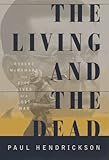
Paul Hendrickson. The Living and the Dead: Robert McNamara and Five Lives of a Lost War. New York: Alfred A. Knopf, 1996. ix + 427 pp. $27.50 (cloth), ISBN 978-0-679-42761-2.
Reviewed by Oscar Patterson (University of North Carolina at Pembroke)
Published on H-PCAACA (December, 1996)
McNamara According to Hendrickson--Power Corrupts
Robert McNamara was president of Ford Motor Company, president of the World Bank, and Secretary of Defense under presidents John F. Kennedy and Lyndon Johnson. He was completely confident in the technological and military capacity of the United States. But it took him thirty years to admit that "we were wrong, terribly wrong" in the decisions made about Vietnam. If the numbers worked, McNamara believed, all else followed.
The Living and the Dead is painstakingly researched and often at odds with McNamara's own version of events. It examines his life in California, his career at Ford Motor Company, and his Vietnam-era decisions. It is Hendrickson's selection of those decisions and his exposition of how they intertwined with five disparate individuals that makes this one of the most unusual and compelling texts about the war in Vietnam.
James Farley had his picture on the cover of Life magazine in 1965. At a time when U.S. forces were still "advisors," Farley's unit was engaged in direct contact with the enemy and "a mass casualty situation was declared"--seventeen wounded and at least two dead, and it was only a troop-ferrying mission.
Norman Morrison's picture didn't make the cover of Life. Morrison, a Quaker, drenched his clothes with kerosene and struck a match. Directly below McNamara's office window in the Pentagon, Norman Morrison burned to death protesting the war in Vietnam. He dropped his daughter, Emily, seconds before the flames completely consumed him.
Marlene Vrooman went to Vietnam straight from a Catholic nursing program. Like most Army nurses, she was young and inexperienced. She saw little blood during her training, but at Qui Nhon in 1966 her unit treated 115 cases in under thirty hours. "There was no time to change linens between patients."
Tran Tu Thanh is the third son of an influential Saigon family. He became a captain in the ARVN and, after the Communist victory, spent fifteen years in prison. The Trans, he says, were patriots. The suffering was destiny.
The year 1965 is when the Vietnam War became an American war. In the later part of 1965, Secretary of Defense McNamara testified in the Westmoreland/CBS trial, he had reached the conclusion that the war could not be won militarily. If at that point, in late 1965, a major political figure, a Secretary of Defense, had stood up and called the war unwinnable, had tendered his resignation as proof of his determination and transformation, then maybe, just maybe, Norman Morrison would not have died, Marleen Vrooman would have learned so much about death a little more slowly, and Tran Thranh would not have spent almost five years in a room two meters five by 85 centimeters wide.
The essence of Hendrickson's argument is that McNamara was a man who could have changed history by standing up for his insights: if the Secretary of Defense had made his stand in 1965 rather than in 1995, there would be 50,000 fewer names on a memorial in Washington and a young artist would not have tried to push McNamara off a ferry in Martha's Vineyand Sound. This is a strong indictment that has been voiced by many, but it may lack a historical understanding of the dynamics of the Vietnam war--a national effort with both overseas and domestic dimensions. Furthermore, some have argued that the "defeat" in Vietnam can be traced to McNamara's policies--not his inability to speak his conscience. The story is a complex one, which Hendrickson explores in one very powerful dimension in prose that is powerful and emotive.
Hendrickson is an accomplished journalist and a dogged researcher. His stories are not gentle stories, but his work is clear, colorful, and provocative. Arrogance and power, Hendrickson shows, corrupt and corrupt completely. Robert McNamara was a victim of the power he wielded as Secretary of State; will others make the same mistakes in the future?
This review is copyrighted (c) 1997 by H-Net and the Popular Culture and the American Culture Associations. It may be reproduced electronically for educational or scholarly use. The Associations reserve print rights and permissions. (Contact: P.C.Rollins at the following electronic address: Rollins@osuunx.ucc.okstate.edu)
If there is additional discussion of this review, you may access it through the network, at: https://networks.h-net.org/h-pcaaca.
Citation:
Oscar Patterson. Review of Hendrickson, Paul, The Living and the Dead: Robert McNamara and Five Lives of a Lost War.
H-PCAACA, H-Net Reviews.
December, 1996.
URL: http://www.h-net.org/reviews/showrev.php?id=717
Copyright © 1996 by H-Net and the Popular Culture and the American Culture Associations, all rights reserved. H-Net permits the redistribution and reprinting of this work for nonprofit, educational purposes, with full and accurate attribution to the author, web location, date of publication, originating list, and H-Net: Humanities & Social Sciences Online. For any other proposed use, contact P.C. Rollins at Rollins@osuunx.ucc.okstate.edu or the Reviews editorial staff at hbooks@mail.h-net.org.

