



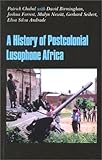
Patrick Chabal, with David Birmingham, Joshua Forrest, Malyn Newitt, Gerhard Seibert, Elisa Silva Andrade. A History of Postcolonial Lusophone Africa. Bloomington and Indianapolis: Indiana University Press, 2002. xx + 339 pp. $22.95 (paper), ISBN 978-0-253-21565-9; $49.95 (cloth), ISBN 978-0-253-34187-7.
Reviewed by Colin Darch (African Studies Library, University of Cape Town)
Published on H-Luso-Africa (January, 2003)
Summarizing Twenty-Five Years of Struggle
Summarizing Twenty-Five Years of Struggle
In their new book, Patrick Chabal and his five co-authors attempt to synthesize in a single volume, although not in a single text, the chequered contemporary history of the Portuguese-speaking African countries (aka the PALOP), since the mid-1970s. The work is divided into two main parts, a long and thoughtful introductory essay by Chabal entitled "Lusophone Africa in Historical and Comparative Perspective," and a series of five country studies by each of the other authors. These include surveys of Guinea Bissau by Joshua Forrest, Cabo Verde by Elisa Silva Andrade, and Sao Tome e Principe by Gerhard Seibert. These contributions vary considerably in style and presentation and, as Chabal points out, can be read independently of one another (p. xix). There is a bibliography of fifteen pages or so, compiled by Caroline Shaw and organized by country, with a short selection of literary works at the end of each section. It must be said that the relationship between the bibliography and the essays is not made as clear or consistent as it might have been. In his lively essay on Angola, for example, David Birmingham simply refers readers to it a couple of times, and then offers us hardly any further supporting references. In her essay on Cabo Verde, on the other hand, Elisa Silva Andrade includes over sixty specific footnotes.
The book is a companion volume to an earlier work, also compiled under Chabal's editorial leadership, The Postcolonial Literature of Lusophone Africa, and has a similar physical look and feel. However, in a literary universe defined by the overwhelming predominance of works written in Portuguese, by writers who read and influenced each other across national boundaries, a "Lusophone" project on fiction and poetry makes prima facie sense. I am less convinced that the same necessarily holds true for political, economic, and social history.
This is an ambitious undertaking, then, partly because it is far from self-evident that the five countries in question constitute any kind of meaningful category for study, although one might hesitate to mention this on a discussion list called H-Luso-Africa. It is also ambitious because of the wide variation in the development of the various national and foreign historiographies, the basis for such syntheses; Chabal is of course aware of this (pp. 31-32). The five Portuguese-speaking countries certainly do not make up a region in any commonsensical meaning of the term, except perhaps to monolingual English-speakers, since they are scattered all over southern and western Africa and the Atlantic Ocean, and have had dramatically differing post-independence experiences. Of course, it is quite possible to write a history of territories linked by something other than contiguity, but one can imagine, for example, what a history of the Commonwealth, or even the Commonwealth in Africa, might look like. It would probably not be a history of the organization's constituent parts: it would almost certainly be a history of the "club's" interventions or non-interventions in such political crises as Rhodesian UDI, the struggle against apartheid, or even the execution of Ken Saro-Wiwa in Nigeria in 1995. But such an option would have offered slim pickings for Chabal et al., since the "Cinco," the organization that grew out of the CONCP after independence, and later became known as the PALOP, has been noted only rarely for its political activism or group influence.
Given the loose structure of the book, to succeed the attempted synthesis has to operate at two levels. First, in the lengthy opening section, which is thematically as well as chronologically organized, Chabal needs to pull together common themes from the shared experience of Portuguese colonialism, apart from language. He does in fact cautiously identify some of these: the bureaucratic legacy of Portuguese colonial administration, for example (pp. 43-44), and the post-independence Marxist option followed by all the dominant parties (p. 58 et seq.). Second, in the country chapters, the other contributing authors should pick up and explore these themes in greater depth, on the basis of a reading of current historical research and interpretation. But it is precisely here that the book's lack of coherence lays it open to criticism. Chabal has opted to favor in-depth country familiarity over interpretative consistency, by choosing the five country experts rather than finishing the book himself, or even allowing his essay to stand on its own. This may be fair enough. However, a title such as Essays on the History of Postcolonial Lusophone Africa might have been a more logical choice under the Trade Descriptions Act.
Chabal admits in the preface that "there seems at first little to connect these five disparate African countries" (p. xvii) and even when he finds something that they share, he is soon compelled to hedge his bets, e.g. similarities "in ideological vocabulary [between FRELIMO and the MPLA] concealed vast differences" (p. 62). Nonetheless, he is interested in comparative politics, and makes a virtue of breaking free of what he calls in his preface "the narrow Lusophone focus which afflicts most accounts of Portuguese-speaking Africa" (p. xviii).
Chabal's long essay is organized around three topics--the end of empire, nation building, and the limits of nationhood--which also serve as a kind of periodisation. Regarding the process of decolonisation, Chabal poses some interesting questions: how important were the specifics of Portuguese Africa for the development of nationalism? What was the meaning of the experience of the luta armada? What did the attempted revolutionary program signify? What does all this tell us about the present predicament of the five countries (p. 17)? His answers largely conform to what Soviet ideologues (the vovos) were saying in the 1970s and 1980s, although the terminology is different: you need to develop the forces of production before you can transform the relations of production (p. 28). FRELIMO and the MPLA were both guilty of voluntarism, or as we might say nowadays, of a lack of pragmatism.
Chabal's second chapter is a detailed examination of the relationships between the revolutionary projects of the nationalist parties and the need to build a sense of nationhood. As he points out, the party (or more correctly, the Party) was supreme, and society was to be remade in its image. He describes the difficulties that ensued in some detail, and is especially interesting on Guinea. He refers more than once to FRELIMO's realisation that political unity was more important than the repression of opposition, a view that he explicitly attributes to the influence of Cabral (p. 115). Newitt supports this view in broad terms (p. 195). The movement's own political history presumably taught its own lessons.
David Birmingham's chapter on Angola is a lively read with a strong analytical line. The scene is set in colorful terms on the night before independence, with artillery pounding the Luanda suburbs and the last Portuguese proconsul in Africa sneaking away on a gunboat under cover of darkness. After a brief outline of the political economy of the three geographic zones of Angola, we are taken briskly through the 1980s and 1990s to a justifiably pessimistic conclusion, written before Savimbi's death brought the prospect of peace and perhaps even democracy.
Although Birmingham touches briefly on historiographical issues in his account of the battle for Luanda in 1975 (pp. 137-138), this reviewer was ultimately frustrated here as elsewhere in the book by what can only be called the authoritative tone of the account. It would have been interesting to know, with regard to Angola as with regard to the other countries, what are the current historical bones of contention in contemporary historiography. Unfortunately, since the text on Angola is almost entirely innocent of footnotes, much of Birmingham's argument has to be accepted on trust and his views on the sources cited remain unknown.
Malyn Newitt, the author of the Mozambican chapter, has already produced a respected volume of synthesis on Mozambican history as a whole, which has appeared in English and in Portuguese. However, his account here of post-independence Mozambican history is sometimes muddled and frequently contentious. For example, he appears to be saying that the nationalization of July 1975 was implemented by the Transitional Government, but this may be simply poor editing (pp. 193-194).
Similarly, Newitt argues that Mozambique inherited a favorable economic legacy from its colonial rulers (p. 188), a view sharply contradicted in work by some economic analysts, such as Marc Wuyts. Indeed, Newitt's passing reference to mounting balance-of-payments problems as early as 1977 inadvertently opens the possibility that the Mozambican economy was not entirely healthy at the time of independence (p. 206). Newitt's view that there was a continuity between the Frelimo liberation war and the subsequent fighting with RENAMO, to the extent that it creates "a continuous history of political violence and social breakdown" up to 1992, is possibly true from the point of view of the grass, but probably not from the perspective of the elephants.
FRELIMO is described as "torn by increasingly bitter internal quarrels" and the assassination of Eduardo Mondlane in 1969 is attributed to these, with no mention of Portuguese agency. Similarly, an unnuanced phrase describes FRELIMO's military campaigns of the late 1960s as having been "largely confined to the extreme north and to the shore of Lake Nyasa," which is true as far as it goes (p. 189). Was FRELIMO ineffective militarily? Published work by Mozambican researchers such as Joao Paulo Borges Coelho have shown that an initial push by FRELIMO in the north had been contained by 1969, for specific political reasons, while a battle of wits was going on elsewhere as guerrillas infiltrated into Tete from Zambia.
As in Birmingham's case, Newitt's authoritative tone is not an entirely reliable guide to where controversy is to be found lurking. He refers to the Mozambican "civil war" for instance, without indicating that this characterization of the war was the subject of a heated debate in the late 1980s (p. 185). Again, his view that the Mozambican state "disintegrated" after independence (he uses the term twice on p. 185) might be thought an exaggeration, especially in comparison with the situation in such countries as Somalia, Liberia, or Sierra Leone. Certainly Maputo's writ was geographically limited by the late 1980s, but it is hard to argue that the state ceased to function, however incoherent it may have been.
It is simply too early for the satisfactory achievement of what Chabal and his colleagues are attempting. There are already signs that local historical writing in some Lusophone countries, especially Mozambique, is becoming available and will gradually become part of general historical knowledge. One thinks, for example, of the series of dissertations by young Mozambican scholars presently being published by Promedia in Maputo. But these interpretations still need to be fully absorbed and dealt with by scholars in Europe and North America.
This is not a book for specialists, but will serve very well for Anglophone readers with little or no Portuguese who need an overview of what, from their point of view, may well constitute a meaningful categorization of African countries by language.
If there is additional discussion of this review, you may access it through the network, at: https://networks.h-net.org/h-luso-africa.
Citation:
Colin Darch. Review of Chabal, Patrick; Birmingham, with David; Forrest, Joshua; Newitt, Malyn; Seibert, Gerhard; Andrade, Elisa Silva, A History of Postcolonial Lusophone Africa.
H-Luso-Africa, H-Net Reviews.
January, 2003.
URL: http://www.h-net.org/reviews/showrev.php?id=7062
Copyright © 2003 by H-Net, all rights reserved. H-Net permits the redistribution and reprinting of this work for nonprofit, educational purposes, with full and accurate attribution to the author, web location, date of publication, originating list, and H-Net: Humanities & Social Sciences Online. For any other proposed use, contact the Reviews editorial staff at hbooks@mail.h-net.org.

