



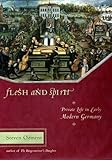
Steven Ozment. Flesh and Spirit: Private Life in Early Modern Germany. New York: Penguin Putnam, 2001. xvi + 348 pp. $15.00 (paper), ISBN 978-0-14-029198-8; $29.95 (cloth), ISBN 978-0-670-88392-9.
Reviewed by Susan R. Boettcher (Department of History, University of Texas at Austin)
Published on H-German (December, 2002)
The Wins of the Fathers
The Wins of the Fathers
Steven Ozment's record as one of the most well-known and active scholars in the field of Reformation history--he is one of the few professionals in this field who still reaches a wider audience with his books--demands the consideration of historians who have focused their writing on narrower audiences. The latest addition to his oeuvre is a collection of five extensive micro-histories of family relationships among the civic elite of early modern Nuremberg. Building on previous research on some of these families, particularly the Behaim, he tells five absorbing stories that illustrate important themes in family history. Compellingly narrated, these gripping accounts draw the reader into a concrete and fascinatingly detailed account of daily life in the imperial city. Ozment is also to be complemented for his translation of a vocabulary and repertoire of customs often obscure to the lay reader with a minimum of awkwardness, though relatively frequent typographical errors and some infelicities of translation in this edition may be distracting. As has often been the case with Ozment's work, this book seems likely to appear controversial to specialists, but an examination of the stories Ozment relates and the conclusions he draws may serve to demonstrate that specialists were not the primary audience for this book.
His first account, of the betrothal negotiations of Lucas Friedrich Behaim and Anna Maria Pfinzing, illustrates the difficulties involved in negotiating patrician marriages. These family mergers represented not only the personal union of two individuals, but more importantly necessitated complex financial agreements and tricky political rapprochements between families who shared generations of common history in the civic elite. The second deals with the offspring and family life of Christoph Scheurl and his wife Katharina, who were extremely unfortunate even by the brutal statistics of the age; they suffered ten miscarriages or premature births in the first thirteen years of their marriage. Here Ozment also discusses the matter of fostering arrangements, for the Scheurls reared four poor relations along with their own children. The third chapter recounts the difficulties of Magdalena Behaim in providing her son Paul with an appropriate Paduan legal education without, however, bankrupting herself and her other children in the process. Here Ozment uses the surviving correspondence to trace an account of tension, detailing Magdalena's conviction that her son was a spendthrift and Paul's protests that his costs were appropriate to his basic needs and education. A fourth chapter draws on the diary of Sebald Welser, a nineteen year old studying in Louvain in 1577. This account details Welser's interest and growing involvement in Catholic piety, along with his struggles to control his drinking as he approached maturity. Here Ozment raises the interesting question of what confessionally-coded behaviors mean in his account of Welser's contacts with Catholicism. Welser was a Lutheran, but took a loyalty oath to the Catholic church in order to matriculate at the university as well as kissing a monstrance and purchasing an indulgence. Ozment concludes that confessional lines and behavior were in much greater flux in the sixteenth century than we often assume, a message particularly important for the non- specialist reader.
The saddest account Ozment provides is the last, which depicts the relationships between Nuremberg pastor Lorenz Duernhofer and the nine of his twenty-three children who survived to adulthood through a family chronicle written by Duernhofer himself.[1] Ozment describes a series of challenging professional peregrinations between Nuremberg and Saxony in Duernhofer's career. The predominating theme of the chapter is the disappointment caused to Duernhofer by his offspring generally and especially by his eldest son, Lorenz, Jr., who failed in every vocational opportunity his father provided, from Latin school to a business apprenticeship to noble service.
Ozment's accounts have the power to fascinate quickly and keep the reader's attention. Consequently, this book would be particularly well suited as a textbook in courses on early modern Europe, a genre in which much of Ozment's work has enjoyed an almost unparalleled success and in which specialists demonstrably make use of research they otherwise find controversial. These micro-histories are exceedingly well narrated, no matter what one takes their meaning to be. Ozment derives their significance from his challenge to the framework of scholarly judgments about the relative merits of pre-modern and modern families, writing that historians who emphasize contrasts in these institutions "have at best exaggerated the differences between past and present, while at worst they have virtually demonized our ancestors" (p. x). This charge against his colleagues may constitute an overstatement, but issues of comparison between modern and early modern families are intriguingly presented and leap from the pages of Ozment's book. In many regards, however, this research is still liable to the sorts of criticisms made of his earlier work by specialists in early modern social and family history who disagree, to varying degrees, with his conclusions.[2] Most notably, Ozment does little to compensate for the inherent flaws of the genre of micro-history, and focuses exclusively on sources from the wealthiest level of an elite society. He also neglects comparative analysis, either to other social groups or other cities, while drawing conclusions about early modern Germany generally. A comparison to the remnants of less prosperous families and their activities as found in story.
Ozment is not really speaking to a scholarly audience here, however, since he responds only generally to this sort of criticism with which he must already be familiar. Instead, he has devoted himself to creating a coherent and personal vision of the early modern family for interested readers. Consequently it seems most worthwhile to determine if Ozment's narrative and evidence demonstrate his claim that the early modern family did a better job than its modern counterpart of protecting children and preparing them to face life's challenges. He carefully delineates the tendency of early modern parents to evaluate their children based on whether they repaid the investment of time and money made in them, or not; in this, it seems clear, there are disturbing similarities between pre-modern and modern families. Frequently, though, this tendency seems to be a matter of class; wealthier people often have more material resources and energy to devote to their children's upbringing, and the reader is left uncertain as to whether this point demonstrates the relative success of early modern families. When these families fail in their objective of protecting and preparing their children, as Ozment concludes happened in the case of Lorenz Duernhofer, Jr., the failure is attributed to the lacking personal qualities of the child. To some extent this is an interpretive problem in the sources, which reflect the assumptions of a society more hierarchical than our own and usually do not provide the subject of an account with an opportunity to respond.
It is uncertain, however, that the Duernhofer story (as Ozment asks us to understand it) really illustrates his claim that early modern families protected and prepared their children more effectively. In it, we see a young man whose mother died in his childhood, who was afterwards mothered successively by an ailing grandmother and a second wife, who was quickly occupied with her own pregnancies and children; his parents moved three times during his childhood, in an age where most people rarely traveled more than thirty miles from home; he lived in what we would today call a blended family; he switched schools at least three times after the last move; and his father was one of the most prominent religious notables in an age of confessional turmoil raging in every community where the family lived. After relating this saga of unsettlement in the lives of Lorenz, Jr. and his two sisters, Ozment remarks upon Duernhofer's chagrin at his son's failure to succeed in school. "To discover then that one's eldest child and only son, in whom so much was invested emotionally and materially, simply lacked the aptitude and/or self-discipline to follow in a father's footsteps was a traumatic parental experience, second only to a child's death. If all the children in the past did not get the parents they deserved, there were also parents denied the children they were worthy of" (pp. 245-246). A parent today would look at this recital of transitions and consider the possibility that Lorenz's lack of self-discipline was not only a flaw of character, but was related as well to the lack of continuity in his oft-disrupted life. A psychologist trained to see such matters from the child's perspective might even venture to suggest that it was a coping strategy developed over years of sudden change. Substantiating this position is the fact that his full sisters apparently disappointed their father as well (p. 247). But Duernhofer's unfulfilled expectations were not limited to the offspring of his first marriage; a son from his second marriage was similarly unable to live up to Duernhofer's academic expectations (pp. 255-256). Was Duernhofer too impatient with his sons? Or given his heavy civic and religious obligations, was he what we today might term an absent father? Similarly, in his account of Paul Behaim's conflicts with his mother, Ozment never pauses to consider the possibility that Paul might have had a more realistic idea of the cost of legal studies in Italy than his mother (who had never been there), or that the complaints of parents over the profligate spending of their progeny, then as now, often have a rhetorical ring to them.
Ozment does not treat these questions, and in his accounts of various sorts of family arrangements, the parental point of view almost always wins the day. To note, as Ozment does throughout, that the circumstances of these families (at least for this age and social class) were not unusual does nothing to mitigate their occasionally disastrous effects on those forced to respond to them. That the peculiar economic, political, religious and social circumstances of early modern Germany shaped the characteristics of the early modern family life is undeniable. Still, one is puzzled by Ozment's closing statement: "The family has historically subjected its offspring to high physical, education, moral, and spiritual demands, sparing them neither swift punishment nor stubborn love...[T]he family of the past did not intend to deny the young their dreams, [but] only to save them from nightmares" (p. 268).
His accounts make it painfully clear that despite its best efforts, the early modern family as a construction was subject to all sorts of influences from which it could not, ultimately, fully protect its members. This was particularly true of disease, economic reversal, political misfortune, or the early death of a parent. In this regard, too, the modern family shares many similarities with its early modern predecessor.
Notes
[1]. This source genre is an important one, barely explored in organized fashion. Readers interested in learning more could turn profitably to the recent book of Susanne Rau, Geschichte und Konfession (Munich and Hamburg, 2002) for specific examples from Bremen, Breslau, Hamburg and Cologne.
[2]. For example, by Robert M. Kingdon in American Historical Review 81 (1976), pp. 1143-1144; Thomas Max Safley in Sixteenth Century Journal 15 (1984), pp. 126-128; Lyndal Roper in Journal of Modern History 58 (1986), pp. 263-264; Susan Karant-Nunn, in Journal of Interdisciplinary History 23 (1992), pp. 368-369; and Gerald Soliday in American Historical Review 106 (2001), pp. 1478-1479.
If there is additional discussion of this review, you may access it through the network, at: https://networks.h-net.org/h-german.
Citation:
Susan R. Boettcher. Review of Ozment, Steven, Flesh and Spirit: Private Life in Early Modern Germany.
H-German, H-Net Reviews.
December, 2002.
URL: http://www.h-net.org/reviews/showrev.php?id=7043
Copyright © 2002 by H-Net, all rights reserved. H-Net permits the redistribution and reprinting of this work for nonprofit, educational purposes, with full and accurate attribution to the author, web location, date of publication, originating list, and H-Net: Humanities & Social Sciences Online. For any other proposed use, contact the Reviews editorial staff at hbooks@mail.h-net.org.

