



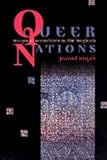
Jarrod Hayes. Queer Nations: Marginal Sexualities in the Maghreb. Chicago: University of Chicago Press, 2000. xi + 307 pp. $50.00 (cloth), $20.00 (paper), ISBN 978-0-226-32105-9.
Reviewed by Frances S. Hasso (Gender and Women's Studies Program and Department of Sociology, Oberlin College)
Published on H-Gender-MidEast (December, 2002)
Voice, Silence and Other Voices
Voice, Silence and Other Voices
I review Jarrod Hayes's Queer Nations: Marginal Sexualities in the Maghreb as an interdisciplinary scholar of nationalism, gender, and sexuality in the Middle East and North Africa, rather than as a literature expert. The text, which is largely based on analysis of postcolonial Maghrebian novels, is breathtaking in its theoretical breadth, depth, and sophistication. Engaging with postcolonial, feminist, queer, psychoanalytic, and cultural studies approaches in a range of disciplines, it begs for wide cross-disciplinary reading and engagement. I successfully assigned the book to undergraduates in an interdisciplinary gender and sexuality in the Middle East and North Africa course, and in the future would assign it with one or two of the novels analyzed by Hayes.
Hayes, who is a scholar of French and Francophone studies, begins with the premise that hegemonic discursive deployments of nationalism frequently exclude--indeed, depend on the repression or sublimation of--the marginal and dissident in collective and individual histories, experiences, and identities in the Maghreb. Hayes's project, in contrast, is recuperative of a post-colonial nationalism that insists on the plural, hybrid, dissident, and marginal in national history. Although the regional category of Maghreb includes Tunisia, Morocco, and Algeria, most of the texts analyzed are by Algerians, followed by Moroccans, and then Tunisians (the latter works are addressed primarily in chapter 12).
Maghrebian post-colonial literature, he argues, has insisted on unburying and exposing the presence of sexual dissidence, marginal sexualities, gender insubordination, ethnic and religious plurality, polyvocality and hybridity in the histories and experiences of peoples in the region. Maghrebian authors of fiction, Hayes argues and demonstrates, have woven in these repressed aspects of identity and history to express and help produce what might be termed counter-nationalist nationalist narratives that are inclusive and destabilizing of hegemonic Nationalist stories. In this respect, they queer the nation so that it hears and includes its margins, in the process reshaping the dominant narrative and challenging hegemonic social realities. Hayes and the Maghrebian-authored texts he analyzes resist the hegemonic through the rearticulation--rather than erasure--of memory, history, and identity so that the outcomes are more ambiguous and complicated. There is a continual play in Hayes's account between "revealing," "unburying," and "unhiding," on the one hand, and revolutionary transformation, or at least instability, on the other. What is hidden is potentially explosive. Hayes, like many of the Maghrebian authors he discusses, provides no full narrative closure.
Voice and silence--the power of voice and the repression involved in silencing dissident women, alternative masculinities, political opposition, marginal sexualities, hybrid identities, and minority locations--are important parts of Hayes's story. How do we study silences given the marginalization one must assume is always present in the dominant narrative? It often requires engagement with these sorts of texts (fiction and poetry). Indeed, the book (like the novels and other texts it engages) fundamentally challenges some of the artificial divisions between fact and fiction, novel and memoir, history and memory, the real and the imagined. It also acknowledges the emancipatory possibilities of speaking and exposing what is queer, or marginal and dissident, in all experiences and histories. I would argue that such a project can only work if it avoids imposing a new disciplining and unifying framework and if it addresses the multiple dimensions of inequality and privilege, which Hayes deftly accomplishes.
As someone whose Middle East research and teaching has not significantly focused on the Maghreb, the book highlighted for me the artificiality of regional conglomeration (theoretically, empirically, culturally, and politically) that defines the "Middle East" as from Morocco to Iran. I leave arbitration and debate to the literature scholars of the region, but issues of hybridity, marginality, and queerness within the nation may be more relevant to post-colonial Maghrebian literature than they are to (colonial and postcolonial) Levantian literature, for example. Or they may be relevant in different ways. I am not sure. Below, I discuss in more detail a number of chapters in Queer Nations.
In "Reading and Tourism," Hayes recognizes the ways in which the Arabian has often been a place for European appropriation and "Orientalist fantasies, sexual and other" (p. 25). He also, however, highlights how homophobia is part of anti-Orientalist critiques of sexual tourism that "trope homosexuality as essentially exploitative" (p. 26) and fail to notice or decry the link between colonialism and the consolidation of compulsory heterosexuality in the metropole and the colonies. In "Moha the Theory Machine," Hayes uses the work of Tahar Ben Jelloun to demonstrate the ways in which an ostensibly mad character who resists attempts to control him, Moha, speaks for the sexually, politically, socio-economically, religiously, ethnically, and gender marginalized in post-colonial Morocco. Moha also speaks the words of and verbally jousts with the colonizers, patriarchs, post-colonial economic elites, and nationalists who would silence, physically erase, or imprison the marginal. Using Moha, Ben Jelloun illustrates that both colonial elites and post-colonial nationalist elites view women's dissidence, feminism, as a menace (pp. 56- 57). By speaking of that which is subordinated and exists at the margins, Moha insists on the hybridity and polyvocality of the Maghreb and refuses the binaries of colonizer versus Nationalist and masculine versus feminine. Moha represents the issues and people in a society and history that can never be fully repressed--they are there, always threatening to speak.
In "Homosexuality (Un)veiled," Hayes argues that sexuality "is central to the narrative economy" of many Maghrebian novels in that sexual transgression and dissidence are often allegories for political and other opposition to the dominant order (p. 73). Rachid Boudjedra's first novel, La r=pudiation (1969) "not only lays bare the mechanisms by which nationalism represses homosexuality to naturalize the Nation as heterosexual and homosocial, but also stages a return of this repressed to denaturalize official paradigms of national identity" (p. 74). Similarly, Hayes argues that Boudjedra's Les 1001 ann=es de la nostalgie (1979) "explicitly establishes sexual liberation as a prerequisite for successful struggle against colonial and neocolonial oppression" (p. 74). In Les 1001 ann=es, Hayes also sees places where Boudjedra presents national liberation as "threaten[ing] to turn men into women at the most biological level, thereby overturning the hierarchy between them and denaturalizing it" (p. 75), although he cautions how in other places, Boujedra, like Franz Fanon and others (p. 78), can be read as communicating a "male imaginary" in which "a dangerous female sexuality threatens to get out of control and invade the spaces traditionally reserved for [Maghrebian] men--the streets, the public square, and caf=s" (p. 76). Hayes also argues that La r=pudiation , even as it presents male homosocial heterosexuality as unstable (pp. 92-93) and heterosexual/homosexual "difference" as always permeable (p. 91), can also be read to reinforce "the nationalist stereotype of homosexuality as a foreign vice imposed by colonialism" (p. 79). In these novels, homosexuality (which must be repressed) and women's sexuality (which must be veiled and contained) are potentially destabilizing, threatening, and subversive of political order.
"Skeletons in the Closet" focuses on the work of Tahar Djaout, a "critic of both the religious right and military ruling elite" in Algeria who was assassinated in the summer of 1993, allegedly by Islamist extremists (p. 96). Djaout's novel Les chercheurs d'os (1984) allegorically insists on remembering and unveiling national secrets through a brother's forced task to dig up the remains of his FLN brother, only to be required by post-colonial nationalism to rebury him even more deeply since his secrets (which include how he was killed) threaten the National order. Homosexual (and sexual) repression, in Djaout's novels, is required in order to consolidate power (p. 112). Djaout brings those hidden skeletons out of the nation's historical closet in his writings (p. 97) and makes parallels with contemporary extremist Islamist projects that aim to control women (p. 108). In this way, he marks and brings to light the violence that Ernest Renan (1882) argued was at every nation's origin (p. 108). In Djaout's work, the repression of marginal sexualities, non-Arab identities, and political dissidence, and the post-colonial elite's willingness to consolidate rather than redistribute wealth (p. 99), invariably come back to haunt and destabilize the Nation (p. 105)--no wonder that skeletons are buried even deeper (p. 103). Hayes draws on Algerian novelist Assia Djebar, who demonstrates how this process of exhumation and reburial for political purposes was not merely a literary allegory, but the practice of 1960s postcolonial Algerian leaders who unburied, selectively remembered what served their political projects, and buried deeper the threatening aspects of nationalist heroes and their histories (pp. 114-119). The marginalized and disappeared memories, pasts, and peoples--particularly when they are revealed--are dangerous to the nation and its official discourses.
In "Sex on Fire," the focus is on Algerian literature written in the revolutionary and pre-revolutionary periods. Hayes argues that rereading Mohammed Dib's combat novel Qui se souvient de la mer (1962), which describes a revolution in full swing, indicates that "the revolution against colonial rule had also always been sexual" (p. 136). The character of Nafissa--a wife, mother, and revolutionary bomber--does not limit her attacks to colonial targets, but challenges the traditional family as well as the more "'modern' heterosexual monogamous couple--established by choice and out of mutual respect and love--that many nationalists have proposed to replace the traditional family as the building block of the new Nation" (p. 137). Nafissa's freedom of mobility and explosive power disturbs the husband narrator and threatens masculinity and family forms premised on gender dominance. Nafissa plants bombs in the colonial city whose reverberations could be heard in their home (pp. 137, 139). For Dib, Hayes argues, "the veil hides a danger, be it woman or bomb" (p. 142), a fire that threatens to spread and burn all in its path, including the heterosexual bed (pp. 142-143). For Fanon, Hayes argues, there is "an absence of coitus at the time of revolution; sex and revolution do not mix"--Fanon argues for the inclusion of women into the revolution but "exempts the Nation's bedrooms from revolutionary change" (p. 146). Dib's vision, in contrast, is more destructive of the traditional heterosexual couple and patriarchal family structure.
In "The Haunted House of the Nation," Hayes discusses the novel Nedjma (1956), also the name of its main woman character, by Algerian Kateb Yacine. The novel was published two years after the anti- colonial insurrection began (p. 149). Hayes argues that while the novel has largely been read as an allegory of the awakening of Algerian national consciousness, "it is also an allegory of the failure of any narrative to write the Nation without marginalizing or doing violence to a portion of its citizens" (p. 150). Nedjma challenges the idea of a physical or cultural "return" to a decolonized, ethnically pure national origin, root, source, place, or ancestry (p. 150), and is itself written in a manner that disrupts an invented national chronology (p. 151). In Nedjma, "Any attempt to narrate an Algerian identity separate from the neighboring nations, even the colonizer, will find that the course of that identity also flows into the Mediterranean, into a common identity shared by the Maghreb, southern Europe, and eastern Mediterranean countries" (p. 154). The character Nedjma, and her house, are haunted by ancestors and "the ghosts of history" (p. 153), which include the marks on the land (ruins) of various North African invaders and the blood that was spilt (155). In the end, Nedjma "rewrites the nationalist paradigm of return by multiplying sites of origin" (p. 156), and "guards Nedjma from interpretive closure," in the process also guarding Algerian national identity from the same (p. 157). Nedjma, a revolutionary force who is sexually unruly (like her mother) (p. 157), moving, and potentially explosive, also challenges the three main embodiments (citing Bruno Etienne) of women in Algerian nationalist discourse: "guardians of tradition, honor, and national virtue," "freedom fighter as symbol of historic legitimacy," and "peasant as symbol of authenticity and keepers of the land" (p. 158). Nedjma turns the nationalist allegory of woman as nation on its head. Or at least mimics it in a way that does not produce predictable outcomes.
In "Becoming a Woman," Hayes uses Tahar Ben Jelloun's two-novel sequence--L'enfant de sable (1985) and La nuit sacr=e (1987)--to discuss the process by which gender is "stamped onto the bodies and minds" of girls and women (p. 165), particularly through language, although rape is another way in which the character Ahmed/Zahra experiences womanness (p. 172). This gender constitutive process (like the one for constructing a national identity and consciousness) is dependent on violence that must be forgotten by girls and women. The texts reinforce Judith Butler's insistence that gender is unstable and performative--drag--involving forgetting that gender is performed and remembering it as natural (pp. 170-2, 176).
In "Personalizing the Political," Hayes discusses Assia Djebar's model for writing history whereby ghosts are resurrected and brought back "to haunt the present" (p. 183). She "digs up women's role in history as well as their suffering and resistance, which have, like the queer ghosts..., been hidden from history in colonial and nationalist historiographies" (p. 183). She also "offers a narrative of revolution in which women's liberation is consistent with the Nation's," unlike some male Algerian authors (p. 185). In Djebar's vision of national struggle there is room for women and for feminists--her nation is a feminist one (p. 188) and thus she does not reject nationalism and its possibilities for women (p. 196).
In "Escaping the Identity Police: Le=la Sebbar," Sh=razade, the protagonist in Franco-Algerian Sebbar's series of semi-autobiographical--although the author refuses this categorization (p. 216)--novels, "thwarts all attempts to control her identity" (p. 215). Sh=razade is an immigrant to France "who challenges dominant models of both French and Maghrebian national identities through feminist resistance" (p. 216). Sh=razade violates gender and national scripts of behavior and existence, resisting the Orientalist gaze and its representation of her by miming the clich=s while challenging them (pp. 234-236). Sh=razade is supposed to return to Algeria (return to origins) but gets off the boat at the last minute and thus her journey fails (p. 217). After being kidnaped by Lebanese guerrillas and then released, she returns to France to complete a film about a transported olive tree, thus narrating "a notion of roots that are transplantable, of identity rooted in narrative fiction" (p. 217). For Sebbar (and Sh=razade), "[i]t is as if, after colonization and the resulting diaspora, no return to a precolonial authenticity or prediasporic experience can occur" (p. 231). Moreover, "roots are not planted before the narration of return to origins. It is the narration itself that plants, replants, even transplants roots" (p. 238).
If there is additional discussion of this review, you may access it through the network, at: https://networks.h-net.org/h-gender-mideast.
Citation:
Frances S. Hasso. Review of Hayes, Jarrod, Queer Nations: Marginal Sexualities in the Maghreb.
H-Gender-MidEast, H-Net Reviews.
December, 2002.
URL: http://www.h-net.org/reviews/showrev.php?id=7006
Copyright © 2002 by H-Net, all rights reserved. H-Net permits the redistribution and reprinting of this work for nonprofit, educational purposes, with full and accurate attribution to the author, web location, date of publication, originating list, and H-Net: Humanities & Social Sciences Online. For any other proposed use, contact the Reviews editorial staff at hbooks@mail.h-net.org.

