



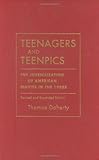
Thomas Doherty. Teenagers and Teenpics: The Juvenilization of American Movies in the 1950s. Revised and expanded edition. Philadelphia: Temple University Press, 2002. x + 266 pgs. $24.95 (paper), ISBN 978-1-56639-946-3; $76.50 (cloth), ISBN 978-1-56639-945-6.
Reviewed by Daniel Cavicchi (Rhode Island School of Design)
Published on H-Amstdy (October, 2002)
Because the power of teens in the fifties is most frequently summed up in the story of rock 'n' roll's rise from regional underground music to multi-million dollar corporate force, it is easy to forget that teens did not conquer America with music alone. Teens were particularly enthusiastic economic supporters of a popular culture system that included an array of increasingly connected urban amusements from radio and television shows to advertising and fashion to magazines, music, and film. In Teenagers and Teenpics, originally published in 1988 and now available in a new revised edition, Thomas Doherty explores the development and impact of teen culture on the film industry. In broad terms, the story is not that much different from the one associated with music: it is about mainstream entertainment executives trailing behind their independent counterparts and realizing, with amazing slowness, that the world around them has permanently changed. In the specifics, of course, there are differences depending on the history of each medium; while the story of rock 'n' roll offers insight into complex age, race, class, and regional divisions in 1950s America, the story of the teenpic more readily captures the national economic shift from "mass culture," catering to all, to "teen culture," targeting the 12-21 set.
While the music business had been primed for change during World War II--fragmented by limits on record production, a musicians' strike, and competing regional styles--Hollywood was still producing and marketing films in a traditional manner: from "the top down," relying on a national and powerful system of studio-run production and distribution. In fact, Hollywood had always proven resistant to social change, most notably weathering the upheavals of the Depression and World War II with consistently high profits. But in the early fifties, a number of calamities forced the industry to join other entertainment corporations struggling with significant change. First, the U.S. government initiated several crackdowns on the industry, in the form of the Sherman Anti-Trust Act and HUAC investigations. Then television lured adults away from theaters in startling numbers, pulling ahead of movies in terms of market share and cultural influence. Finally, in a double financial blow, countries overseas levied new taxes and regulations on U.S. entertainment ventures, and new domestic tax loopholes encouraged the formation of more and more independent production companies. As studio heads felt the floor falling out from beneath them, they acted desperately, cutting back on the numbers of pictures made and selling their film catalogs to television networks. Miffed at this "sell-out," many exhibitors turned to low-budget and independent fare to keep the screens alive and fill the seats. That low-budget fare was known as the "exploitation picture," which was, historically, any picture with timely subject matter that could sustain expanded marketing, but which, over the course of the fifties, grew to refer to a specific kind of film that combined controversial subject matter (delinquents, aliens, rock 'n' rollers), outrageous marketing (giveaways, doctors in the aisles to aid the frightened) and a carefully targeted audience (teens).
Doherty incorporates a number of different disciplinary perspectives in telling this story, first outlining the parallel plot lines of a failing film mainstream industry and a growing teen culture, and then highlighting their collision in various teenpic genres, including the rock 'n' roll film, the juvenile delinquent film, the horror film, and the "cleanpic" (featuring wholesome teens learning life lessons). Doherty's definition of teen film genres is useful, combining structural analysis with the more mundane (and sometimes more important) social realities that shaped such structures. This approach is best realized in his recounting of the crass but strangely honest motives of teen-exploiting executives James H. Nicholson and Samuel Z. Arkoff at the horror film powerhouse AIP films. Nicholson and Arkoff created a genre, but they did so with an eye toward money not art, hastily building the content of films from carefully conceived advertising campaigns rather than the other way around. Doherty also gives a lot of attention to the government and civic concern in the fifties about teen delinquency, but argues for the ways in which teenpic producers purposely did not push the envelope of the production code or social morality (despite what their advertising implied) for fear of losing their market, something apparently lost on the bumbling Kefauver Committee that investigated film violence in the 1950s (and again among the Senate Commerce Committee doing the same in 2000). Throughout, such contextual discussions are interwoven with numerous and consistently insightful analyses of the characters, plots, and marketing strategies of teenpics like Teenage Crime Wave (1955), Rock around the Clock (1956), and I Was a Teenage Werewolf (1957).
While much film criticism is steeped in gravely serious theoretical gobbledy-gook, Doherty's prose reveals an inviting sense of humor about some of the situations and characters he discusses. It is as if Doherty adopted the approach of some of the "B" filmmakers he describes, who jettisoned the pseudo-artistic pieties of their trade and concentrated instead on the real business of reaching and holding an audience with compelling content. Many lines are just plain laugh-out-loud:
"At one point, segments of the industry tried 'to wean the teenagers away from rock 'n' roll' with a campaign 'to establish the polka and commercial corn dance music as the next national craze.' Unaccountably, Steve Wolowic's Polka Band failed to knock Gene Vincent and the Bluecaps off the pop charts." (p. 45)
"Like the early rock 'n' roll teenpics, the drag-strip cycle both validates and domesticates a controversial teenage activity. A Freed-like mediating agent, often a sympathetic cop, is the buffer between worrywart town elders and grease-monkey kids. Complicating matters is a chicken race for honor and, usually, an accidental automotive death, often instigated by a speed-crazy female hellcat." (p. 88)
"Arkoff and Nicholson [owners of the horror film company AIP] were always quick to point out the they maintained a happy working relationship with the Production Code Administration and overseas censorship boards. AIP kept the cleavage of 'The Astounding She-Monster' (1958) within prescribed limits; the British censors in turn agreed that because the title creature of 'It Conquered the World' was neither human nor animal, it was not entitled to Review Board protection against wanton cruelty and could, therefore, be blow-torched to death." (p. 130)
Even an innocent sentence like "Teen idol transmedia exploitation advanced apace in the career of Edd 'Kookie' Byrnes" (p. 173) comes across as simultaneously serious--understanding the ways in which teen idols served to redefine and realign the popular culture industries in the 1950s--and slightly mischievous, juxtaposing such idols' importance for understanding film and society with the sheer goofiness of their marketed personas.
Overall, Doherty's combination of business history, social history, and narrative analysis is seamless and compelling, representing one of the heights of film criticism since 1980. He focuses on both the logic and the absurdities of movies in the post-War age, revising our understanding not only of teen films but the whole Hollywood machine. On a micro-level, the book's focus on teens puts a number of contextual facts in a new light. For example, we learn that the puzzling prevalence of Biblical and ancient pictures ("sword and sandal" epics) in the fifties was not simply a fad but purposefully meant to lure international audiences back to theaters with "universal" stories, magnificent sets, and blockbuster special effects, or that the reason for the blatant miscasting of "dreamboat" Jeffrey Hunter as Jesus in the "King of Kings" (1961) was done in order to appeal to the all-important teen demographic. On a macro-level, the book traces the beginnings of a new Hollywood, built less on the vertical integration of its studio empires and more on the horizontal combinations made possible by new media technologies. Doherty's discussion of "transmedia exploitation," where a star in one medium crosses over to star status in another (music's Elvis Presley or Pat Boone becoming film idols, TV's Ricky Nelson or Annette Funicello becoming music and movie stars), significantly places the teen movement on a larger cultural scale, aptly showing the ways in which teens helped to unify American popular culture industries just as the popular culture industries were learning how to best exploit teen culture.
Despite the quality of the Unwin Hyman edition of Teenagers and Teenpics, the edition from Temple University Press is an improvement on the original. First, it has a more interesting design. The cover is suitably lurid, featuring a sprawled and ravished young woman and mimicking the visual style of paperback novels in the early 1950s. The chapter endnotes and endnote symbols have been edited out of the text, with the notes arranged at the end of the book according to page number and relevant phrases. In addition, the photograph and poster examples have been given a clearer printing, without the half-tone screen blurring the image, and the text itself has been given a fresh and readable typeface. Content-wise, Doherty improved on the original by "correcting typos, purging mistakes, repairing syntax, and blue-penciling a few boneheaded comments." He also added a short section to the final chapter that updates the analysis of teenpics to include teen movies in the age of AIDS. While those readers who have read the book before may find that such changes do not go far enough to justify buying a new copy, this re-release is sure to create a new group of converts to the author's work, inside and outside of academia. Whatever the audience, Temple's release will keep the book around on the bookstore shelves for a while longer, something it richly deserves.
It is a testament to Doherty's expertise that, among the over 150 films that Doherty screened, analyzed, and referenced in the book, I found only one minor inaccuracy: a description of a teacher in Blackboard Jungle (1955), whose jazz records are destroyed by hoodlum students in one of the more famous scenes from the film, as a "music teacher" (p. 58). He was actually a math teacher trying to use music to reach out to his students, something that makes the students' betrayal even more horrifying.
If there is additional discussion of this review, you may access it through the network, at: https://networks.h-net.org/h-amstdy.
Citation:
Daniel Cavicchi. Review of Doherty, Thomas, Teenagers and Teenpics: The Juvenilization of American Movies in the 1950s.
H-Amstdy, H-Net Reviews.
October, 2002.
URL: http://www.h-net.org/reviews/showrev.php?id=6837
Copyright © 2002 by H-Net, all rights reserved. H-Net permits the redistribution and reprinting of this work for nonprofit, educational purposes, with full and accurate attribution to the author, web location, date of publication, originating list, and H-Net: Humanities & Social Sciences Online. For any other proposed use, contact the Reviews editorial staff at hbooks@mail.h-net.org.

