



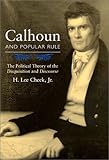
H. Lee Cheek, Jr. Calhoun and Popular Rule: The Political Theory of the Disquisition and Discourse. Columbia and London: University of Missouri Press, 2001. xii + 202 pp. $29.95 (cloth), ISBN 978-0-8262-1333-4.
Reviewed by John M. Sacher (Department of History, Emporia State University)
Published on H-South (October, 2002)
John C. Calhoun: American or Aberration?
John C. Calhoun: American or Aberration?
Where does John C. Calhoun belong in the pantheon of the American political tradition? H. Lee Cheek, Jr. seeks to answer this question by examining Calhoun's thoughts as expressed in his Disquisition on Government and his Discourse on the Constitution and Government of the United States. Both of these works were written during the last years of Calhoun's life (with the Discourse remaining unfinished upon Calhoun's death in March 1850), and both treatises were first published posthumously. In his examination of these texts, Cheek stresses that Calhoun should hold a prominent place in the American political tradition, specifically because of his ideas regarding the dangers of majority rule and his solution to this problem--the concurrent majority. While Calhoun and Popular Rule successfully places Calhoun in the history of American political thought, the book too often removes Calhoun's ideas from his life and times.
Cheek seeks to rescue Calhoun's reputation, for the South Carolina statesman has been derided as an aberration in the history of American political thought. He adroitly traces the historiography of Calhoun's political theory, blaming Louis Hartz and Richard Hofstadter for many of the misinterpretations regarding Calhoun that persist today. For Cheek, Calhoun did not serve as a champion solely of slavery and the South, did not derail the ideology of American republicanism, and was not a reactionary thinker whose ideas were antiquated even during his own lifetime. Instead, this "last of the Founders" (p. 79) was a "source of moderation amid seas of extremism" (p. 22) and a "seminal political thinker" (p. ix) whose thoughts, particularly those regarding the protection of minority rights, provided lessons not only for his contemporaries but also for the modern world.
Before examining the Disquisition and Discourse directly, Cheek analyzes the origins of Calhoun's thoughts. He sees Calhoun as an example of South Atlantic republicanism. In contrast to the better-known New England republicanism, South Atlantic republicanism had a greater toleration for dissent, and it stressed the ideas of a moral regime founded on localism in political/religious concerns. In order for society to maintain virtue, Calhoun believed strongly in the value of both personal and societal restraint. To restrain the government, South Atlantic republicanism preached keeping government subordinate to society primarily through a diffusion of power.
To find Calhoun's intellectual precursors in the United States, Cheek focuses on the Virginia and Kentucky resolutions and Madison's "Report of 1800" which he sees as the "lenses for viewing the soul of South Atlantic republicanism" (p. 60). These documents stress that the federal government only held the powers specifically delineated in the Constitution and that the people of the states, as creators of this national government, can judge whether or not the federal government has overstepped its boundaries. When the federal government has done so (and Calhoun contended that governments always had a tendency toward abusing their power), the people of the states should intervene. Cheek shows that well before writing the Disquisition and Discourse, Calhoun demonstrated his commitment to this strict constructionist outlook in his 1826 pseudonymous "Patrick Henry"-"Onslow" exchange with either President John Quincy Adams or a confidant of the president. In this debate over the vice president's responsibilities in presiding over the Senate, Calhoun speaking as Onslow declares that the federal government should "assume no power in the least degree doubtful" (p. 70), and this view of limited federal powers remained constant in Calhoun's thoughts.
Cheek finds the capstone of Calhoun's political thought in the Disquisition and Discourse where Calhoun explains how to restrain the national government. Allowing the voting or numerical majority to rule without restraint does not provide adequate protection for minority interests. Citing as supporting evidence the Declaration of Independence and the Articles of Confederation as well as the Constitution, Calhoun contends that the people of the states as creators of the nation are allowed to protect themselves. The concurrent majority provides the best method for the states to protect their citizens from the national government. If the people of a state consider an action of the federal government to be unconstitutional, they can intervene and nullify that federal law. According to Calhoun, the concurrent majority has the virtue of allowing both the state and the federal government to check the other's abuse of power, thereby protecting the citizens from undue restrictions on their liberty.
While Cheek's work is an important addition to the study of Calhoun's thoughts, it suffers from some weaknesses. First, though Cheek's focus is intellectual history, at times his failure to link Calhoun's thoughts more securely to the political controversies of the time undermines his work. Cheek posits Calhoun as a moderate statesman in contrast to scheming politicians. However, with the Disquisition and Discourse being written during a time when Calhoun was practicing confrontational politics by issuing the strident Southern Address, supporting the Nashville Convention, and opposing the Compromise of 1850, it is hard to view him as the moderate statesman whom Cheek describes. For Calhoun and Cheek, politicians attached to political parties sacrifice principle for ambition, yet it is these partisans (more so than Calhoun) who worked together to fashion compromises and to avoid extremist solutions.
Second, Cheek does not address the problem that John Niven and others have pointed out regarding the concurrent majority's protection of minority rights.[1] While the system prevents the tyranny of the majority at the national level, it does not address the tyranny of the majority at the state level. Within Calhoun's own South Carolina, William Freehling has shown how opponents of nullification were bullied into supporting the measures by an overbearing majority, and others have argued that a significant minority of southerners were unable to stop their states from seceding in the aftermath of Lincoln's election.[2] Additionally, Cheek's argument would have been stronger if he had explained how to avoid the abuse of the concurrent majority. While maintaining that Calhoun only wished that states would intervene in "times of crisis" (p. 145) and as a "last resort" (p. 153), Calhoun's theory fails to explain who would be the judge if such a situation had arisen.
Third, and directly linked to the protection of the state-level minority, the impact of slavery on Calhoun's political philosophy needs a greater analysis. Cheek claims that defending slavery was not the cornerstone of Calhoun's ideology and that he "incorporated slaves into his community as much as possible and described slaves and their relations as 'family'" (p. 91), but these contentions beg further analysis. Critics of Calhoun's political thought have deemed it a cover for a defense of slavery, and Cheek needs to do more to demonstrate why he considers this assertion to be a falsehood. Perhaps because of his reluctance to address the impact of slavery on Calhoun's thoughts, Cheek, in his discussion of Calhoun's early career, ignores Calhoun's authorship of the South Carolina Exposition and Protest (1828) and his role in the nullification crisis which both Freehling and Richard Ellis have tied to the defense of slavery.[3] With Cheek's repeated emphasis on the utility of Calhoun's political thought for the protection of minorities today, Cheek needs to address more directly the impact of race on Calhoun's political ideas.
These weaknesses do not overshadow the contribution that Cheek has made by devoting scholarly attention to Calhoun's contribution to American political thought. Cheek's focus on the importance of the Disquisition and Discourse in understanding Calhoun helps bring about a greater comprehension of Calhoun's view of the Union and his attention to minority rights. Moreover, Cheek certainly is correct in his contention that viewing Calhoun as a reactionary or an aberration helps us understand neither the man nor his times, and his analysis of the historiography of Calhoun's political theory is of great use to anyone studying antebellum southern politics.
Notes
[1]. John Niven, John C. Calhoun and the Price of Union: A Biography (Baton Rouge: Louisiana State University Press, 1988).
[2]. William W. Freehling, Prelude to Civil War: The Nullification Controversy in South Carolina, 1816-1836 (New York and London: Harper & Row, 1965).
[3]. Freehling, Prelude to Civil War; Richard E. Ellis, The Union at Risk: Jacksonian Democracy, States' Rights, and the Nullification Crisis (New York and Oxford: Oxford University Press, 1987).
If there is additional discussion of this review, you may access it through the network, at: https://networks.h-net.org/h-south.
Citation:
John M. Sacher. Review of Cheek, H. Lee, Jr., Calhoun and Popular Rule: The Political Theory of the Disquisition and Discourse.
H-South, H-Net Reviews.
October, 2002.
URL: http://www.h-net.org/reviews/showrev.php?id=6820
Copyright © 2002 by H-Net, all rights reserved. H-Net permits the redistribution and reprinting of this work for nonprofit, educational purposes, with full and accurate attribution to the author, web location, date of publication, originating list, and H-Net: Humanities & Social Sciences Online. For any other proposed use, contact the Reviews editorial staff at hbooks@mail.h-net.org.

