



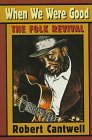
Robert Cantwell. When We Were Good: The Folk Revival. Cambridge, Mass.: Harvard University Press, 1996. xii +413 pp. $24.95 (cloth), ISBN 978-0-674-95132-7.
Reviewed by John G. Stevenson (Columbia College, Chicago, and Roosevelt University)
Published on H-PCAACA (November, 1996)
In the years between 1958 (when the Kingston Trio had a hit with "Tom Dooley") and 1964-65 (when the Beatles and "the British invasion" swept the pop charts and Bob Dylan turned to electric instrumentation), "folk music" (the term is a contended one) not only enjoyed a great deal of commercial success, but also became associated with a subcultural style (an attempt on the part of many youth "to dress, groom, speak, comport themselves, and even attempt to think in ways they believed compatible with the rural, ethnic, proletarian, and other marginal cultures to whom folksong was supposed to belong") that exercised great influence among the earlier cohorts of what would become "the sixties generation(s)." This is the "folk revival" that Robert Cantwell--himself an erstwhile participant--sets out to describe, analyze, evoke, and situate in American cultural history.
When We Were Good traces the main strands of the history of the representation of American folk culture through the last 150 years or more, demonstrating the connection of the 1960s folk revival to that history, as well as its relation to the more immediate political, social, and cultural history of the 1940s and 1950s in the United States. The book, though, is more complex and multi-aspected than such a straightforward description would seem to imply.
Moving from musical descriptions, to musical politics, to psycho-cultural portraits of revivalists such as Mike Seeger and his half-brother Pete (to whom a chapter is devoted), to nineteenth-century minstrelsy, and drawing on the cultural and historical studies of others as well as his own research and experience, Cantwell has written a wide-ranging, valuable, and suggestive study whose sometime flaws must be measured against its complex aims. More than simply a history, the book aspires to excavate the meaning of a historical moment. But Cantwell is also engaged in attempting to understand his own past and identity, as well as, on a broader level, to contribute to the delineation of the contradictory concept of "the folk," and to comprehend the articulation of personal identity through culture (topics that were the subjects of his previous publications).
Space permits only a brief (and even here, truncated) illustration of Cantwell's handling of these topics and themes. Many of the roots of the early 1960s' revival lay in the leftist popular front politics of the 1930s and early 1940s and its interconnections with the study, valorization, and performance of folk music. Yet in between, postwar anticommunist repression meant that this tradition arrived as an array of "politically eloquent but ideologically mute" icons and symbols--which circumstance, however, may have been precisely what gave this tradition its appeal. For the folk revival was built, not on ideas, but on their deliberate refusal: "the demand implicitly made on the music that it would be personally transforming; that between the public persona projected in the performance of music and the psychological subject making the projection, a 'folk' performance would somehow bridge the gulf, melding one into the other, reinventing social and personal identity toward closely connected ends..." (p. 120).
The weaknesses of the book correspond to its strengths. His complex aims lead Cantwell, on occasion, into thickets of prose so allusive and intertwining that light flickers within them only intermittently. And the breadth of his subject as he construes it--the interrelation of cultural with social and political history--leads to some discussions that rely too heavily on too few sources (see for example his notation [p. 392, n.3] that his historical account "draws largely from" one book, Frederick Siegel's Troubled Journey: From Pearl Harbor to Ronald Reagan).
Yet this is an important book about an important topic: how the popular arts interact with generational change, politics, and the vision of a democratic society.
This review is copyrighted (c) 1996 by H-Net and the Popular Culture and the American Culture Associations. It may be reproduced electronically for educational or scholarly use. The Associations reserve print rights and permissions. (Contact: P.C.Rollins at the following electronic address: Rollins@osuunx.ucc.okstate.edu)
If there is additional discussion of this review, you may access it through the network, at: https://networks.h-net.org/h-pcaaca.
Citation:
John G. Stevenson. Review of Cantwell, Robert, When We Were Good: The Folk Revival.
H-PCAACA, H-Net Reviews.
November, 1996.
URL: http://www.h-net.org/reviews/showrev.php?id=677
Copyright © 1996 by H-Net and the Popular Culture and the American Culture Associations, all rights reserved. H-Net permits the redistribution and reprinting of this work for nonprofit, educational purposes, with full and accurate attribution to the author, web location, date of publication, originating list, and H-Net: Humanities & Social Sciences Online. For any other proposed use, contact P.C. Rollins at Rollins@osuunx.ucc.okstate.edu or the Reviews editorial staff at hbooks@mail.h-net.org.

