

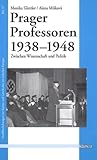
Monika Glettler, Alena Miskova, eds. Prager Professoren 1938-1948. Zwischen Wissenschaft und Politik. Essen: Klartext Verlag, 2001. 682 pp. EUR 21,50 (paper), ISBN 978-3-88474-955-5.
Reviewed by Jeremy King (Department of History, Mount Holyoke College)
Published on HABSBURG (September, 2002)
Professors tend to agree that universities are important institutions. So do political actors, at least in revolutionary times. To seize control of universities, after all, is to seize control of a pivotal site for the production of culture, science, social elites, and political legitimacy. Monika Glettler and Alena Miskova's volume contains more than thirty articles concerning a particularly dramatic instance of the revolutionary politicization of academic life: Prague's Charles University during the ten years when it fell first under Nazi, then Czech, and then Communist rule. Taken together, those articles comprise a significant contribution to the scholarly literature. Better still, many of the authors will be publishing on their topics again. In this area of mid-twentieth-century East Central European history, as in other areas, the blossoming of scholarship made possible by the taboo-shattering and archive-opening collapse of Communism in 1989 seems only to have begun.[1]
Throughout the interwar era, there were actually two Charles Universities in Prague, one Czech and one German--because Czech leaders had succeeded in dividing and nationalizing the original institution in 1882, against German and Habsburg resistance.[2] That binational structure survived the Habsburg Monarchy, but not the first Czechoslovak Republic. Following the Munich Diktat in September 1938 and the Nazi creation of the "Protectorate of Bohemia and Moravia" from Czech-speaking areas of the rump Second Republic in March 1939, and shortly after the start of the Second World War, some Czechs tested the tolerance of the Nazi regime with street demonstrations. Police shot a medical student, Jan Opletal, who soon died of his wounds. On the day of his funeral, students demonstrated again. The Nazi response, ordered by Adolf Hitler himself on November 17, 1939, was to replace relative restraint with more naked force: the authorities shipped more than one thousand Czech students to a concentration camp, and decreed a halt to instruction at all Czech institutions of higher education.[3]
In the spring of 1945 came the great reversal. Czechs reopened their university and terminated the German one. Edvard Benes, the reinstalled Czechoslovak President, made the termination official and permanent in the fall. (His order, one of the "Benes decrees" so much in the Central European media recently, was retroactive to November 17, 1939. A sign of the enduring potency of that date is that on its fiftieth anniversary, in 1989, Czech students clashed with police again, and this time set off a "Velvet Revolution.") Between 1945 and 1947, Benes also oversaw the expulsion from Czechoslovakia of its entire German minority, which had made up 22 percent of the population in 1930. Then, early in 1948, Czechoslovak Communists seized power, and helped to seal the country off from most Germans with an Iron Curtain. Arrests, mass expropriation, and additional Stalinist measures within Czechoslovakia quickly followed, including a wholesale purging and restructuring of higher education. Now there was only one Charles University, and it was Czech--but gutted.
Article after article in Prager Professoren shows how individuals fared during that decade of upheaval. Czech professors, it becomes clear, faced different constraints than did German professors, and made different choices--without necessarily starting out as very different people. Dr. Arnold Jirasek, for example, the subject of an article by Ludmila Hlavackova, is worth comparing with Dr. Hermann Hubert Knaus, the subject of an article by Alena Miskova and Petr Svobodny. On October 5, 1939, Jirasek, chief of surgery at the Czech Medical School in Prague, was interrupted as he sliced into a patient's brain. Dr. Kurt Strauss, a Nazi from Berlin, barged into the operating room wearing his SS uniform, delivered a Nazi salute, announced that he had just been appointed chief of surgery at the German Medical School, and then, having compromised the sterile environment, departed. Later that month, Strauss attempted to seize half of Jirasek's equipment and space.
Strauss also probably stood behind an order that reached Jirasek from Berlin on the morning of November 17, to the effect that he had six hours to evacuate more than 200 patients and to surrender his entire surgical unit (where Opletal, the Czech medical student, had died days before) to the Waffen SS. Jirasek succeeded not only in meeting the deadline but in opening an outpatient clinic elsewhere in Prague the very next day, as well as in recovering some of his equipment in December. Most remarkable, perhaps, is that Jirasek, who tolerated no fools, succeeded in concealing his rage, and indeed, in cultivating excellent relations with his powerful new rival.
Knaus, meanwhile, a prominent gynecologist who had moved from Austria to join the German University in Prague in 1934, became Dean of the Medical School on the day that Germany invaded Poland. The next month, he sought, and failed, to block Strauss's transfer to Prague by pointing to the high death rate among the surgeon's patients in Berlin. In 1940, Knaus spoke up in favor of two Jewish radiologists who had been stripped of their professorships. And in 1942, he received a formal Nazi Party rebuke for having persisted in his campaign against Strauss--whose continuing butchery drove some Nazis needing surgery to seek out Jirasek, and eventually resulted in Strauss's demotion to a convalescence unit in the Bohemian countryside (where he committed suicide in 1944).
In 1938, Knaus had joined the Sudeten German Party, and in 1939, the Nazi one. Yet at the beginning of May 1945, when Jirasek and two other Czech professors demanded Knaus's resignation from the faculty, he declared that he was not a German professor but a Czechoslovak one. He seems to have stood ready to give every regime whatever it demanded, provided only that he could continue researching, publishing, teaching, and tending to the sick. The confidential assessment of a Nazi associate professor at the Medical School, written in 1939, rings correct: "politically uninterested," "an upright yet brutal and ruthless personality, an outstanding doctor, and a particularly proficient gynecologist" (p. 437). Knaus was expelled from Czechoslovakia, and finished out the last fifteen years of his career where it had begun, in Austria.
Like Knaus, Jirasek made a pact with the Nazi devil in order to continue at his work, or at least part of it. In the winter of 1939-40, in return for permission to reopen the Czech surgical unit, much reduced, he committed himself to abide by the ban on any instructing of Czech students, as well as to keep clear of all politics. In 1944, he agreed to join the new League against Bolshevism. Yet Jirasek did not become a member of the faculty at the German Medical School, or a German, or a Nazi--although he could have. He spoke fluent German; his wife was from a Prague German family; neither of them had Jewish grandparents; and the Nazi regime encouraged "national mutation" among Czechs.
In 1945, Jirasek received his reward for having ranked his Czechness a high second to his calling as a surgeon: non-expulsion, but also talk by some Czech colleagues of disciplinary action. At the end of May, he lamented to his diary that "For the whole of the war, I endured all adversity, because it came from the Germans, and gave hope for the time after them. And now this from my own people, who could see what I was doing and why. I am sickened at the thought that they actually mean to strip me of the surgical unit, the meaning of my life" (p. 458). Only shortly before the Communist coup d'etat did Jirasek succeed in clearing himself of charges that he had committed "offenses against national honor"--an elastic set of crimes defined ex post facto through one of the Benes decrees. He then made a pact with a quite different devil, from the East, and remained chief of surgery until his retirement in 1958.
A third case, important for the light it can cast on how Czechness and Germanness worked together as a system, is that of Johann/Jan Boehm, which Dieter Hoffmann and Vaclav Podany discuss in separate articles. Born in 1895 in Budweis/Budejovice, south of Prague, Boehm (whose name has the nationally neutral meaning of "Bohemian") grew up completely bilingual. An outstanding chemical engineer who studied with Fritz Haber in Berlin, Boehm considered himself a German,[4] and married a Czech. He also detested the Nazis, and shortly after Hitler's seizure of power, left a tenured position in Germany for one at the German University in Prague. There he quickly developed deep ties to a brilliant, British-trained chemical engineer at the Czech University, Jaroslav Heyrovsky. During the Nazi occupation, Boehm refused to join the Nazi Party, which classified him early on as an "Aryan with a very bad political past" (p. 533).
But in November 1939, he agreed to spearhead the German takeover of Heyrovsky's Institute of Physical Chemistry. Why? In order to help Heyrovsky continue at full steam with his work on polarography--and even teach a few Czech graduate students. Interned in a camp for Germans in May 1945, Boehm quickly won release, thanks to Czech friends. Indeed, in December, he became one of the few Germans to win provisional reinstatement of their Czechoslovak citizenship, and thus exemption from expulsion. In a cruel irony, though, his good relations with Czechs seem to have led the Allied Control Commission for Austria to deny him an entry visa that he needed in order to accept a position at the University of Vienna. A year later, he found himself trapped behind the Iron Curtain, apparently with no hope of finding work within Czech higher education.[5]
Even Heyrovsky encountered some trouble in 1945. "I have been accused," he wrote in English to Boehm's former mentor, a Hungarian-German in Sweden, "for collaboration with the Germans (i.e. Boehm!), distanced from University and put before a committee to decide my fate" (p. 535). Like Jirasek, Heyrovsky eventually prevailed. Indeed, by 1952, he had enough clout (despite being regularly refused permission by the Communist authorities to attend conferences abroad) to get Boehm an offer to head the laboratory for chemical engineering at the new, Soviet-inspired Czechoslovak Academy of Sciences. But Boehm, ill and deeply depressed, declined. Even in the supposedly international realm of science, his resistance to the national excesses of the 1940s had cost him dearly. His early death meant that he was denied the pleasure of seeing the more fortunate Heyrovsky win the Nobel Prize for Chemistry in 1959.
Glettler and Miskova's volume contains, in addition to ten articles about natural scientists, eighteen more about humanists. Frank Hadler and Vojtech Sustek, in an outstanding example of archival research and of German-Czech scholarly collaboration, provide an account of Josef Pfitzner, the deeply politicizing "Sudeten" historian who served as Deputy Mayor of Prague under the Nazis. Vit Vlnas provides a subtle biography of Abbe Josef Cibulka, the learned and wily art historian who exploited his position during the war at the head of the former Czechoslovak National Gallery in order to acquire many works of art--without losing his moral bearings. Antonin Mestan contributes a colorful essay on Matija Murko, the elderly Slovene and Slavicist at the Czech University who spoke German beautifully and Czech terribly, and in the words of Vaclav Cerny, "looked like a Balkan bandit" (p. 315). Daniel Kraft contributes a persuasive analysis of the anti-Nazi politics concealed in a wartime publication by Eugen Rippl, a Slavicist at the German University who explored "prdolin mit Sockenduft" and other mysteries of language mixing among German recruits in the interwar Czechoslovak army. And the list of excellent essays could continue.
Unfortunately, as Glettler notes in her preface, some authors who had agreed to contribute to the volume--which is the result of a conference held at Freiburg i. Br. in 1998--ended up not doing so. Among those missing studies, perhaps, are ones about Josef Susta, a leading Czech historian who played a complicated game during the occupation and then killed himself in 1945; about Wilhelm Saure, the first Nazi-appointed rector of the German University; and about any of the professors at either university who were classified as Jews, and thus lost their positions in 1939.
Not cancellations by individual authors, probably, but a programmatic focus by the editors on the Nazi years explains the lesser emphasis in Prager Professoren on the second revolution to hit Czechoslovak higher education, in 1945, and the quite abbreviated treatment of the third, in 1948. The editors seem also to have assigned higher priority to sharing the results of their conference quickly than to complementing this cluster of short biographies with an introduction and a conclusion aimed at synthesis, structural analysis, and comparison. In this regard, Antonin Kostlan's 50-page article, "The Prague Professors, 1945-50: Attempt at a Prosopographical Analysis," stands almost alone.
Perhaps it is no coincidence that Kostlan is the only contributor to cite John Connelly's doctoral dissertation concerning Czech, East German, and Polish higher education between 1945 and 1956, finished at Harvard University in 1994. Connelly's findings, revised and published as a book two years ago,[6] help greatly to place the articles of Prager Professoren in context. He confirms, for example, that Czech professors tended not to become collaborators during the Nazi occupation, but adds the important point that they also tended not to become active in the resistance. Conservatism--reflected in the nearly complete exclusion of women from the academic ranks--explains much here. So does Nazi policy.
The shuttering of higher education turns out to have been much less total in the Protectorate than in Nazi-occupied Poland. Many Czech professors, if they remained politically passive and kept away from students, could continue researching, publishing, and drawing a salary. One consequence was to undermine the authority of Czech professors, and thus to open the doors of Charles University to student-led Communism already in 1945.
Glettler and Miskova's volume and Connelly's book complement one another well. One focuses on the first, Nazi revolution in higher education, and the other on the third, Communist one. At least one collection of essays has appeared recently, meanwhile, that addresses in detail the second, Czech and anti-German revolution--in some respects the most radical of all.[7]
A firm empirical foundation has now been laid for systematic comparison. For contributing much to this effort, and for bringing back to life such figures as Jirasek, Knaus, and Boehm, the scholarly community owes Glettler, Miskova, and the other authors in their volume thanks and congratulations.
Notes
[1]. Recent publications concerning East Central European higher education and scholarship during the Nazi and Communist eras include Wilhelm Zeil, Slawistik an der Deutschen Universität in Prag (1882-1945) (Marburger Abhandlungen zur Geschichte und Kultur Osteuropas 35; Beiträge zur Geschichte der Slawistik 1, Munich: Sagner, 1995); Peter Schöttler, ed., Geschichtsschreibung als Legitimationswissenschaft 1918-1945 (Suhrkamp-Taschenbuch Wissenschaft 1333, Frankfurt am Main: Suhrkamp, 1997); Jan Havranek and Zdenek Pousta, eds., Dejiny Univerzity Karlovy 1918-1990 (Prague: Karolinum, 1998); Blanka Zilynska and Petr Svobodny, eds., Veda v Ceskoslovensku v letech 1945-1953: sbornik z konference (Prague: Univerzita Karlova, 1999); John Connelly, Captive University: The Sovietization of East German, Czech, and Polish Higher Education, 1945-1956 (Chapel Hill: University of North Carolina Press, 2000); and Frantisek Weyr, Pameti, 2 vols. (Brno: Atlantis, 1999-2002).
[2]. See Ferdinand Seibt, ed., Die Teilung der Prager Universität 1882 und die intellektuelle Desintegration in den böhmischen Ländern: Vorträge der Tagung des Collegium Carolinum in Bad Wiessee vom 26. bis 28. November 1982 (Bad Wiesseer Tagungen des Collegium Carolinum, Munich: Oldenbourg, 1984).
[3]. The only other Czech university (as opposed to institutions of higher education in technical fields) was the one in Brünn/Brno, founded in 1919 and named after the first Czechoslovak president, Tomas G. Masaryk.
[4]. Podany is in error, however, when he writes that Boehm's father "had the young Johann registered as a German" (p. 543). In the Habsburg crownland of Moravia, next to Boehm's native land of Bohemia, national registration (Czech or German) became required of most residents through the "Moravian Compromise" of 1905. But in Bohemia, nationhood did not become an official, registerable, and public status until 1939. See Jeremy King, Budweisers into Czechs and Germans: A Local History of Bohemian Politics, 1848-1948 (Princeton: Princeton University Press, forthcoming), chapters 4 and 5.
[5]. After 1948, Boehm could easily have found university employment in the Soviet Occupation Zone/German Democratic Republic. He chose, however, to stay in his native land. In the whole of Glettler and Miskova's volume, there is mention of only one professor who taught at a German institution of higher education during the war and then found work at a Czech institution afterward: Josef Wanke, a specialist in the use of steel in the construction industry (p. 575).
[6]. See note 1.
[7]. See Zilynska and Svobodny, in note 1. Many of the contributors to their volume are contributors to Glettler and Miskova's as well.
If there is additional discussion of this review, you may access it through the network, at: https://networks.h-net.org/habsburg.
Citation:
Jeremy King. Review of Glettler, Monika; Miskova, Alena, eds., Prager Professoren 1938-1948. Zwischen Wissenschaft und Politik.
HABSBURG, H-Net Reviews.
September, 2002.
URL: http://www.h-net.org/reviews/showrev.php?id=6726
Copyright © 2002 by H-Net, all rights reserved. H-Net permits the redistribution and reprinting of this work for nonprofit, educational purposes, with full and accurate attribution to the author, web location, date of publication, originating list, and H-Net: Humanities & Social Sciences Online. For any other proposed use, contact the Reviews editorial staff at hbooks@mail.h-net.org.

